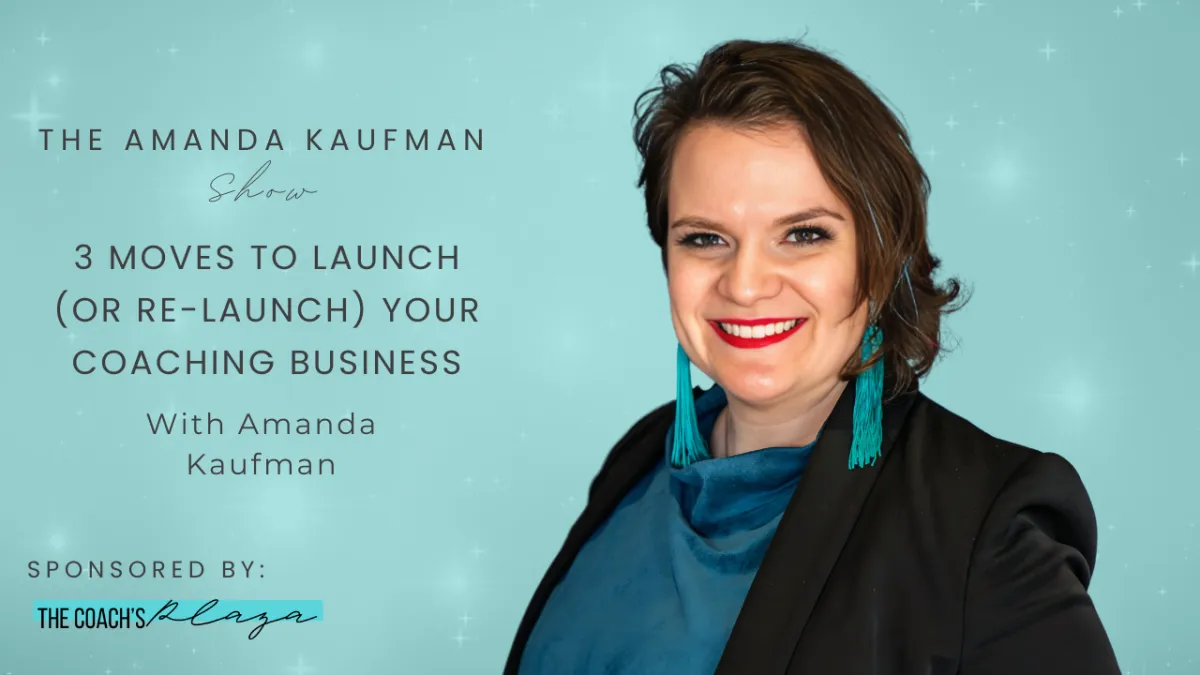
3 Moves To Launch (Or Re-Launch) Your Coaching Business
3 Moves To Launch (Or Re-Launch) Your Coaching Business
Most coaches don’t struggle because they lack talent, credentials, or passion. They struggle because they try to build a business without a system that can survive real life.
Kids get sick. Parents need help. Travel plans change. Energy dips. Confidence wobbles. None of that is a personal failure. It’s life doing what life does.
The difference between coaches who consistently have clients and coaches who stall out is not hustle, charisma, or social media reach. It’s whether they’ve built a simple, repeatable system that works even when things aren’t perfect.
In this episode, I broke that system down into three moves. They’re not complicated. They don’t require fancy funnels or a massive audience. But they do require honesty, consistency, and a willingness to stop overcomplicating what actually works.
Move One: Take Action Before You Feel Ready
Most coaches wait far too long to take action. They wait until they feel confident. They wait until their offer feels polished. They wait until their schedule magically clears.
That moment rarely comes.
When I was starting my business, I didn’t feel ready. I didn’t have extra time. I didn’t have a huge network outside of work. I was on maternity leave, exhausted, and running on very little sleep.
What I did have was a requirement to complete ten complimentary coaching sessions. I didn’t know exactly how I was going to do it, but I knew I needed to start.
So I sat down and looked through my contacts. My phone. My email. My LinkedIn connections. After ninety minutes, I had eight names on a Post-it note. I needed ten.
Instead of stopping, I took action anyway. I wrote an email. It was too long. Too apologetic. Probably confusing. But I sent it. Then I copied and pasted it to the other seven people.
That single action created momentum. Every one of those eight people said yes.
Action creates information. Waiting creates stories. If you don’t take action, you never get data. You only get assumptions about why things won’t work.
Move Two: Track What Actually Happens
After my first few complimentary sessions, something unexpected happened. A client finished a session and said, “I have a friend who would really benefit from this. Would you be open to talking with them?”
It stopped me in my tracks.
It had never occurred to me that people know people. That one conversation changed how I thought about client creation forever.
Tracking is not about spreadsheets for the sake of spreadsheets. It’s about paying attention. What happens when you reach out? What happens when you ask a question? What happens when you invite someone into a conversation?
I started noticing patterns. People were happy to help. People liked being asked. People were far more generous than my fears suggested.
Tracking also helps you see where the real gaps are. Often, the problem isn’t that something doesn’t work. It’s that you’re not doing enough of it. In coaching, the currency is conversations. If you’re not consistently starting conversations, no strategy in the world can save you.
When coaches tell me they aren’t getting clients, the first thing I ask is simple: Who are you talking to right now? If the answer is vague, that’s the problem.
Move Three: Build Belief From Evidence, Not Hype
Belief is the hardest part for many coaches, especially if you’re thoughtful, intelligent, and self-aware. Doubt sounds reasonable. It wears a very convincing disguise.
I’ve Googled business failure statistics. I’ve scared myself with worst-case scenarios. I’ve wondered if people would want to hear from me.
What shifted everything was grounding belief in evidence instead of positive thinking.
I noticed how I felt when someone reached out to me. A text from a friend. An email checking in. An invitation to talk. I felt good. Seen. Valued.
That made it logical to believe others might feel the same way when I reached out with genuine care.
Belief doesn’t have to be dramatic. It can be practical. It can be built by looking for examples of people who had less support, fewer resources, or bigger obstacles and still made progress.
When you see someone else do more with less, it reframes what’s possible. Not in a motivational way, but in a grounded, factual way.
Why Systems Matter More Than Motivation
People already build systems for their jobs. They know when to show up. How long they’ll work. When they’ll eat. How they’ll communicate.
When it comes to building a coaching business, many abandon that logic entirely. They rely on bursts of motivation instead of structure.
Your life will always show up. The question is whether your business can withstand it.
A system doesn’t eliminate effort. It directs it. It makes progress repeatable instead of exhausting.
When you take action, track what happens, and let belief be built from real evidence, you stop relying on willpower alone. You create something sustainable.
Start Where You Are
You don’t need more clarity before you begin. You need movement. You don’t need certainty. You need feedback.
Take one action. Track the response. Let that inform the next step.
Repeat.
That’s how businesses are built. Not in perfect conditions, but in real ones.
And if your life feels full right now, that’s not a reason to stop. It’s the reason to build a system that actually works.

Chapter List:
00:00 Introduction to Coaching Success
02:26 The Importance of Systems in Coaching
05:03 Taking Action: The First Step
10:44 Tracking Progress: Learning from Experience
14:14 Believing in Yourself: The Key to Success
Full Transcript:
Amanda Kaufman (00:00)
The real truth of it is that your life is going to life. Your life is going to life. That much I can absolutely guarantee you. The question is, what systems do you have in place that even when life shows up, you are okay, you're safe, you're good and in service.
Good morning, good morning. Welcome to the Coaches Plaza live training. So today we're gonna be talking about how to get your first, next, several clients as a coach. And I'm really excited about where we're gonna be heading with our live stream series. Let's see.
Today we're talking three moves to launch or relaunch your coaching business because you are a great coach. And the thing is the difference between coaches that have lots of clients and coaches that don't is one word and that word is system.
There we go. All right. Looks like we've got it all cooking and ready to go. So last week I was not live. And the reason that I wasn't live is because I was dealing with a pretty big family emergency. So thank you so much for those that checked in with me. I really appreciate it. But we're back on track this week. And it's so funny because
I say we're back on track this week, but are we really back on track? We went and attended a really cool retreat with the Live Life Fully coaches this weekend, and it was so awesome, and there was a huge storm. we ended up staying put. We were planning to be in Fort Worth back home today, and things just didn't go as planned.
and I'm safe and I'm good and I'm with my friends, it really made me think a lot about our topic today, which is around the system. Like what is your system for building and running your business that even if you have travel interruptions, even if you have medical emergencies, even if your kids need you, even if your parents need you,
that your business can still continue on and that you can continue to thrive. And I'm going to be talking a lot more about this in my weekly live streams because there's a limiting belief that's really prevalent among a lot of coaches, which is that you can't or you aren't allowed to pursue coaching because you think that the rest of your life is holding you back. And
The real truth of it is that your life is going to life. Your life is going to life. That much I can absolutely guarantee you. The question is, what systems do you have in place that even when life shows up, you are okay, you're safe, you're good and in service.
And you know what's so interesting is that when people have a job, they already set this system up. They know like, here's the route that I'm going to take to work.
Here's the hours that I'm gonna be at work. Here's how I'm gonna make sure I eat lunch during the day. This is how I'm going to maintain the relationships at work. People do set up systems for their success when it comes to their job all the time. So why is it that when we go to do something like a coaching business or consulting business or an expert-based business, we're like, nope, can't do it?
And it's because we're not slowing down to think about, what is the system to make it happen? So today I want to share with you a three part framework that is going to get you started on the path of having the system that you can still have space for the rest of your life. All right. I'm modeling real time what it looks like to just show up and do the darn thing. So.
Let's talk about this system. The reason that you will find that you do or do not have clients is one thing. You are or you are not having conversations with people who could be your client. That's it. That's it. It's the conversation is usually the gap. So when I'm working with somebody more closely and I ask them, I'm like, what's on your calendar?
My kids are on my calendar. My housework is on my calendar. My entrepreneurial group is on my calendar. My fellow coachy friends are on my calendar. But you know what's not on the calendar is meeting new people that you can serve. Or creating content to help you meet new people. Or coming up with what is the conversation you want to have on social media, right? All of those things are designed to help you meet people.
and connect with people. And there's a lot of pressure, I think, in the coaching industry to become like a big guru or to have a really fancy and complicated system. And at the end of the day, and you know, as a consumer of a lot of those systems, I'm here to tell you that you can have enough conversations with the right people to build a six or multi six figure business without having to become
a version of you that you can't support. So what do I mean by a version of you that you can't support? Well, if your reality is that you have kids, then kids take time, right? If your reality is that like we homeschool our kids, right? That takes time. That takes focus. That takes energy. you know, I'm married, so that marriage takes time. It takes focus. It takes energy. And it's the same thing with your coaching business. Who are you serving with this coaching business and are you even talking to them?
And the hardest lesson for me to learn on this and the first part of our framework today is that we simply just need to take action on it. So when I was starting my business way back, had all my relationships are tied up in work. I didn't really have a lot of time on the weekend, I thought, to go and meet anybody new. And so I was taking the certification that asked me to put together 10 complimentary coaching sessions. And I didn't want to tell anybody at work because
I knew I wanted to start a business and I didn't want them to catch wind of what I was doing and cause a problem financially for my family by getting bad over it and firing me. But I knew I needed, I wanted to have a certification, I wanted to be qualified, so I needed to get these 10 complimentary coaching sessions under my belt. And so I sit down with my cell phone and I'm going through my contacts.
And it's just work contacts, work contacts, work contacts, like people I didn't feel like I had rapport with, people I couldn't even remember where we met. Then I opened up my Google, my Gmail, and I'm looking for all the past emails, all the sent folder. And I'm just like looking and scrolling and looking and scrolling. And I've got this Post-It on my desk as I'm finding people and I'm writing down a person when I find a person. So I looked at the Gmail.
And then I was like, wait, I have a LinkedIn account. Let me go check out my LinkedIn account. So I went and I scrolled through LinkedIn and I'm looking at all the connections that I have. And at the time I had a couple hundred. And after 90 minutes of looking at every list that I could find, I had eight names on a post-it. Eight names. I needed 10. I needed 10 of these sessions and I just came up short. Like it just, wasn't working.
So I decided, and this is the first part of the framework, to just take action anyway. I wrote an email to the first person on that, posted, and it was way too apologetic, way too long, and probably enormously confusing. But I wrote it, and I took the action, I sent the email. And then I realized, copy paste. I copy pasted the same email to the seven other people, and I waited. And to my surprise, within minutes,
I got a reply from one of those eight people saying, sure, I'll do a session with you. And I actually heard back from all eight of them and they all agreed to meet with me sometime in the next two week period. And so I was like, well, it's not perfect, but it started. And that's the action it part. Now the second piece of this framework is to track it.
So I show up to the first complimentary coaching session. It goes really well. They're super excited about having an experience with me. And I say, thank you. They say, thank you. They say, good luck. I say, thank you. I move on to the second complimentary session. And the guy was like, hey, this was amazing. Like he was very thankful, profusely thankful for the coaching experience. He says, I've got a buddy.
And it was like a record skipping in my brain. was like, wait, he says, I've got a buddy and he has been struggling with whether he wants to continue in his job or not. Would you be willing to do a session with my buddy? And I was blanked out here for a second because it just didn't occur to me that people know people. So even though I only had like eight names on a post it.
This person immediately thought of because of the experience we had together of a friend that would benefit from the same experience. And I said to him, said, absolutely, you know, I'd love to meet your friend. And so he made the connection and look at that. I've got nine of my complimentary sessions and the track it part of this is paying attention to what actually happened in that meeting. What I realized was that people know people.
And what if I asked at the end of my coaching session whether somebody would like somebody they knew would benefit from this session. And so I started doing that. So I did that for session three, four, five, literally since forever. And not only did I hit my 10 complimentary sessions, I now have the beginning of a system for how I could continue to serve as a coach. And by the way, at the time I was on maternity leave with a baby at home.
So when a lot of people, tell me like, I can't because, and they list all of the obligations that they have in their life. And I just know from my own experience that I was able to do this on four hours of sleep a night while breastfeeding. And I'm not saying that you need to sleep deprive yourself or that there's any worthiness. I'm just saying that, you know, if you're handing a mother a maternity leave, the opportunity to start a coaching business and she's able to do it, that's just a data point, right?
Track it, track these data points. Who in your life is succeeding despite it all, right? Who in your life shows up more than anybody else does? What is it that they do differently? How do they believe differently? How do they speak differently? track it, track it all, pay attention to all of it, not to overwhelm yourself, but to learn. So the first part is to just take action.
You might not have all of the answers, but just take the action and activate, then track what you're doing so that you can see what you can do differently as you refine that action. The last part of this framework is to believe it. Believe it. Now, a lot of times, we have a lot of reasons to believe against ourselves. Isn't that true? Right? We've got people around us that say, well, I would never do that, which for them may be 100 % true.
We have a lot of examples of failure. I remember when I was starting out, I'm a big Google girl, so I Googled and I was like, what's the percent likelihood of a business succeeding? And that statistic scared the patootie out of me. I was just like, I couldn't even. I'm like, how is it that people start businesses and they believe in themselves at the very beginning, but such a high percentage of them never continue?
And then I started a business and I started to see why. The doubts will be there. The doubts will be there. And you know why? Even when you really believe in something, sometimes things don't work out the way that you thought. And the thing is that cultivating faith and cultivating a belief in yourself, your ability to figure things out, your ability to find a new way of a new path, that is the single most common thing that I see in the most successful entrepreneurs.
They simply believe that they can figure it out. They believe they can meet the right people. They believe that it'll work out in the end. And so when you're building a business or helping or serving or even just developing any other kind of habit, the three-part framework is first you take action, even if it's kind of blind, even if it's, even if it's, you know, messy and difficult and you're, you're wrestling with your perfectionism, all of that stuff, take the action anyway.
Right? Just be so donkey stubborn about taking an action anyway. The next thing is track. So when I do this, what happens? And one of the things that a lot of people have to learn in entrepreneurship is maybe you're doing the right thing. You're just not doing enough of it. So I said in coaching, the currency is conversations. Who are you connecting with? Are you reaching out and saying, hello, are you taking responsibility for your relationships? If you're not taking any responsibility,
for the quality of your relationships and you're not proactively reaching out, then why on earth, right? If we just track that, what on earth is telling you that people are rejecting you if you're not even inviting anybody, right? And then the final part is believe it. So one of the things that really helped me believe that people wanted to hear from me is how happy I get when I hear from other people in a positive way.
Like when I get a text message from a friend, I light up. I don't even have to know what it says, right? I'm just so excited to hear from a friend. And when I realized that, I was like, well, I believe, I feel, I have a deep knowing that when people treat me really well, I feel good. And when I got very specific about what is treating me well, it wasn't about buying me, you golden baubles or, you know,
telling me lies about who I am or anything like that. It was literally getting to spend quality time. I love when somebody asks me a curious question and wants to know me, the real me. And when I got really clear about what is it that I enjoy in relationships, boy, I can believe it that other people would probably feel the same way. Like, it's very logical. It's not a huge faith leap, right? Yet where we spend a lot of our time and our thinking is often in the disbelief.
Right. And seeding the doubt and going, well, I doubt they want to hear from me. I doubt they're going to find me interesting. I doubt they're going to think I'm smart. I doubt they're going to want to know somebody who identifies as a coach. I doubt, I doubt, I doubt, I doubt. I'm like, you know, you can do that all day long. And it's not actually going to help you with. Feeling the courage or or or just being willing to take the risk to take the action. So these three things work together.
you know, in a supportive triangle, take the action anyway, even if it's ugly, track what happens. And the more you get sophisticated about tracking and starting to really see trends in data, the more empowered your belief is going to become. Cause you'll know, you'll see it in the nuts and black and white. It's not going to be based on assumptions. It's not going to be based on self-talk. It's not going to be based on any of these things. It's going to be externalized and you're going to see it. And you're going to know when this
then that happens, right? Then the belief, because you know when you first start, you don't have the data, you don't have the experience, you don't have the wisdom. So you need to lean on something else. And so for some people that faith could be very spiritually based, for others it could be finding examples out in the world where other people had less and did more. That's one of my favorite things to find. Who can I find who had less
and did way more than what I'm proposing to do because that helps reinforce and seed my belief. I'm like, wow, you know, if somebody was able to do this with, for example, a huge disability or if they were able to do this with major trauma in their background or if they were able to do this at a very old age or a very young age, like who's doing more than what I'm asking to do? And they started out with way less. I find those types of stories incredibly inspirational and help reinforce the belief that yes,
Little old me can do it too, right? So that's our framework today. Action it, track it, believe it. And let it be that simple. Stop overcomplicating everything. Just let it be that simple. Start from where you stand and keep going. All right, so that's my big message for you this week. Thank you so much for joining me. When your life shows up, just keep coming back. Action, track, believe.
All right, my friends, thank you so much for your patience with me these days. I see somebody joined us. Thank you. Thank you. Thank you. I'm so glad that you're here, Lynn. I will see you again next week. We're going to go even deeper into what specifically do you do to cultivate and activate these relationships? I want to give you some real strategies next week. Until then, keep believing and do what matters. We'll see you soon.