How Talking Turns Into Clients Through One Repeatable Talk
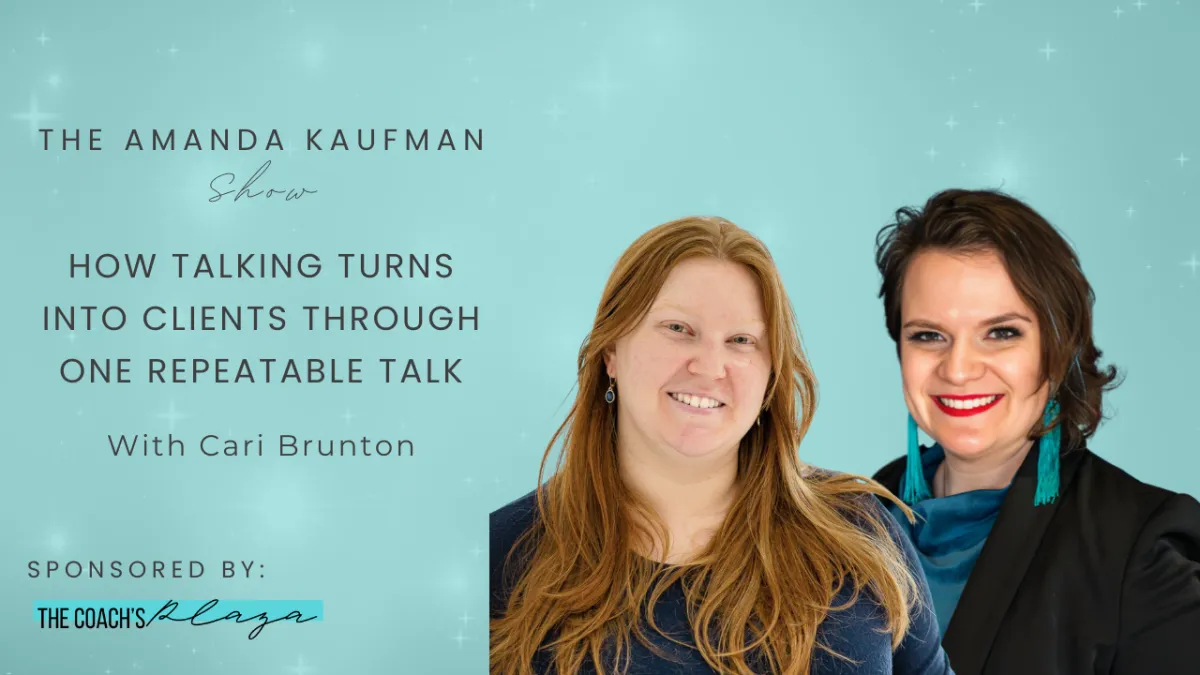
How Talking Turns Into Clients Through One Repeatable Talk
Most entrepreneurs believe speaking should work for their business. They have expertise, experience, and something meaningful to say. Yet after a few attempts, speaking often feels heavy, inconsistent, or not worth the effort.
In this episode of The Amanda Kaufman Show, I sat down with speaking and event strategist Cari Brunton to break down why that happens and how speaking actually becomes a reliable way to generate clients when it is approached correctly.
The difference is not confidence, charisma, or being “good on stage.” The difference is whether speaking is treated as performance or as a system.
Why Speaking Breaks Before It Works
Most people approach speaking the same way they approach content creation. Every opportunity feels like it requires something new. A new talk. A new angle. A new presentation.
That assumption turns speaking into a constant drain on energy and creativity. Entrepreneurs already juggling multiple responsibilities start to feel trapped in a cycle of preparation without payoff.
Cari explains that this mirrors the same issue people have with social media and blogging. The pressure to constantly create something new makes consistency impossible. Speaking never gets enough repetition to build momentum.
The strategy breaks before it ever has a chance to work.
One Repeatable Talk Changes Everything
The core reframe in this conversation is simple and uncomfortable for many people to accept. You do not need more talks. You need one clear, well designed talk that can be repeated.
A single talk can be delivered across podcasts, summits, webinars, networking groups, trainings, and events. The power of speaking does not come from novelty. It comes from clarity and repetition.
Each time you deliver the same talk, your message sharpens. Your confidence increases. Your ability to guide the audience improves. Instead of starting over, you compound progress.
This is how talking turns into clients over time.
Speaking Is Not the Same as Teaching
One of the most important distinctions Cari makes is between teaching and speaking to sell.
Most entrepreneurs default to teaching. They explain, educate, and share generously, believing that value alone will drive decisions. The problem is that learning is passive, while decision making is active.
Teaching alone leaves people informed but unmoved. Speaking to sell is not about pressure or persuasion. It is about structuring your message so people can clearly see the next step.
Selling from stage is about clarity. It helps the right people recognize themselves in your work and decide whether to engage further.
Why Speaking to Sell Is Not Sleazy
A major reason entrepreneurs avoid speaking is fear of being salesy. Cari reframes this directly.
Speaking to sell is not about pushing people. It does not always include a pitch. Sometimes it simply creates enough clarity that people want to continue the conversation afterward.
When your work genuinely helps people, avoiding that conversation creates more confusion, not less. Ethical selling gives people permission to choose.
Talking openly about how someone can work with you is not manipulation. It is service.
Where Speaking Opportunities Actually Live
Another misconception is that speaking only works if you are paid to do it. While paid keynotes exist, they are not the fastest path to clients.
Speaking to sell often happens in summits, guest trainings, networking groups, webinars, podcasts, and business events. These opportunities may not come with a fee, but they offer something more valuable.
Trust.
Once someone hears you speak, they are significantly more likely to buy from you. Speaking accelerates connection in a way few other strategies can.
What to Do If Fear Is Holding You Back
Stage fright and visibility fear stop many capable entrepreneurs from ever starting. The key is not to go big immediately.
Cari recommends starting where you feel safest. Podcast guesting, webinars, or small group trainings allow you to control the environment and build confidence gradually. Speaking improves with practice, not perfection.
Over time, most people begin to enjoy speaking because they are talking about work they care deeply about.
What Top Speakers Do Differently
The most effective speakers are not necessarily the most charismatic. They are the most intentional.
They understand the difference between teaching and selling. They respect the host and the audience. They show up prepared, professional, and aware of the energy they bring into the room.
Most importantly, they stop trying to be someone else. Authenticity builds trust faster than polish ever could.
Speaking Is a Skill You Can Build
One of the most grounding takeaways from this episode is that speaking is not a personality trait. While some people may feel more natural at it, most success comes from skill development.
Entrepreneurs often assume that being good at their work automatically makes them good at communicating it. Speaking is its own craft. When treated with intention, feedback, and repetition, it becomes one of the most reliable ways to build client momentum.
Speaking does not need to feel like more work. When done correctly, one repeatable talk can become one of the most efficient growth systems in your business.

Chapter List:
00:00 Why Speaking Is a Powerful Client Strategy
01:05 The Red Bucket Events Origin Story
01:56 One Repeatable Talk vs Constant Reinvention
02:54 Keynotes vs Speaking to Sell
03:44 Getting Paid to Speak vs Selling From Stage
04:49 Why Selling While Speaking Isn’t Sleazy
06:26 How to Start If You’re Afraid to Speak
09:12 Why Teaching Alone Doesn’t Drive Sales
10:52 What Top Speakers Do Differently
12:40 Measuring Real Results From Speaking
15:24 How to Connect With Cari
15:45 Final Takeaways and Call to Action
Full Transcript:
Cari Brunton (00:00)
Everybody when they first start speaking gets up and just starts teaching because they think I'm gonna teach you a couple things and you're gonna see the value in me and it's gonna be helpful to you and you're just gonna want more. But that's not how our brains work.
Amanda Kaufman (00:28)
Well, hey, hey, welcome back to the Amanda Kaufman show. And today I'm chatting with Cari Brenton, who makes getting clients fun. She's the founder of Red Bucket Events, and she is a speaking and event strategist who helps entrepreneurs turn speaking into a steady stream of clients. And she does it without the salesy weirdness. Cari's clients build signature talks that sell, design events that convert.
and create systems that make marketing feel fun again. And she's known for mixing sharp strategy with playful energy and the occasional pop culture metaphor. Cari believes growing your business shouldn't feel like a chore. It should feel like a celebration. And when she's not helping entrepreneurs scale with speaking, you'll find her reading fantasy novels, gaming, collecting rubber ducks, or lovingly annoying her mother. There you go. I love it. Cari, welcome to the show.
Cari Brunton (01:23)
Thank you so much for having me, Amanda. I'm so happy to be here today.
Amanda Kaufman (01:26)
I love it. So red bucket events. What? Tell me about this red bucket. What's what is that?
Cari Brunton (01:32)
So there comes a wonderful time when we all have to name our business, right? And I just initially was working off of Brunton Events and it just, didn't sit right to me. I knew that my brand was going to be bigger than myself, but I also wanted something fun and kind of different and really memorable. And one day it occurred to me that there is this red bucket that sits on my desk and I've had it for many years now. And whenever I have a really good idea, I go to the bucket to write it down. And so what if I built a business where clients could go to the
every time they had a great idea. And so Red Bucket Events was born.
Amanda Kaufman (02:01)
that's so clever.
I love it. So speaking in events, what is it about that strategy that you wish more entrepreneurs really knew? I just finished doing a coaching call actually, not 10 minutes ago, we were talking about speaking as a strategy. What is it about that that you think is so important for an entrepreneur to really understand?
Cari Brunton (02:24)
Most people come and they have this preconception that it's going to be really onerous and it's going to be a lot of work because they constantly think that they have to write a new speech every time they're going to speak and that they have to develop new content and that's the same issue that they already have with social media or blogs or any of the other things was they don't want to constantly be trying to make something new because it's stressful and it makes you feel like you're a hamster caught in a little cage, know, just running and running and running.
Amanda Kaufman (02:35)
Yeah.
Cari Brunton (02:51)
I personally really hate that feeling. And what I am happy to help a lot of people understand is that you don't have to do that. You can write one great talk and take it a whole bunch of places. You can give the same talk 80 times, you can give it 240 times. You just, it's about finding a new place to give it. And that takes a lot less time and energy than constantly trying to make something new from scratch. And so it just...
Amanda Kaufman (03:11)
Interesting.
Cari Brunton (03:13)
It creates a really streamlined strategy, which I really love.
Amanda Kaufman (03:17)
Yes, yes. And who benefits the most from having a keynote?
Cari Brunton (03:21)
So keynotes, and this is where terminology gets thrown around and changed a lot, a keynote speech is usually someone who's being paid to be there.
And a keynote usually isn't about selling, it's usually more about inspiring or educating. So what I help people do is get on stage to actually sell their services. So they're not necessarily doing a keynote, but they might be doing a masterclass, they might be talking at a summit, they might be doing a guest spot at a networking meeting or with groups like that. So you can absolutely do a keynote and get out there and go that way.
But I like to encourage people to be able to sell right away because they'll see returns faster.
Amanda Kaufman (03:56)
Mm-hmm.
Mm-hmm. Mm-hmm. So talk to me a little bit about that. Like, how do you find those opportunities where you can, you know, sell? Like, what is the real difference between becoming, like, a speaker for hire and someone who's speaking to sell?
Cari Brunton (04:12)
Yeah, so the big difference is when you get paid. So speaking to sell is you are selling your program and you get paid in however many people buy your program. Getting paid to speak means you get a flat fee. This is how much you're getting paid. You usually get paid at least partially in advance. You get up, you speak. You're paid, you're done. But
there's a cap on that. It is whatever the payment is. With speaking to sell, the better you are, the more you sell, the more money you make. And so the big difference is going to be in the way you approach it and how you talk about it. So for entrepreneurs who are looking to sell their services, who aren't necessarily, who don't necessarily want to get up and talk and get paid that way, and there's nothing wrong with that. I know people who do it and love it, but some of us just want to fill our programs.
And so for that, you're more looking at summits that you can speak on. Can you speak at other people's business events? Can you speak to networking groups? Things like that, that you're not necessarily getting paid upfront, but you can get paid way more in the long run because people become 40 % more likely to buy from you once they've heard you speak.
Amanda Kaufman (05:17)
So talk to me a little bit about the opportunity here, because I don't think everybody who's listening understands or realizes the world of like summits. Like maybe I thought they might be having is why on earth would someone invite somebody to speak if all they're going to do is sell? Can you can you help us understand that world of like where it is okay to pitch?
Cari Brunton (05:38)
Absolutely. here's, we get tangled up in the notion of selling, right? Because we have this long-term cultural bias of, you know, the sleazy car salesman. And it dates way back when to like, when people were selling alcohol and calling it a magic potion to make you brave. And, you know, and those people sucked, right? Like, let's be honest, they were liars and they just sucked. We are not those people. We are trying to sell services that genuinely help people. And
Amanda Kaufman (05:59)
Yeah.
Cari Brunton (06:03)
So speaking to sell isn't about being sleazy. It's not about that kind of thing. And sometimes it doesn't even necessarily include a pitch. It's just about showing up and talking in a way that makes people want to engage with you after. And maybe you just want to drop a freebie so that they have that opportunity. Right. So it's a matter of reframing it in your mind of getting out there, helping people really see your services and the value that you have to offer and how brilliant and amazing you are.
and just doing that by opening your mouth and letting words come out. Which hopefully comes somewhat naturally to you.
Amanda Kaufman (06:41)
What if it doesn't? if people are like, okay, I see the opportunity and I can see why this would be a skill that would be really important. What would you suggest to somebody who's maybe got the stage fright and they're not sure about getting up there and really doing this thing?
Cari Brunton (06:54)
absolutely I see this in my clients all the time and they're like Cari I know that this could be so good for my business that could be awesome for visibility for sales for all of it I am terrified every time I try to do the talking thing as soon as you know the state as soon as I step on stage as soon as the camera turns on anything like that I clam up you know the sweat starts going any of those things and so
What I tell them is deep breath. You don't have to speak in front of 500 people tomorrow.
So start in ways that make you comfortable. Maybe it is guesting on a podcast, which is a form of speaking. Maybe it's webinars, which are one of the best ways to get started because you control everything. You control how many people are in the room, who's in the room, what you're allowed to say and not say, all the things that can sometimes get a little bit more, slightly more complicated when you're speaking on someone else's stage because they get to make the rules. But if you start with a webinar, it's your rules. It's your work.
and it's your stage so you can do whatever it takes to make yourself feel okay. And that might even mean inviting 10 specific people who are friends and only speaking in front of them at first until you get comfortable, more comfortable. And it's one of those things that gets better with practice and time and I can tell you that 95 % of my clients have come to love speaking and enjoy it over time.
Amanda Kaufman (08:14)
Absolutely.
Cari Brunton (08:14)
Because at the end of the day,
it's talking about yourself and talking about your business. So it should be talking about stuff you love. So hopefully you can have some fun with that.
Amanda Kaufman (08:21)
Mm-hmm.
What personally motivated you to consult on speaking? What is it about this that lights you up?
Cari Brunton (08:29)
So here's my bit of a freakish backstory. I started public speaking when I was four. Okay. And yes, I know that's super weird. My school had a program. I got to get out, go out of school for a day. I got to go have lunch at Harvey's. It was, you know, it was a whole great thing. When you're four, it's like the best thing ever. And I just kept doing it every year because it felt relatively easy. And again, I got to get out of class and go eat burgers. And all I had to do was do this short little public speaking thing.
So it's always been fairly natural to me. When COVID happened, my business got shut down. I had only been doing live event planning and I'm up in Canada and we went two years without live events. So clearly I needed to do something. You know, I'm ripping my hair out, know, crying on the couch, trying to figure out what on earth I'm going to do. And
suddenly people started asking me about webinars and it started as marketing them and handling them as events which felt very natural for me but as I was watching people speak I was like we can make some changes here that would make this way more effective you know I could see the way that they weren't using their body language correctly and they weren't changing their tones or they were just flat out using the wrong kind of language to get people excited
Amanda Kaufman (09:39)
Yeah, or they don't have it be very exciting at all, right? Sometimes the...
Cari Brunton (09:40)
So I, right? They're, you know,
they're kind of dry and monotone and they don't realize, like some people get very caught up in technical aspects and don't realize that that is not what motivates anybody to buy from them. And so I realized there was a great opportunity here and I ended up going and doing a ton more training on sales psychology and gestures and movements and all these lovely things that make speaking even more powerful and coming back.
and introducing it as part of my services. And I haven't looked back ever since because I am unbelievably passionate about helping entrepreneurs grow their businesses. My father is an entrepreneur, my brother is an entrepreneur, my husband is an entrepreneur. I collect them everywhere I go. And so I've, I do, I do. I laugh because know, know, dragons hoard gold, I hoard entrepreneurs. And so...
Amanda Kaufman (10:22)
You love the entrepreneurial world,
Cari Brunton (10:32)
I have seen up close and personal how rough it is when business isn't going well and when it's inconsistent and how that affects you and your family and your friends and it just creates this really gross ripple effect that's not good for anybody.
So if I can help my clients see an easier way to create that consistency and turn it into a positive ripple effect where they are helping people around them, everybody's excited about their business, their family's happy and healthy, then that's exactly where I can be and I can't think of a better way to spend my time.
Amanda Kaufman (11:04)
I love that. I love that. If somebody was wanting to, you know, become the best speaker that they could be for 2026, what do you think are some of the things they should really be paying attention to in order to stand out from the hordes?
Cari Brunton (11:20)
They are coming.
Amanda Kaufman (11:21)
Yeah, because like everybody needs to be successful,
right? And so I've been helping coaches build a business. And one of the things that coaches always say is like anybody can call themselves a coach. Well, it's kind of the same, you know, so to speak on speaking. like if somebody wants to be genuinely successful, top 10, 20 percent of speakers, what do you notice they do differently than somebody who's approaching this, shall we say, casually?
Cari Brunton (11:35)
Absolutely.
So one of the first big things is understand the difference between speaking to cell and teaching. Everybody when they first start speaking gets up and just starts teaching because they think I'm gonna teach you a couple things and you're gonna see the value in me and it's gonna be helpful to you and you're just gonna want more. But that's not how our brains work.
learning is a fairly passive activity, whereas decision making, so choosing to buy something is an active.
activity. So they occur in different parts of your brain. So we have to be careful how much we teach and how easily we leave our audience in that passive sector. We want them ready to make a decision.
The other thing I see is simply like being a professional goes such a long way, know, be courteous and kind to any hosts that you're working with, get your materials in on time, be organized, show up, smile, you know, if you know, just be aware of the energy that you're bringing to the room. That's a big thing. If you bring the room down, I'm not having you back. You know, that's not what I want for my stages.
So that's that's a big thing. And an authenticity goes so far. Stop trying to be someone you're not. Be you. You is wonderful. You is awesome. Let it out. So those are the big places I would start if you want to set yourself apart.
Amanda Kaufman (12:52)
Mm-hmm. Mm-hmm.
Mm-hmm. Yeah, that's super helpful. What is something that no one ever asks you, but you wish that they would when it comes to speaking and being successful?
Cari Brunton (13:07)
That's such a good question.
Amanda Kaufman (13:09)
I stole it from Jenna Kutcher, so just so that we're...
Cari Brunton (13:13)
No, no, I love it. I'm making mental notes that I have to ask that question to people more often. I think one of the big things that I wish people would ask is just simply and honestly, how can I do this better? Because I run into so many speakers who don't realize how ineffective they're being.
Amanda Kaufman (13:17)
Yeah.
Cari Brunton (13:32)
And they think they're being fine until they're willing to sit down with me and have a conversation. And we actually look at the numbers and I say, okay, well, how many people are actually taking the action that you put in front of them? How many people are, you know, booking sales calls and downloading your your freebies and whatever it is that you tell them to do from stage. And then they start looking at their numbers and they're like, hmm.
Because they're hearing people tell them, oh, that was great, that was lovely, that was wonderful. So they think they're crushing it, but they're not actually getting any of the results they want. And they don't realize that they've got work to do. And that as much as there's, I would say there's a bit of an innate talent to speaking and some people have it, but it's 90 % skill work.
It's about learning and growing and we're all doing that constantly. I still do speaker training regularly, right? Because there are things I don't know yet. I know what they are, but when I figure out what they are, go and I learn them. So, yeah.
Amanda Kaufman (14:18)
Mm-hmm.
Absolutely, know, any craft requires
mastery. I think like a common thought pattern that a lot of entrepreneurs have is they are good at a thing. So they assume that they will also be good at this other thing simply because they are doing it and they're like taking kind of their identity of I'm good at stuff. And then they're actually a beginner or they don't even realize, like you said, they don't have the black and white that's telling them.
you know, in black and white, in numbers, here's how effective you are being, or even what good looks like, you know. I think the courage to act is super important. That's why my motto is do what matters. And it takes more than that because like that's the first stage gate. And then after that, it's this commitment to a level of mastery. And to your point, you can actually be pretty effective at
generating sales, creating leads, creating conversations and things like that without necessarily being a New York Times bestselling author and the top speaker on the circuit. That being said, there's a lot of people that do really appreciate, they do approach a lot of things more casually and it's probably a big opportunity for a lot of folks.
So Cari, what's the best way for people to keep up with you, follow you, and connect with you further?
Cari Brunton (15:51)
The best way is to look me up on Facebook, because that's the platform I spend the most time on. You will find me on the other ones, but that's where you're going to find me most.
Amanda Kaufman (15:59)
Super, I love it. Well, listener, we'll make sure that Cari's notes, sorry, links are in the notes below. And thank you so much, Cari, for being here.
Cari Brunton (16:09)
Thank you so much for having me. It's a lot of fun. I'll come hang out with you anytime.
Amanda Kaufman (16:13)
awesome. And dear listener, if you've got a friend who is thinking about adding speaking to their repertoire, make sure you grab the link to this episode and send it to them over DM or text, however you guys like to connect. And if you haven't already, make sure you smash that subscribe button so you never miss a future episode. And if you're loving our show, just make sure you take a beat and share an honest review because it does help people to decide.
Cari Brunton (16:31)
Do it.
Amanda Kaufman (16:38)
whether they want to spend time with us and every review is an absolute gift. So thank you so much for taking the time to do that. And until the next time, make sure that you just stay focused and do what matters.