How to Create a Marketing Strategy That Actually Fits You
How to Create a Marketing Strategy That Actually Fits You
Most business owners are not failing at marketing because they lack discipline, creativity, or intelligence. They are failing because they are trying to force themselves into strategies that do not fit how they think, communicate, or live.
Marketing advice is often delivered as universal truth. Be on every platform. Post daily. Push through discomfort. Follow the formula. When that advice does not work, the assumption becomes that something is wrong with the business owner.
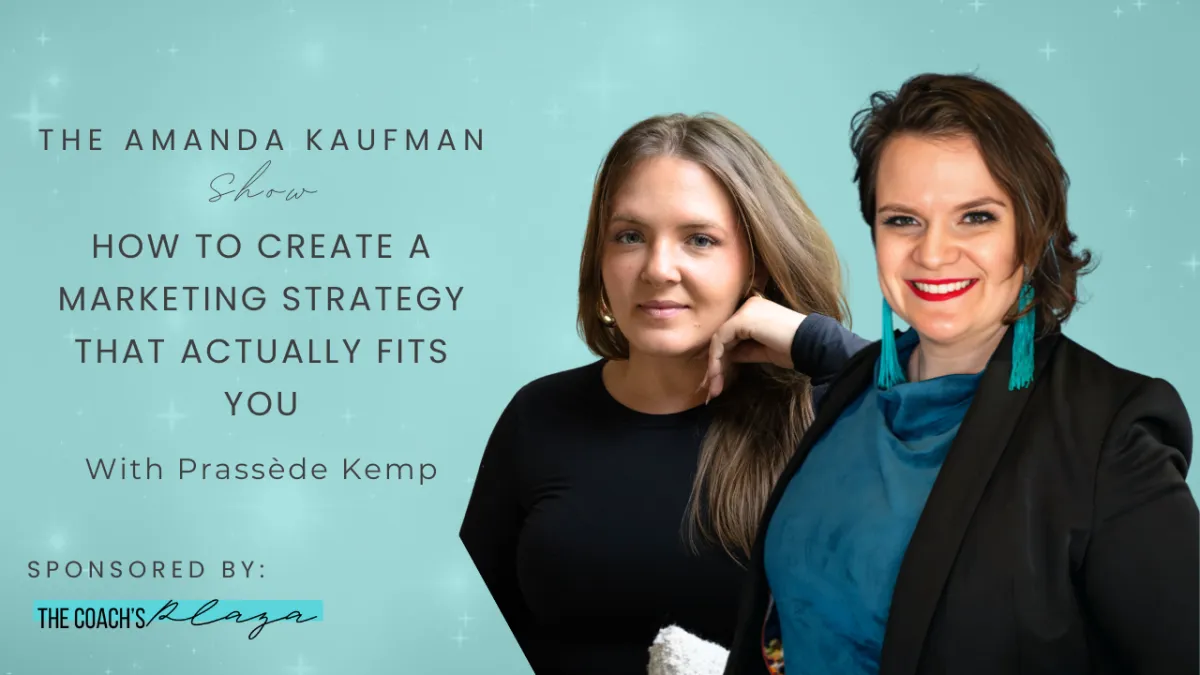
In this episode of The Amanda Kaufman Show, Amanda sits down with marketing strategist Prassède Kemp to challenge that assumption. What emerges is a grounded, practical conversation about why marketing feels heavy for so many capable people and how to build a strategy that works with you instead of against you.
Why Marketing Feels Hard for Smart People
Many service based business owners are thoughtful, perceptive, and deeply invested in the quality of their work. That same depth often becomes a liability in marketing environments that reward speed, performance, and constant output.
Prassède explains that she noticed this early in her agency work. Clients had strong visions but struggled to execute them. Video content went unfinished. Messaging felt flat. Motivation dropped. The issue was not laziness or fear of visibility alone. It was cognitive dissonance between who they were and how they were being told to show up.
When marketing advice ignores the human behind the business, it creates friction. Over time, that friction turns into avoidance, perfectionism, or burnout.
Good Marketing Is Not Platform Dependent
One of the most important reframes in this conversation is simple and often overlooked. Good marketing works because it is good, not because it lives on a specific platform.
There is a constant drumbeat online telling business owners where they should be. Instagram. TikTok. YouTube. Podcasts. The pressure to choose correctly creates paralysis and the belief that marketing success lives somewhere outside of you.
Prassède encourages a different starting point. Instead of asking where you should be, ask how you naturally communicate. Are you verbose and thoughtful, needing space to explain ideas fully. Are you energized by conversation. Do you prefer writing, speaking, or teaching live.
When you choose platforms that match your communication style, consistency becomes easier. Marketing stops feeling like performance and starts feeling like expression.
Marketing Is Communication, Not Performance
Amanda pushes the conversation deeper by challenging the idea that marketing is primarily a tool or tactic. Marketing, at its core, is communication.
For business owners, that means communicating clearly to the people who need to hear from you, in a way that feels sustainable. It does not require mastering every channel. It requires choosing a few that allow you to show up consistently and honestly.
Email marketing becomes a powerful example here. It is often dismissed or avoided, yet it allows for thoughtful communication, relationship building, and low pressure consistency. The effectiveness of a channel is not determined by trends but by fit.
The Difference Between Fear and Authenticity
One of the most nuanced parts of the episode is the distinction between fear and authenticity. Many people say a strategy is not authentic when what they are experiencing is fear.
Prassède explains that fear and authenticity feel different in the body. Fear is constrictive. It shuts things down. Authenticity feels grounding, even when it stretches you.
Avoidance often masquerades as alignment. When something keeps resurfacing as a desire but is continually avoided, it is worth exploring why. Growth does not require forcing yourself into discomfort, but it does require honest self reflection.
Building Confidence Through Structure
Confidence is often treated as a prerequisite for visibility. Prassède flips that narrative. Confidence is built through structure and small, repeatable action.
Instead of asking someone to jump into high exposure platforms immediately, she encourages stepping stones. Faceless content. Interviews. Long form conversations. Each step builds evidence that you can show up and be seen safely.
This approach removes pressure and replaces it with capability. Over time, confidence becomes a byproduct of consistency rather than a barrier to entry.
From Participation to Authority
Amanda adds another layer by reframing authority as a progression, not a starting point. Authority is not claimed. It is built.
Before leading a conversation, you participate in it. Before participating, you absorb it. Reading, listening, observing, and reflecting all contribute to the formation of a personal philosophy.
Authority emerges when you can articulate what you believe, why you believe it, and how your perspective contributes to the space. That clarity cannot be rushed, but it can be cultivated intentionally.
A Strategy That Fits You Lasts Longer
The most powerful takeaway from this episode is that sustainable marketing is personal. It respects your nervous system, your energy, and your life.
When strategy fits, consistency follows. When consistency follows, trust builds. And when trust builds, growth becomes inevitable.
You do not need louder marketing. You need marketing that fits.

Chapter List:
00:00 Introduction to Prasadah Kemp and Her Journey
02:42 Authenticity in Marketing: The Real Struggles
05:27 Defining Marketing: Beyond Tools and Platforms
08:20 The Role of Authenticity vs. Clarity in Business
11:03 Building Confidence Through Small Actions
13:34 The Importance of Contribution in Conversations
16:35 Absorbing Knowledge Before Leading
19:06 Final Thoughts and Resources
Full Transcript:
Prassede Kemp (00:00)
I believe that good marketing works. It's not that.
good marketing only happens on X platform. It's that good marketing works.
Amanda Kaufman (00:26)
Well, hey, hey, welcome back to the Amanda Kaufman show. And today I'm introducing you to Prasadah Kemp, the marketing strategist who helps visionary CEOs finally fire themselves as their own marketer and show up with real confidence. After nearly a decade helping service-based brands stand out with bold personality-driven content, she built a multi-six-figure agency, shifted into coaching and launched Numinous,
to make visibility feel doable for real people who have real lives. Forseti is the queen of untangling perfectionism, yes, simplifying systems, amazing, and teaching confidence through structure, not pressure. She creates visibility plans that feel grounding instead of overwhelming in tools like her Camera Shy to Content Ready Kit that get even the most hesitant creators on camera without the second guest's spiral.
Now she's building the Ascend Collective, which is a membership that's designed for sustainable visibility, confident leadership, and content systems that help you grow without burning out. This is gonna be so good. I cannot wait to dive in. Welcome to the show.
Prassede Kemp (01:39)
Thank you for having me.
Amanda Kaufman (01:41)
my gosh. Okay, so I would just love to understand what has made authenticity and showing up in your marketing in a way that is really real and very grounded. What makes that so important to you?
Prassede Kemp (01:55)
Well, I think it came from solving a very practical problem in my business early, early on, which was that business owners would come to me and they wanted to do this and that in their marketing and then we would pursue those efforts only for them to maybe not turn any video footage in or...
not be really like excited about the material that we were producing. And so I really had to dig deeper on what exactly was happening in that interaction where they had a vision, but when it came to the execution there were so many, just like a lot of cognitive dissonance I noticed.
And so in really exploring that, I realized that there are so many different elements to this conversation around authenticity and how we produce content online and how we get business owners to show up for themselves and for their businesses, that I really started to build a philosophy on how to work with business owners to get through those things so that they could actually fulfill the vision that they had for themselves. So it came from a very practical, practical place and just evolved into so much more than that.
Amanda Kaufman (03:07)
makes so much sense. You my own business journey, I spent probably the first two years, was definitely a networking hustle bunny. Like I would just go to any seminar, networking group, conference, you name it. I spent like a ton of time on planes and in cars just going to like be among people and meet them. But do think I had like any Instagram presence at all? I didn't even have an Instagram account. I wasn't emailing people. Like the formality of my marketing was just simply missing. ⁓
Prassede Kemp (03:30)
Yeah.
Mm.
Amanda Kaufman (03:37)
So talk to me a little bit about what you're seeing a lot of business owners facing as like we're at the time of this recording. We're about to head into 2026. The landscape's changed like crazy. You know, there's so much there's a lot of rhetoric out there about about how everything is changing. But I think there's also paired with that a lot of pressure to perform in your marketing in certain ways. I'm curious, like what are you seeing and what are you thinking?
Prassede Kemp (04:00)
Mm.
Amanda Kaufman (04:05)
that business owners should be doing about it.
Prassede Kemp (04:07)
There are so many things that I want to speak to in that. I guess what I will first say is that I have never seen much success from forcing yourself to do something that goes against your own internal authentic code. So even though we hear all of this rhetoric on you should be here, you should be doing that,
I try to build marketing strategies from a place of mixing strategy and mixing your well-being. For example, one thing that I talk about a lot is making sure that you're choosing the right content vehicle or modality for you and your brain and your well-being. So for example, I loved that example that you came up with. I think networking is a really, really great place for a lot of people. And the reason...
maybe that you are a great human connector or that you just get so much more out of being in person or from having like an in-depth conversation with someone. And so I encourage my clients to look at how they communicate, how they ingest information and really deduce what it is that their strong points are in terms of communication. For example,
I have a lot of clients who are really verbose, like they're really great when you give them room to run when they're communicating, right? They're much more long form and style. And when you try to translate that to maybe, you know, this short form video style, they really, really struggle. It's not that they don't have amazing messages to convey or that, you know, that they don't like to talk. It's just that they want room to run. So...
You know, in that circumstance, we might direct them towards a blog or a YouTube channel rather than having them start on an Instagram or a TikTok. So I would encourage people that it's, you know, there's a lot of rhetoric online about where you should be and why, but taking a step back to really reflect on your communication style, because I believe that good marketing works. It's not that.
good marketing only happens on X platform. It's that good marketing works.
And if you know how you wanna communicate and connect with people, you can actually choose platforms that suit that, and you're gonna be a lot happier in the long run. So, I don't know if that answered your question. I hope it did. An important message I want business owners to Yeah.
Amanda Kaufman (06:40)
I think so. think so.
Yeah, I mean, totally agree with you. Like good marketing just works, right? And having worked with a lot of people over the years, I see a lot of the conversation that's very surface level tends to be very transactional. And it turns out they've got a tool for sale, right? And so like we, it's easy to form the belief system that
marketing is the tool, right? Like marketing is this podcast or marketing is this TikTok or marketing is, you know, the short forms on Instagram or marketing is doing YouTube. Like, you know, I could list all the different ways. There's so many different ways. There's a lot of different choices. Let's just take a like beat because we may be saying the word marketing and our listener, me,
have a specific idea of what that means that may be different than what we're saying. So maybe just take a beat for us and share like how do you define it's marketing? You're working on marketing right now.
Prassede Kemp (07:24)
and
Hmm, that's a great question. I think that For the business owner marketing is Communicating to Every key player what it is that you want to communicate what it is that they need to hear from you
I think that that's probably a definition that most business owners can get behind. You know, because for most business owners, they don't want to go as deep into what marketing is or is not. And I always say that if you're going to go too far down that road, at some point you're going to have this tension between you as the CEO or you as the face of your business and you as the marketer, right?
So when focusing on marketer marketing as a business owner, I really want you to focus on avenues and modalities and forms of communication that get your gets you in front of the people you need to be front in front of in the way that you like and do it consistently and commit to a consistency with it and
You can inform that with a lot of different data or by talking to professionals, but I would say qualify marketing that way. And until you've scaled to a point where you can bring on more consistent expert help, then that's a good definition. As an example of that, have a lot of sales calls in the week and one...
form of marketing that I think people really overlook is email marketing. And for a lot of like service-based businesses, email marketing goes so undersung and is so beautiful and creative a tool and effective tool for a lot of service-based businesses that goes very, very, very underutilized. And it's easy to...
create systems around, it's easy to create templates around, it's easy to communicate, and it's a much lower lift than creating content every single day for social media. And it puts you in front of every email that you already have, every person that you might already consider a warm lead. And so how, you know, that's excellent marketing, but...
A lot of times people don't even think of it as marketing. They think of it as like spam or, you know, there's just a bad stigma around it sometimes. So to answer your original question, I would say when it comes from the perspective of a business owner, marketing is our attempt to get you in front of the people that need to see you in the most effective way possible, in your voice.
Amanda Kaufman (10:12)
I love it.
Totally and like on the on the spam thing It's only spam if it's from a complete stranger and you know You have no idea where it came from and you have no interest in that subject matter, right? like for sure there's spam like but that is a very different thing than a communication with someone that you have met previously or had Encountered you previously in another marketing channel and you know I think I think that's part of the confusion is like marketing is like as big of a topic as business
Prassede Kemp (10:38)
Mm-hmm.
Amanda Kaufman (10:43)
It's such a big...
It's such a huge discipline if you really want to like dive into it because there's the advertising, there's your content strategy, there's your branding and your positioning. Like there's all these different things and I think people it's easy to get into the perfectionism wheel because our brains really crave that simplicity and the bias is like, there's just one way. Like there's got to be one way to do this thing. And like you're saying, no, there's lots and lots of ways and
Prassede Kemp (11:06)
Mm-hmm.
Amanda Kaufman (11:16)
often there's easy to do things that, know, easily done, easily not done, I suppose, but there's so many things that people could be doing to simplify. And to your point, like...
One of the things that came up for me as we were talking about this whole role of authenticity is super often when people say, that's not authentic to me. As a high performance coach, sometimes I notice that people are saying it's an authenticity issue and it's actually a clarity and desire to earn skills issue.
Prassede Kemp (11:51)
Mm.
Amanda Kaufman (11:51)
You know what I'm saying?
Like there's something that's like pulling them to want to increase their proficiency in a particular type of marketing or in a particular arena that they find themselves in. And then they kind of default to using authenticity as the explanation for why they're not, you know, pursuing improvement in that. So can you speak to that a little bit around balancing, I suppose? Like, am I really listening to my inner truth?
Or am I scared of doing something that's new and it's like uncomfortable to pursue that? you know, because I don't know, my authenticity, just speaking for me, it seems like I've done my best to maintain authenticity the whole time, but I am authentically a very different human nine years into my business than I was on year zero. Yeah.
Prassede Kemp (12:43)
Mm-hmm.
I would say one way that I try to discern is that fear and authenticity, they actually feel very different in the body. And if you have a confusion around that, I think it's always great to take a moment to pause and tap in. Fear can often feel...
constrictive. It feels like your brain going offline, right?
it can feel like, I don't know where you feel it, but like I feel it maybe here in my throat, right? If we can identify it as fear, fear often also feels like you've come up against this wall in the road and it's just so impassable, but you look at it and instead of pausing to think, how do I get around this, immediately in the body, you're like, I need to go the other direction, right?
There is a moment there where you freeze up and it feels too much for the nervous system. And what I try to teach is to treat that fear instead as a door, right? You're walking up the stairs to a door. You know that the door is closed. You pause. You knock on the door.
Then when the door opens you prepare yourself to enter right and it's a transition between One space and another space. It doesn't have to be a roadblock. It doesn't have to be a wall You know, it is a barrier, but then we make an intentional choice to open that door and move through So I think with that What people really can do is pay attention to how that sensation exists in the body
Amanda Kaufman (14:25)
Mm-hmm.
Prassede Kemp (14:26)
and where it is that you may be playing it safe and calling it authenticity. And also look at perhaps the gaps between where you envision yourself going and what you're maybe refusing to do to get there and why that may be the case. I have a client, for example, who I've worked with her for over five years and she...
has always had this inner yearning to share her message more via video via YouTube in a long form way. But anytime we would approach a project like that, she would just not feel great on camera, right? But she still has this internal deep desire to share her message that way. And so if these things continue to come up and come up and come up for you, but you're refusing to do
them. There's something there, right, that deserves to be explored and so, you know, part of my approach with her and it took some time and it's okay if it takes time is to build confidence through small action until you really get closer not only to that vision of you as this certain version of you but seeing yourself have the capacity to do so, right? So maybe it's not launching a YouTube right away
but maybe we can teach you how to do like some faceless B-roll, you know? And then maybe we can teach you how to do an interview. And then when you feel really good about those things and seeing yourself repetitively online, being on YouTube is gonna feel like that much more tangible, goal. You know what I mean? So, yeah.
Amanda Kaufman (16:11)
love that. I
was just thinking about another interview we did recently. And we were talking about expert authority positioning. And this idea that sometimes we feel this pressure, like we've got to lead the whole conversation. And of course, when you're the expert authority, it's like, yeah, I mean, you are leading the conversation. But how do you get there? Right? And it's like,
The framework that we arrived at, and I'm curious how you feel about this one, is that we were saying, okay, expert authority is the destination, but before that, are you contributing? Are you contributing to the conversation? Are you furthering the conversation? And that's one reason I love doing this dialogue-based podcast as a format for marketing, because it's like, hey, it's actually, it's a collaborative contributing thing, and it's my show, my name on it, but like...
it's such a great opportunity to, for example, do podcast guesting, right? Because you don't have to have your own show, but you can build the skill of speaking to your subject matter in other people's containers. And it's like beneficial to you because you're developing skills. It's beneficial to the host because they've got somebody that's bringing a fresh conversation, right? So before you're leading it, sometimes the thing to do is to contribute to it. And if you're not contributing to it,
Let's just check in. Are you even participating? Like, are you subscribing to things that you do like? Are you participating in like, well, what I would say if I was saying it? Like, are you kind of rehearsing at that level first? Because if you're not participating, then it's gonna be hard to contribute. If you're not contributing, it's gonna be hard to lead the conversation. Yeah.
Prassede Kemp (17:40)
Hmm.
Mm-mm-mm-mm.
Yeah, I love that. I think even included in that, maybe we'd include this in participation or before that, are you even absorbing this conversation that you eventually wanna lead in? Are you researching this conversation that you eventually wanna lead? ⁓ And I think that a lot can come, not much, I wish folks spent more time.
Amanda Kaufman (18:07)
I love that.
Prassede Kemp (18:17)
sitting down and really reflecting on their philosophy in their space. That's always been something that I have sought to address in my work. I have always seen myself as someone who could see where someone else was trying to go and be the bridge.
them to see themselves that way as well. And so if you don't have that middle man, I would love to see more people sit down and really think about the space that they're trying to occupy, the problem that they're to solve, who they are within that space as well, what that contributes to their sense of identity.
how they've already been executing on that in their own personal work, right? It doesn't have to be on a public platform at all. It can be with the clients that you already serve. What do they see in you as well, right? Where are you, how would they voice your contribution to them? So I think that that's a wonderful philosophy. I believe very much in the baby step, in the consistent baby step.
Amanda Kaufman (19:22)
Yeah.
Prassede Kemp (19:32)
you know, if we can be asking the harder the question that we ask, the better the result. And so I think that even just sitting down and saying,
How do I see myself as capable of existing in this space? What else is going on in that space and what is my relationship to it? It can be a really easy first step that doesn't require vulnerability, like a lot of vulnerability, and you can build confidence there without the sense of being exposed in it by being a thought leader in it. That can come later.
Amanda Kaufman (20:04)
Absolutely. Well,
and like I think about influence, right? And it's like, in order to influence one, one really should understand, right? Understand what you're influencing and understand, like, and to understand it requires to your point, like observations. So I got this advice, like years ago from somebody else, they said, if you're going to claim expertise, you need to read the top 10 books in that arena.
minimum and you need to every year be reading the top books that are coming out in your space so that you can speak intelligently to what is happening.
you know, around you. So I think people can take it too far, you know, get a little addicted to the consumption side. But if you don't, like you said, if you don't, if you don't have the information or the data to be able to form a philosophy, a personal philosophy, then it's going to be hard for anybody to listen to you in any format, because it's like, well, what's informing your what's what's informing the opinions that you're expressing, or what's informing your understanding of the issues, if you like aren't demonstrating that.
Prassede Kemp (20:57)
Mm.
Amanda Kaufman (21:07)
Yeah, that makes sense. So what is the best way for people to follow you and to sorry, let me start that over. What is the best way for people to follow you and find out more?
Prassede Kemp (21:20)
Yeah, you can follow me on Instagram at numinus.creative, numinus spelled N-U-M-I-N-O-U-S dot creative. That's probably the best way to connect with me. Yeah, I love communicating with people there. Shoot me a DM, I'm happy to chat.
Amanda Kaufman (21:35)
I love it, I love it, and I understand you have a little gift for somebody who does reach out to you.
Prassede Kemp (21:40)
Yes, I do. If you go to Instagram or perhaps in the show notes as well, I have a workbook I'd like to offer your audience. It's called The Creator's Mindset Reset. It talks about this perfectionism trap, this imposter syndrome trap, this line between authenticity and fear and how to really bridge that because I very much believe that the problem isn't the camera, it's just how we're relating to the camera. So if you're someone who
just feels like fear is that wall for you in appearing more online. Let's stop, let's pause, let's address that so that you can be the empowered creator that you see yourself as. So shoot me a DM, I'll have a special code for you to get that product. And I hope that it helps.
Amanda Kaufman (22:24)
it. Well, thank you so much for being here, Sade. I really appreciate it.
Prassede Kemp (22:29)
Thank you. I appreciate your time. It's been wonderful.
Amanda Kaufman (22:32)
Love it. Dear listener, if you've got a friend who you know, they've been wanting to post more content, they've been, you know, wanting to be more effective with their marketing and they're just kind of stutter stepping or maybe they've enrolled in a couple of programs and then, you know, slammed into that wall, definitely share this episode with them. So you can do that by grabbing the link to the episode wherever you happen to be watching or listening and just send it to them on text or DM. Do that with three of your friends and just watch people clear those blocks. If you haven't already subscribed,
Make sure you do smash that subscribe button and finally if you've been loving the show lately Do take two minutes, please and go ahead and do an honest review It helps other people when they're considering the show to spend time with us when you do that And we are always so grateful for that. So thank you so much We'll be back with another episode very shortly and until then make sure you just do what matters