How to Fall In Love With Your Body After 50
How to Fall In Love With Your Body After 50
There is a point in life when you start looking at your relationship with your body and think, “Something here is not adding up.” You might still be doing all the things you have always done. Or maybe you stopped doing things that used to work. But what usually becomes clear is this. The way you relate to your body now is not the same as it was at 25, 35, or even 45. And honestly, that makes sense.
You have lived a lot of life. You have taken care of people. You have carried responsibilities that shaped how you treated yourself. And somewhere along the way, your body became the thing you pushed through, not the thing you partnered with.
Julia and I talked about this at length, and if there is one message that stood out, it is this. Falling in love with your body after 50 is not about trying to look like you did 20 years ago. It is about building a healthier, more honest, and more respectful relationship with the body you have right now.
You Are Not Meant to Disappear After 50
One of the myths women grew up with is the idea that aging is a slow fade into the background. Quiet down. Take up less space. Stop wanting attention. Stop wanting things for yourself.
But women over 50 are not fading. They are waking up.
This stage of life is often the first time a woman has the emotional clarity and self awareness to actually ask herself what she needs. That alone is powerful. And yes, your body plays a major role in how you show up for that. When you feel run down, uncomfortable, or disconnected, it is much harder to fully inhabit the next chapter of your life.
So no, this phase is not a decline.
It is a reset.
It is a chance to rebuild your relationship with your body from a place of wisdom, not insecurity.
The Hard Part Is Not Knowledge. It Is What You Have Been Carrying.
Most women in midlife already know the basics of health and wellness. Move your body. Eat foods that support you. Sleep. Drink water. This is not new information.
What is new is the awareness of how much emotional and mental weight they have been carrying that makes change feel harder than it should.
A lot of women hit 50 and feel frustrated because they “should know better.” But the real question is not whether you know what to do. It is what has been shaping your relationship with your body all these years.
Here is what often shows up:
Pressure to be “further along” or “more disciplined.”
Old comments from family members that stuck with you longer than they should have.
Beliefs you picked up as a girl or teenager that made you question your worth.
Years of putting yourself last because you were taking care of everyone else.
Standards that were never realistic, yet still influenced how you measured yourself.
When that is the emotional backdrop, it is not surprising that change feels overwhelming. You are not just shifting habits. You are untangling a lifetime of messages that told you your value was tied to how you looked or how well you took care of others.
This is why so many women struggle with consistency. It is not because they lack willpower. It is because they have been operating from old stories that no longer fit the woman they are becoming.
Confidence Looks Completely Different Now
Confidence at 50 is not about what it used to be.
It is not about impressing anyone.
It is not about meeting some external standard.
Confidence today is about how you feel when you move through the world.
It is about:
Waking up with enough energy to live your day instead of getting through it.
Putting on clothes that feel good on your body instead of reminding you of who you were.
Trusting your decisions and not second guessing yourself.
Looking in the mirror and seeing someone who takes herself seriously.
Confidence after 50 is practical. It is grounded. And it is deeply connected to how you treat your body, not how your body looks.
Sustainable Change Comes From Small, Realistic Shifts
One of the best insights Julia offers is that change does not have to be extreme to be effective. In fact, extreme is usually what keeps women stuck.
You do not need an overhaul.
You do not need a perfect plan.
You do not need to turn your life upside down to make progress.
What you need is something your body and your mind can actually absorb. Small, reasonable shifts that stack on top of one another and build momentum over time.
Small changes work because:
They do not trigger overwhelm.
They help you rebuild trust with yourself.
They allow your body to adapt in a healthy way.
They create wins that motivate you to keep going.
This is not about being perfect.
It is about being consistent in a way that feels doable.
Your Light Did Not Go Anywhere
Every woman has a specific energy she brings into the world. For women over 50, that energy is richer, clearer, and more grounded than ever. But when you do not feel well in your body, that light dims. Not because it is gone, but because you are tired, stretched thin, or distracted by discomfort.
Reconnecting with your body allows that light to come back into focus. It is not about becoming someone new. It is about returning to yourself.
Your body does not need to match an old version of you.
It needs to support who you are now.
And you deserve that kind of support.

Chapters List
00:00 Why Women Over 50 Lose Connection With Their Bodies
02:44 Julia’s Journey From Crisis to Self Love
06:18 Releasing Old Stories and Generational Expectations
10:20 Healing Body Image Through Presence and Awareness
14:37 Menopause, Energy Shifts, and Reclaiming Desire
18:55 How to Stop Shrinking Yourself in Midlife
22:42 Becoming the Woman You Were Meant To Be After 50
Full Transcript
Julia Linn (00:00)
It's not about a number on the scale. It's about your relationship with your body from a much higher perspective.
Amanda Kaufman (00:25)
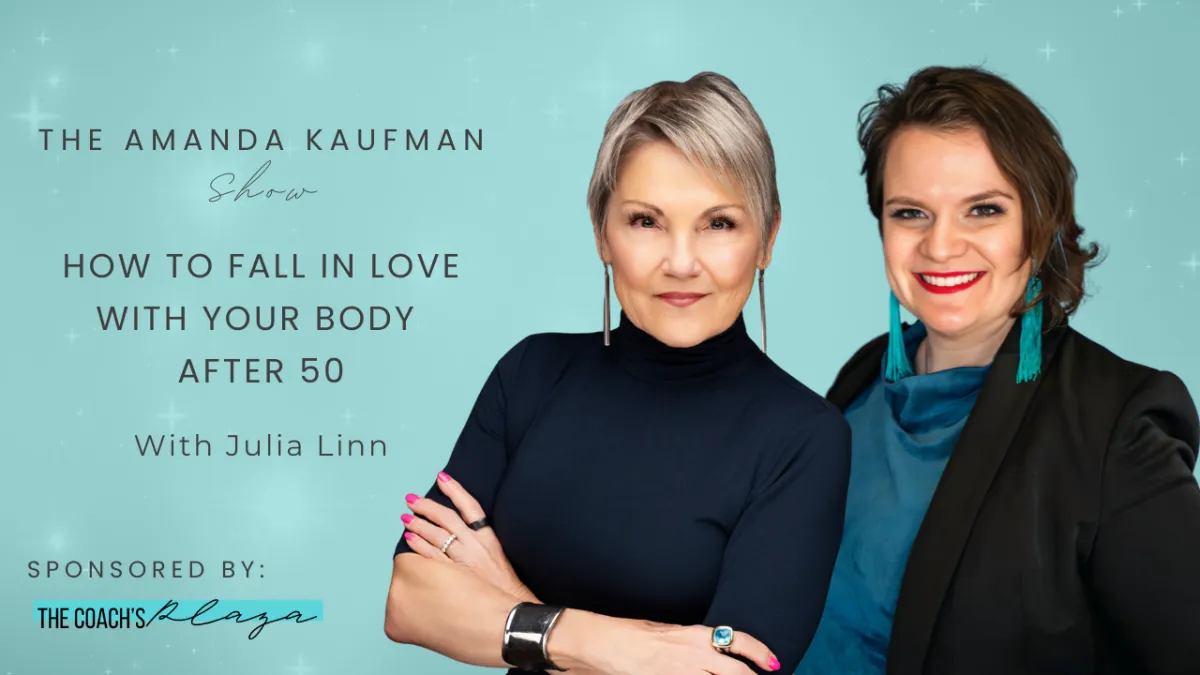
Well, hey, hey, welcome back to the Amanda Kaufman show. And today we are going to talk about something super important with my guest Julia Lin. She is a visionary transformation leader and master coach whose focus audience is women over 50. But hey, if you're not over 50, still listen. And if you're not a woman, still listen because you know a woman over 50 who needs to hear this. And you know, she loves working with people who
are ready to step into their next chapter full of vitality and purpose and power. She delivers body, mind, spirit coaching, immersive retreats and signature programs that result in a lasting physical transformation, expanded confidence and deeper soul alignment. And I think what really makes Julia special is her own journey. know, she has, uh, has moved through childhood diabetes. She's been told that she wouldn't live
40 and she after getting a double organ transplant at just 34 years old and a cardiac bypass at 48 by 62 she decided to get in the shape of her life and she competed and won a bodybuilding competition at age 64 way to go
Her transformation inspired her to get certified as a fitness coach and use her professor background in spiritual life perspective to help women in menopause experience a path to life and a body that they really love. She's based in Savannah, Georgia. She works with clients online, nationwide and internationally. Julia, holy cow, welcome to the show.
Julia Linn (02:09)
Thank you Amanda, I'm so happy to be here.
Amanda Kaufman (02:13)
my gosh,
you know, I do meet a lot of coaches given what I do. And I'm always so impressed and inspired by someone who has such a strong, you know, personal journey to kind of couple with the wisdom that you're bringing into your coaching practice. I'm so curious though, what was it about coaching that really drew you? I mean, like you...
You did and accomplished a lot and overcame a lot. So what told you that coaching was going to be your next big chapter for your own vitality?
Julia Linn (02:46)
I Amanda, I have always been, let's just call it a cheerleader. Like literally I was a cheerleader in junior high and high school, but I really get a lot of satisfaction out of helping other people. And I got into the coaching space after a long career as a fashion professor and also kind of as a spiritual advocate and speaker.
in that realm and realized how much I could help women get the results, not just in their body, but in their life, based on my journey there. And it was just a natural fit wanting to teach and use communication. And I'm also an artist, so visually, all of those things just came together. And to help women in my age group get
the life they love and a body they feel is beautiful is like so satisfying to me. I just love doing it.
Amanda Kaufman (03:46)
amazing.
So needed, you know, so needed in the world these days, you know.
Let's just like start there with the need, you know, for coaching, especially for this particular demographic. Are you finding that women are largely receptive to the idea of working with a coach like yourself on these things? you know, a lot of coaches report to me, and I'm so curious about your personal perspective on this, they get a little frustrated that the people that they want to help are perhaps not as receptive to receiving that help. And I'm just curious, like, for you.
for this demographic, what have you found to be the truth of it? you find that women are just like really wanting to work with a coach on these things or are you finding there's some hesitancy there? Like what's been your experience?
Julia Linn (04:34)
My
experience with that is that it all comes back to me. What am I putting out there as an entrepreneur, as a business owner, as a professional expert coach in this space? Am I putting out there, you know, it's a financial thing, I wanna make a lot of money, la la la, or is it, I love you ladies in this age group, we are sisters, bonded, I wanna help you.
And so I feel like just the message and energy and the reason I'm doing this brings me the right clients. And of course there are women that they've never worked with a coach or they don't want to spend the money or they don't have the time. There's so many different excuses that can come up. And that just tells me, she's just not ready. And I am not going to push her to do something.
she's not ready to do. So I really love the action takers because that's where it all starts. And at this stage, post menopause, women are dealing with, well, menopause, looking at their body and going, who am I? And they might be taking care of aging parents who then pass away. They might be getting a divorce. They might be in retirement, empty nest, all these things. And they look back on their life and go,
I've been taking care of everybody else my entire life. They don't know how to take care of themselves. And that's who I really speak to. And we go through all the nonsense online about your body and what you gotta do to lose weight and all this stuff. And to me, it's really more about your self-identity, which will change your body. But you've gotta take action with the nutrition and the exercise.
It just to me, it's very much, if it's a fit, then I'm expressing correctly what I'm actually giving in value. And if a woman's ready, she sees that and signs up. The ones that, you know, don't wanna pay for transformation or they want a free or a cheap version, they can go on YouTube and all of that. They usually won't get the results on their own, but.
I realized over my business career that if I really want to grow and expand, I need to pay an expert to help me. And it's just becoming very much just kind of what I think works. Yeah.
Amanda Kaufman (07:03)
Yeah, you shared like a lot of gold in that and really validated the importance of having a message that actually resonates with a higher sense of shared purpose. So it's not just your purpose, but it's also this purpose that your potential clients would have to live a better life and to pursue that belief, but then reinforce it with transformation.
I think another thing you said that was super, you reinforcing of I've had a similar perspective is, uh, is the essence of community and choosing, you know, who to be with. And, you know, for, for any coach that's listening to this, who's looking at what Julia is doing, um, you, you have a very community minded approach. Like you want to lead a community. You may work with people privately, privately, but you have a broader.
scope, I guess, of recognition of the challenge and the issue. And that's really, really powerful. And then like the final thing around investment, you whether it's investment of time and energy, you know, to win a bodybuilding competition at 64. my goodness. You know, like that's that is that's extraordinary, you know, and I'm so curious for yourself as you went through that transformation. I'm assuming you invested in
coaches and support and all of that kind of thing to be able to accomplish that goal.
Julia Linn (08:27)
Oh, absolutely, absolutely. And the reason I actually moved into that as a goal was at age 62, I was in that spot so many women are like, what happened to my body? you know, I have time left on this planet. How do I want to feel? What do I want to do? And I'm like, I got to get my health back. Plus, at age 64, that was going to mark the 30th anniversary of my organ transplant.
Gina, who was 25, died in car accident and I got one of her kidneys and her pancreas that cured the diabetes I'd had since childhood. And I just really wanted to celebrate that I was still here. you know, my husband and I have been married 36 years. I want to be around for him. I want to travel. There's just so much I want to do. So I decided I'm going to get healthy. The message was not, I'm going to get skinny. I'm going to get healthy. Yeah.
Amanda Kaufman (09:23)
that is good. that
is good. I love that. Yes. So you went like really healthy though.
Julia Linn (09:29)
Yeah, so.
I did. Well, that was also a process. So I started lifting weights. I entered a challenge. I won the challenge for people over 40. Then we moved from Mexico to the U.S. And I thought, I need to find a coach that I can work with in person. And I did. And he saw how hard I was working. I was going to the gym five days a week. And he's like, you should compete. And I said, what do you mean compete? And he explained the bodybuilding world and
masters level categories according to your age and sparkly bikinis and stripper heels on stage. And I'm like, no way, no way, no way. Who wants to see a woman in a bikini at 64? Well, apparently a lot of people do. So I just thought I'm gonna do this. And I found there is community around that. A lot of bodybuilders, they don't drink, they don't smoke, they're kind of focused spiritually.
I liked them, I liked this tribe. And so I just kept going and realized that my example could send the message, if I can do this with all my health history, you can do it too. was a very, just to show up and do it made a powerful impact on other people. And that's, I had not thought about coaching until my Instagram blew up and so many women were.
DMing me do coach do coach do coach and I thought I'm an educator. I love community Yeah, I should look at this and I did got certified and immediately hit the ground running Yeah
Amanda Kaufman (11:08)
so good. That's so good. And, man. So Julia, what is something that people don't really ask you that you wish they did?
Julia Linn (11:19)
about the journey that I offer as a coach or about...
Amanda Kaufman (11:20)
Sure, yeah,
about the journey you offer or about like this phase of life. Like, you know, you do interact with like a lot of people and they probably have their interests, right, of what sparks their curiosity. But I love to know like when somebody has really deepened their expertise the way that you have, what's the question they're not asking you that you wish that they did?
Julia Linn (11:44)
I wish they would ask me more about the actual transformation that they're looking for, but sometimes they don't know. So we all know that we need to give our clients what they want. And when they're in that container, then we give them what they need. And I wish more women would ask, what do I really have to do to get the transformation? Because there's action steps and there's mindset steps. And the thing is,
Amanda Kaufman (11:53)
Yeah.
Julia Linn (12:14)
It's not that hard. You do not have to go to the gym five days a week for an hour and a half. You do not have to completely change your way of eating and living. It's a very small, it's like the book Atomic Habits by James Clear. Little tiny steps at a time so your body can adjust, your mind can adjust, but then it becomes permanent and sustainable and enjoyable. So.
I think a lot of women are afraid because they think it's overwhelming to get a transformation physically, that they're going to have to give up their favorite foods, that they're not going to be happy on vacation or holidays. That's not true. And as the weight and fat begins to come off because they're building muscle, they're changing their self-identity, they just like, I've got strategies where they'll just wake up one day and go, my God, this hasn't been that hard. And look at, look at myself in the mirror.
And I think women over 50 in particular, women in menopause, we're the bad ass creatures on the planet and the world needs our energy. We are the wise grandmothers and if you don't feel well, you can't give your light to others. And I'm not talking about bikini body, I'm talking about you're confident in your body, it's working well.
your clothes fit, you go out the door, you feel good about yourself. It's not about a number on the scale. It's about your relationship with your body from a much higher perspective.
Amanda Kaufman (13:45)
Hmm.
That's so good. Well, I feel called to ask this question. So what would you say to someone who has perhaps struggled with weight for their whole life and now they're getting to this stage of life? You know, I really feel like you're unique. You have a very unique perspective because you have been through so much, you know, physical change. That's not a small thing to go from, you know, experiencing childhood diabetes to organ transplants and, you know, like
Lots of actual real change. So what would you say to someone? I noticed like there's there's there's people who are like I want to get back to like a level of fitness, but what would you say to the person who maybe? Doesn't have that baseline. They want to have like a new different Level that they're not going back to but rather they're activating something that maybe they've never had before
Julia Linn (14:38)
Yeah, would first of all really want to ask them questions about their journey. I would want to ask them about their relationship with food and how they feel about their body and maybe how they, messages they got growing up. I want to know more about that woman than anybody. if somebody's, the thing is we all know how to lose weight. We all know we have to eat less and exercise. Like we all know that. So why?
Amanda Kaufman (15:04)
Right.
Julia Linn (15:07)
Why don't we do it and why doesn't it stick? And it's all the other weight we carry on the inside that keeps us from actually manifesting it on the outside. I always say that the body is a 3D journal of our inner life. And if you're carrying the weight of I should, I can't.
Amanda Kaufman (15:23)
and
Julia Linn (15:27)
the weight of other people's opinions, the weight of messages you got as a child or in your teen years or by somebody you respected that really made you feel small, those are the things I like to know about because otherwise, just to tell someone, I did it, you can do it, how am I supposed to believe that, right? So we need to build another vision for someone that hasn't.
Amanda Kaufman (15:48)
Right.
Julia Linn (15:53)
In a way, it's great if they haven't tried a lot of different things because then hopefully they're more open and it's never a matter of you've got to do all these things. It's a matter of what can you do right now? What feels doable? And let's just do it one day at a time. So yeah, it just, doesn't matter what stage she's at because I've been at all those stages too. And I'm learning more and more how to find out.
the best way to help that woman. Part of it is personalized because we're all unique. We all have a different medical history. We all have a cultural background with food and genetics and DNA and all that good stuff. So it ends up being, what do you need? What can we do to help personalize this for you? It's never like, here's your, you know, to...
Amanda Kaufman (16:37)
you
Julia Linn (16:49)
1200 calories a day, here's your food list, here's your exercise plan, see you later, check in every couple of weeks. It's like, what can you do with where you are now? And then constantly this expansion of, my God, my God, these little winds which are so important end up being huge transformational shifts in her self-identity. And nothing's more exciting to me than seeing that happen because...
It's gonna impact her family. It's gonna impact the people around her. It's gonna impact her life. She's gonna be able to live this amazing life for the years and decades she has left.
Amanda Kaufman (17:27)
you
So good. I love that. And you know, it's so, it's so interesting too, because I do more business coaching. tend to focus more on the business side of coaching. And especially in this, in this modern world, we find ourselves in, you know, the resistance to being seen, the resistance to having repetition in our messaging, the resistance to like a lot of that visibility piece and the invitation forward to conversion. That's like what, that's like the thing that I spend probably 95 % of my time on with people because it's actually like the
same thing. They get handed that recipe card, not unlike the 1200 calorie thing. And it's like, okay, call me a month when you've shed all the weight. And people can't work with the recipe card. they get it, but they can often turn into a stick, you know, that they beat themselves with because they're not complying enough with that thing. And they don't know what else is going on. And so often it is a lack of social support.
Julia Linn (18:24)
Mm-hmm.
Amanda Kaufman (18:25)
That's the most beautiful thing that coaching can really offer. In my opinion, is that it's a social construct that is going to make up for where your friends can't do it, your family can't do it, your employer can't do it. It's having that space to really focus on that goal that's uniquely important to you. I love it.
Julia Linn (18:44)
Absolutely.
Yeah, and you mentioned community before, which to me is like the key ingredient. And in group coaching, I do one-on-one personal and then I have group coaching. In the group coaching, the women get so comfortable with each other. I don't know how many times I've heard, I've never told anybody this. And then that's a place for them to safely share.
You know, and those kinds of opportunities to build community as a coach, as someone who's giving service, whether it's in health and wellness or relationships or wealth building, like being around other people that want the same thing you do and being led by someone who's walked the walk and is on the path. That's the other thing. As a coach, I always feel like
I'm really not telling you anything you don't already know. I'm just helping you discover that you know it and you've been ignoring it. Why? Because of all these like blocks, emotional blocks.
Amanda Kaufman (19:44)
Yeah, it's the accountability
side, that mirroring side that just helps us shift our focus. Well, Julia, I've really appreciated having you on the show today. How can people follow you and get to know you better?
Julia Linn (19:51)
Yeah.
Yeah, they can follow me on Instagram and I have a very, you know, it's not it. It's an unusual name. It's dolphin DOLPHIN with INE after it. Dolphinine. And I picked that name five years ago because of a dream I had being in a dolphin body. And they're all about play and joy and strength and they have a high sense of justice and community. So it's like my spirit animal. So dolphinine.
Amanda Kaufman (20:14)
Okay.
Julia Linn (20:28)
Dolphinine following follow me on Instagram and if you go there send me a DM with the word fabulous and I will send you my free ebook which is the five mistakes women make that keep from looking and feeling fabulous after 50
Amanda Kaufman (20:46)
So good, amazing. Well, thank you so much and dear listener, all of Julia's links are below in the show notes wherever you happen to be listening or watching. And don't forget to grab.
a link to this episode and share it with three of your friends who would find this super beneficial. And don't forget to hit subscribe so you don't miss another episode. And if you have a moment, make sure you take a moment to review our show because it helps new listeners decide whether they want to spend time with us. And we always really appreciate that. Until the next time, just make sure you keep your chin up and you do what matters.