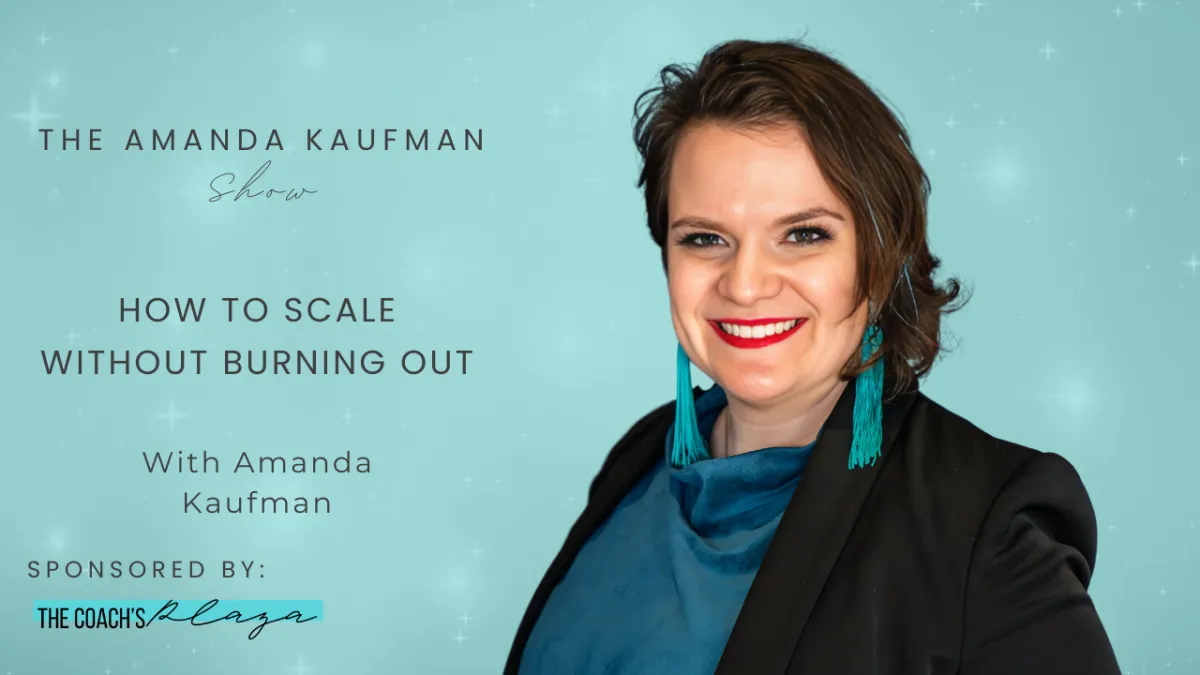
How to Scale Without Burning Out
How to Scale Without Burning Out
Most people do not start a business because they want to be exhausted.
They start because they want freedom, impact, flexibility, and a life that actually feels good to live. And yet, somewhere along the way, growth begins to feel heavy. The business that was once energizing starts to demand more and more while giving less back.
If that sounds familiar, there is nothing wrong with you.
What you are running into is not a lack of discipline or motivation. It is a scaling problem.
Why Hustle and Grind Stops Working
Hustle and grind strategies are often rewarded early on. You push harder, say yes more often, sacrifice sleep, and results follow. That pattern teaches high achievers that endurance equals success.
But endurance is not a scalable strategy.
At some point, your health, relationships, and energy start paying the bill for growth. And when a business is built on your ability to tolerate pain, it eventually breaks.
The goal of scaling is not to do more. It is to create results that do not depend entirely on your personal output.
Heart Led Businesses Burn Out Faster Without Structure
Many coaches and experts start their businesses from a deeply heart led place. They want to help. They care. They connect deeply with people.
That is a strength. But without systems, it can also become a liability.
When your business relies on emotional labor without boundaries, the light that drew people to you in the first place begins to dim. Not because you stopped caring, but because caring without support is exhausting.
Scaling requires structure that protects your energy, not just your calendar.
Tired Is Not the Same as Burned Out
One of the most damaging myths in business is that any form of fatigue means burnout.
It does not.
Being tired is part of growth. Being disappointed is part of growth. Experiencing frustration, fear, or self doubt does not mean something is broken.
Burnout is different.
Burnout is when rest no longer restores you. When your nervous system never fully comes down. When even things you love feel heavy. When exhaustion becomes chronic instead of situational.
Often what people need is not a full life overhaul. Sometimes they need sleep. Food. A weekend. A vacation. Or simply permission to pause and listen.
Think of fatigue as a check engine light. Ignore it long enough and the system fails. Listen early and you can correct course.
Capacity Versus Capability
One of the most overlooked reasons people burn out while scaling is confusing capacity with capability.
Capability is knowing what to do and how to do it. It is skill. Process. Execution.
Capacity is your available time, energy, emotional bandwidth, and financial reality.
You can be highly capable and still fail if you do not have the capacity to support what you are trying to build. And you can have capacity but lack capability, which leads to spinning and wasted effort.
Scaling without burnout requires honesty about both.
The Scale Smart Method
Sustainable growth follows a predictable pattern. Simplify. Systemize. Support.
Simplify means choosing where to focus instead of trying to do everything at once. Pick one primary growth channel. One offer to refine. One process to improve.
Systemize means turning what works into repeatable rhythms. Documenting steps. Creating templates. Establishing routines that reduce decision fatigue.
Support means getting help. From people. From tools. From automation. A business that cannot function without you is fragile. Support is what turns effort into leverage.
Protecting Energy Is a Leadership Skill
Energy is not a luxury. It is a business asset.
Your ability to focus, think clearly, make decisions, and connect with people determines how well your business grows. When energy is drained, everything slows.
Protecting energy means setting boundaries around your time. It means working with your physiology instead of against it. It means recognizing when something needs to be delegated, delayed, or redesigned.
Leaders who scale well do not have unlimited energy. They design businesses that respect the energy they have.
Growth Should Expand Your Life, Not Shrink It
Scaling does not have to mean grinding harder or sacrificing more.
It can mean fewer decisions. Clearer systems. Better support. Healthier boundaries.
The goal is not to build a business that demands everything from you. The goal is to build one that supports the life you actually want to live.
If growth has started to feel heavier instead of freer, take that seriously. It is not failure. It is feedback.
And when you listen early, you get to scale smarter instead of burning out.

Chapter List:
00:00 Scaling Without Burnout: An Introduction
02:48 The Heart of Coaching: Balancing Passion and Business
05:28 Hustle vs. Systematic Growth: Understanding the Difference
08:02 Identifying Burnout: Signs and Solutions
11:15 Capacity vs. Capability: Key Concepts for Growth
13:53 The Scale Smart Method: Simplifying Business Growth
16:25 Building Sustainable Systems: Protecting Your Energy
19:37 Conclusion: Growth Without Burnout
Full Transcript:
Amanda Kaufman (00:00)
I don't want you to build a business that is like foundationally set on your capacity to endure pain. You know, that's not sustainable in the long term.
Well, good morning and welcome to our weekly training with the coaches plaza. My name is Amanda Kaufman and this week we are talking about how to scale without burning out. We're going to talk about the smart way to grow and what a perfect time to be talking about this because we are about to start a new year. Oh my gosh. And if you're looking for the recording for today's training, make sure you are in
our Clients Over Chaos community, you can join us at next number five clients.com, that's next number five clients.com, and you can catch this recording and all of our past replays, that's where we store it. let's get this party started because like I said, now's a good time of the year to be thinking about what could I be doing?
to have a great 2026 and achieve my goals and scale my business and not have the whole thing suck. So I think that that's a pretty important objective because here's the truth. Most of the people that come to me, they already know how to coach. They already know how to help people. They already have, you know, this delightful way that they connect with other people.
But the thing is is that very quickly those beautiful powerful incredible skills end up Getting the light dimmed I'm like looking at a lamp. I'm staying in an Airbnb in Canada today Actually for the past couple of weeks But yeah, like your light tends to dim right away as soon as we start to actually grow business around it why well because
People tend to have a lot of habits around sacrificing their health, sacrificing their time, sacrificing their sanity. And like, don't need that, right? You don't need that. And for a lot of people who are building a coaching and an expert business, good morning Annie, I'm glad you're here. I noticed that like these businesses tend to start from a super heart led place. I know that was true for me.
Shout out to heart if you're like, yeah, I I did this because I did the thing I needed to do for a long time. But my heart led me to wanting to help other people in a really meaningful, impactful way.
So what I want to talk to you about today is like, how do you build this business in a way that is sustainable and energizing and ideally not exhausting? Now you might feel tired from time to time. Like, I stayed up super late with my family and that's their habit. But I stayed up super late with my family and I am tired.
but I'm not exhausted in the kind of energy where it's like you can't recover from it. You know what I mean? So I never wanna make it sound like business is just so crazy easy and there's like nothing to it, but I do think that we tend to approach things in a way that makes it a little harder than it has to be. That's fair, right? I hope that's fair. So today we're gonna talk about...
you know, how do you know that you are getting stuck in kind of a hustle and grind strategy versus a systemic scalable strategy? Okay. So if you're, and by the way, high achievers, they're honestly at the most risk of hustle and grind because you've learned somewhere along the way that if you just do the work, you're going to get the reward.
You learned that. I don't know where you learned that. I don't know where you got that from. Maybe you got that from your parents. Maybe you got that from your schooling. Maybe you got that from your career, but you got it from somewhere that as a high achiever, you can pretty much just like show up and focus real hard and you're gonna get somewhere. But the thing is, is that that can be really unsustainable, right? So very often high achievers will pair that with like terrible sleep hygiene. I was just talking about my, I'm on vacation. Y'all like, come on, give me a break. But generally.
Terrible sleep hygiene, they pair that with drinking, is really, really common among high achievers that I work with, and we have to remove that security blanket very often, or at least reduce that considerably. Very often high achievers will tolerate bad behavior from other people for really long time, and it grates their soul. And the thing is that you learn somewhere that you can really get somewhere just by enduring that stuff.
I don't want you to build a business that is like foundationally set on your capacity to endure pain. You know, that's not sustainable in the long term.
And if you're with me, The other thing we're gonna talk about is like how do you spot whether you are legitimately tired from doing something or are you flirting with burnout? And we're gonna talk about...
some of the experiences I've had with burnout over the years, yes, it happens, but we're gonna talk about like, how to identify it in an earlier stage, and what happens if you don't. We're gonna talk about the difference between your capacity to do something and your capability in doing something. Because again, as a high achiever, very often you learn somewhere along the way that you can just sort of grit your way through.
And sometimes you think you don't have capacity when you do. And sometimes you don't think you have capability and you do. And we're going to talk about the difference between both and how you make space for both. Let's see, what else have I got on our docket today? we're going to walk through a method together called the Scale Smart Method, where we're going to simplify, systemize, and support.
It's super simple, but it's such a powerful framework. I'm gonna walk you through that. And we're gonna learn how you can grow your business while keeping something that I lovingly refer to as boundaries. So boundaries, we're gonna talk that today. Does this sound like a flight plan or what, right?
And by the way, if you haven't already registered for the planning extravaganza, do make sure that you register at the link that I just popped in the chat. So, and if you're on the Instagram or watching me elsewhere, make sure you send me a direct message and say extra so I can get you a ticket. It's free to watch on New Year's Eve. It's like New Year's Eve, earlier day, my time, which is central time.
but it should be wrapped well before you have to go to dinner or anything. Coffee moment. So let's talk about it. So why do traditional hustle and grind strategies fail high achievers? I think there's a few reasons for this. The reason it ultimately fails you is you're too smart. And I'm not blowing smoke.
I mean you're too smart, like you see that it's unsustainable and you see how tired you are feeling or you're seeing the suffering and the pain and when there's no end in sight to that, you fail. Because you know that that's not what you want. And especially as you're moving into different chapters or seasons of your career, you know that you don't want to just like blindly hustle maybe the way you did when you were 20. And I'm already there.
Right? Like I'm 20 years into my career and I'm like, yeah, there was some dumb stuff that I did that was like really unsustainable that I'm like, not gonna do it. So Hustle and Grind doesn't really work. I think another reason why Hustle and Grind doesn't really work for very high achievers is very often you have several people really depending on you being your best. So that was definitely my experience. You know, I've got my kids, I've got my Chris, I've got my family, I've got friends.
You know, I've got a lot of people in my life that I want to show up well for. And if I'm always in a hustle, I'm always in a grind, and I'm always justifying why I can't come to their party or take the phone call or, you know, have a positive relationship, that really sucks. And I think especially among coaches, you're so heart led, you understand the value of relationship. so hustling and doesn't really work, right? Because you don't really want...
to, no worries, Debbie, we got you on recording, it's no big deal. But you don't really want to be in a long term hustle and grind strategy because the reason you became a coach was because you wanted to access your heart and you wanted to give your heart, right? So that's why it doesn't work. So when I say hustle and grind strategy, what do I mean? I mean like the advice like,
just go join a bunch of Facebook groups and send messages to the members, right? Or like send a bunch of friend requests and hope for the best. Or I actually hate networking for this. Like just endlessly going to networking events, new networking events, and like hunting for people. You know, like those are very grinding kinds of strategies. Now, if you're working a process, and we're gonna talk about the scale system a little later.
there's always gonna be an initial period where you work out the kinks and you work out the actual system and the actual process. So I think like people start these processes and that's okay, that's not yet hustle and grind. Cause what that is, is that's research, that's data gathering, that's optimization. Like those are really valuable activities. When it becomes hustle and grind is when you skip.
the part where you start to systemize what works. Notice what I said there, systemize what works, not just systemize because you're systemizing, but systemize something that's actually working and giving you the result that you're actually after. And if you're not getting to a place where you're even delegating either to like physical team members or AI agents or you know, like getting things off your plate.
again, that work, because there's a lot of people that are building a lot of stuff right now. And this is actually classic hustle and grind where they're building automations they don't understand. They're using prompts they don't understand and they don't understand why they're doing it. And they don't understand the outcome that they're really after. We're turning into like this copy and paste society that is just copying and pasting indiscriminately. And they're not
creating things that they really understand. So that's like another rant for a different day. But it's basically creating a lot of AI slop. What do you think happens when you build a business full of slop? Right? Are you going to be fulfilled by that? I got to tell you, there is a correlation between how burned out you feel and the results that you're getting. If you're getting decent results or you're getting progress results,
You're gonna be like, all right, you know, that was hard work. I sweat a little, you know, it took a little more effort than I thought it was gonna take, because it always takes more effort than you think it's gonna take. But you don't mind, why? Because you're making progress. And I think a lot of people are not making the kind of progress that they're gonna be wanting to see in a few months, because we've got this real copy paste culture. So sometimes, hustle and grind is really the result of a habit.
around not really engaging with what you're building. So yeah, it kind of funny, hey, like you would think that copying and pasting would make your life a whole lot easier and you'd be less burned out. And I'm not saying that you shouldn't use prompts. I'm not saying you shouldn't use, you know, technology. In fact, I believe you really should, but direct it towards something that you have a reasonable conviction that there's going to be an outcome that you really care about. So for a lot of coaches,
Using AI to help you with crafting your social content, good idea. Good idea, right? Using it to build your avatar profile for who you want to market to and who you want to sell to and do your offer design, great idea. Using it to actually build your offer so it doesn't suck and it's actually appealing to somebody else, it's a good idea. I mean, like, it helps, right? So the way I would think of the AI,
question that it's not just hustle and grind copy and paste chasing all the newest things that are coming out at rapid pace is to instead say like how can I do what I was gonna do ten times better or ten times faster right like that's a higher quality perspective to apply
Because who cares if Google came out with this new version of whatever engine and it's amazing? OK, cool, right? That's interesting. But what are you here to do? Are you here to be the AI expert that's on the bleeding edge of all of those things? Or are you a coach that wants to connect with human beings? And being aware of the tools helps you to decide whether you want to apply them to what you're building. But you see what I'm saying, right?
Exactly, exactly. And I mean, like, you can even use it when you're in programs with me, right? No problem, no problem. You can use it. I'm just saying don't turn it into another social media feed, right? Where you're just not really building anything. Okay, so let's talk about how do you spot whether you might be burning out? About a week ago, I think it was actually last week, I did...
a live stream where I was talking specifically about the difference between challenge and, how did we phrase it? It was challenge and drag, Unsustainable drag. So if you didn't see that one, you might go back and you can go to nextfiveclients.com and you can go up to the learning tab and you can see the vault.
Where we have all of our past recordings and you can check out that training there a Lot of times in a very Mental health fixated society with a lot of short form video addiction happening We tend to get very Pop psychology ish, you know, you know what mean by that like we tend to
We tend to be really obsessed with the pop psychology, right? And the thing is, is there's like really good science around psychology and mental health. But if you're getting most of your information from 30 second clips, you're probably not getting the highest quality information, you know, just like being for real, for real there. And so the thing is, that the reason I bring this up is that our society has pathologized
normal emotional experience. That's my take, right? That's my hot take. So anytime somebody feels scared, they're like, there's my anxiety. And it's like, well, maybe you're just scared because you're actually being challenged by something. You know, like that's there's a there's a difference between pathological, you know, condition and a normal emotional experience. And when you're building something new, when you're building a business, you are going to encounter
Ideally and I hope for you a range of emotions You're gonna experience joy you experience frustration. You're gonna experience sadness. Maybe bouts of depression you're gonna experience I'm just like listing all the things that I that I often will feel excitement is a good one but that doesn't mean there's something wrong with you and You know, I've had a lot of clients over the years who have this real and you know
fear of burnout and they describe burnout. And I'm like, how do you know that you're burned out? And they'll tell me a story about when they got legit burned out like 20 years ago because they didn't know any boundaries and they're a young person and they got like really like physically just distraught, you know, like they needed to have therapy. They needed physical physiological intervention. They were under slept. They were
poorly eating like they had a whole like real episode. So I'm not here to say that burnout is not real and it's like something in your imagination. But I am here to observe that a lot of the time that experience, that memory of that experience, which by the way, you'd be so shocked how many people actually relate to that experience and have a version of that story. But they did the work. They got on the other side of that.
And now there's this like, if I get the slightest bit tired, if I get the slightest bit confused, if I'm experiencing a heavy negative emotion, it might mean that I'm returning back to that place. And I just really want to encourage you that if you are actually that scared and nervous about it, you should probably be working with a therapist to release yourself from that, you know, and maybe there's more work that needs to be done.
Being tired is not the same thing as being burned out. Being disappointed is not the same thing as being burned out. And I think our society in general, like I said, tends to pathologize, tends to catastrophize that because a negative emotion is being experienced, that there's something fundamentally wrong. And I'm like, you know,
Another way to look at it, another way to look at it is that it's a check engine light. So if you really are tired, like listen to that for sure. Listen to that. When was the last time you really tuned into your intuition? Right? Like it doesn't have to take, you don't have to go all the way to like, there's something, you know, totally wrong with you that's going to take years and years to repair. Sometimes you need a sandwich.
You know, or a weekend or a vacation, you know, I've been on vacation for the last couple of weeks. I honestly didn't even realize how much I needed this vacation. I'm on it and I'm kind of going like, wow, you know, I don't think I was on the verge of burnout by any stretch, but I can really feel my mood elevating. I can really feel my my energy, you know, returning to the ideas that I like to create and all of that kind of thing simply because I took a break. So if you're like, so how do you know that you're
possibly in a burnout place or possibly derailing your growth. If you're starting to feel like you can never get untired, right? Like you're carrying the sleep debt, it's time to get that back on track, right? Because to me, in my experience anyway, it's the sleep debt that causes usually a downhill spiral for everything else. Because it's kind of one of those keystone foundational habits that if you are way out of whack on the sleep thing,
It's hard to be in whack with everything else. So, so definitely check that out. If you're finding that your social habits around follow up, follow through, maybe you're short tempered, maybe you feel like you're overly emotional, it's like, okay, we got it. We got to check in. We got to check in on your physiology. You know, some of us are going through like different life stages and things like that. Hormonal changes like
be accommodating of yourself. know, don't think like you're, you're, you don't have to push beyond it or deny who you are or what your physiology is. Understand it and work with it. That's what I would say. Right? Yeah. Make sure every day you're giving yourself breaks. Make sure every day you are giving yourself an opportunity for reflection. Ideally in a journal, you know, ideally
Give yourself 10 minutes to just meditate in the quiet. You know, that can be so, so life changing to just do those things. If you do those things, you can continue to make progress every day. So then you're not derailing your growth. OK, so let's talk about the difference between capacity and capability. So when something is not getting done or when something needs to get done, that's like new, you actually need both.
capacity and capability. So capability is knowing what to do and specifically how to do it. So sometimes when I'm working with coaches, they know what they need to do. They know that they need to post on social media, they need to have an email list, they need to have an offer, but they don't have the capability to do those things yet because they don't know
the specific step-by-step routines to execute to produce that result. That's capability. And, you know, I think about business is a lot like math. Like there's foundational things that when you learn those foundations, then the next layer can go on top and the next layer can go on top and the next layer can go on top. And, you know, after years and years, you might just be able to do some pretty crazy calculus stuff, you know?
But if you never learned how to divide, how are you going to be able to handle differential equations? Why would you? So capability is learning how to execute a routine with excellence, ideally, to produce an outcome. That's capability. That's how I think about capability. And just like math, there's procedure to it.
Or cooking is another one, right? Maybe you don't relate to math, but maybe you relate to like being in the kitchen. If you're a highly capable cook, you are able to execute a sequence of steps in a specific way to create a particular outcome. Who here has ever met a terrible cook, right? Like a terrible cook, it's simply that they didn't have that capability developed exactly, right? They may have the capacity to cook,
So meaning they went into the kitchen, they put some ingredients together, they did stuff to it, but they might not have the best outcome because their capability in cooking isn't very good. Capacity is your time, your energy, and your financial capacity to apply a capability. Okay, so.
I'm going to say that again, capacity is your available time, your available energy. And energy, would say, is physiological, like ability to stay focused kind of energy, but it's also an emotional energy, right? If you have the tenacity, if you haven't read Grit, by the way, by Angela Duxworth, totally worth reading. But energy to me is like not just your physical capacity.
but also your emotional capacity to do these things. And then finally, like financials. So some things do cost money. And sometimes you can spend money to save time, but most certainly to create something you will need time, you will need energy, you will need focus, you will need to make decisions, and very likely those will have financial implications. And whether they are...
straight up investments. So sometimes you make a decision where it's like, I'm gonna spend money to get a thing, right? Sometimes it's actually, I'm gonna spend my time over here, which means I won't be making money over there. So that's called opportunity cost. And it's still part of your capacity because sometimes you have opportunities that might deserve more of your attention.
And I bring that up very specifically because a lot of coaches get into this because they want to have more money for what they do as a genius. And I love that. And also sometimes the thing to do is have a part-time job as well.
because their financial goals can create a lot of undue pressure on the capacity to actually build the business because they're not able to make the right decisions or have the right tenacity because they're so stressed by their finances. yeah, capacity. You need both. You need both capacity and capability. And there's a lot of people in this world, my word, there's a lot of people in this world that have capacity that turn away from developing capability. And they turn away from developing capability because they
They think, well, good enough is good enough. They think, well, you can't teach an old dog new tricks. They think, well, I should already know this. I was victim of that one, because I was in corporate America for 10 years, and I was selling consulting. So I had a lot of good, relevant experience. But I kept telling myself the lie, that I should already know how to sell. I should already know how to do the financial management. I should already know how to do the marketing.
And I have to really humble my ass, right? I had to humble, humble, humble, humble to realize that although I had a lot of capacity in terms of my energy and my enthusiasm, lot of capacity in terms of I had prioritized the time to do this, I had to really humble and say like, I may have had really cool capabilities in the old career, but I didn't necessarily have them in this context.
Right? So that's kind of like getting back to the cooking example. Maybe you're like really good at roasting turkeys and making soup and, you know, peeling potatoes. But if somebody asks you to do puff pastry or like a tiered cake dessert, even though you're good in the kitchen with other things doesn't automatically mean that you're going to be good in the kitchen with new things. Right?
So sometimes your scaling is being held back because you're not putting enough time into it. I hear that a lot. But I think that if you had more capability and knew what it would actually take, you would have more willingness to assign the time that's required to actually complete the tasks, right? Okay, let's talk about the Scale Smart Method. So when you're building your business, there's like,
The cool thing about an expert business is it's actually a super simple model. You meet people that you can help and then you talk to them and then you invite them to have a conversation or an experience about whether there's a fit to work together in a deeper way and then you get to work with them. So it's four steps, meet, talk, fit, coach, meet, talk, fit, coach. So I've been teaching MTFC for years.
at in the simplest terms. And this is really, really powerful because I used MTFC when I mainly had networking as the way that I met people. I used MTFC when I was mainly using paid traffic to to meet new people. I used MTFC when I switched to being almost 100 percent organic meeting people. I mean, it just works. Right. And so the model itself is actually pretty simple.
It's the nuances of how do you decide to meet people? What's the best way for you to meet people? And I'm so curious, are you an urban person? Like, do you live in a city?
So like your nearest Walmart is a good 20 minutes away. A little bit of a proxy. Okay. So kind of urban suburban, urban suburban. Yeah. That's most of my clients and that's, you know, that's me too. I'm suburban as well. So for you, because you're urban suburban, meeting people, the fastest way is probably to go to networking events.
If you're rural, and I've helped a lot of people who are rural, the fastest way for you to meet people is probably through virtual, right? Now, here's the thing. You can do virtual no matter where you are. And what's great about virtually meeting people is that you can do it 24 seven. So if you're like me and you have commitments and family and all that kind of thing, it's not a terribly convenient thing to get in a car.
drive for an hour, go to the thing, be there for two hours, drive for an hour, you lose at least half a day. And that's not considering the energetic toll, you know? I'm an introvert, so when I go to in-person events, it's like, that's like the day, you know? It's like the day. So it really has to be a room that's worth it for me to do it. And I have found those rooms, but I love the virtual. Now here's the big disadvantage with virtually meeting people.
is that the, you know, I almost think of it as like the relational distance is automatically so much longer. So when you meet somebody in person, you find things in common really quickly. It could be physicality, it could be style, like they've got great shoes or the notebook that they're carrying is really cool. And because you're like forced physically together in a small number,
you learn really quickly about the other person and you can share really quickly about yourself. So that's why like networking is a really great strategy for meeting people. When you do virtual, you literally see less of each other, right? And because of that, it's harder to build common ground, commonality. It takes more repetition. It takes more...
focus, takes more finesse, there's more precision that's required to show the parts of you on purpose that they can find common ground with. And so that's why you end up having to meet so many more people with virtual networking than you do in-person networking. The other thing is that in a virtual environment, there's so much distraction, right? So when I'm in a networking environment, it's eye to eye, know, belly to belly.
When I'm here, I don't know how many taps you've got open, but you've probably got a few. You know, I don't know how many pings and dings you've received since we started this training, but probably several. And so I'm not just, you know, showing a very small fraction of who I am and you having the same thing. There's also just so much attention that's competing at the same time. Now that's not to say that it's impossible, but it does change the model, right?
So with the scale model, we simplify, systemize and support. So one way you can simplify is you can simply make the decision to choose where you wanna focus. Do you wanna focus on in-person networking as your primary channel? Do you wanna focus on digital networking as a channel? Do you wanna focus on digital marketing as a channel? Well, digital marketing is where
You catch attention and you pull them into your own community. That's what I do. But pick one, right? Simplify, just pick one. Stop requiring that you've got to be so good at every single thing that you do because there's just too much to do, right? Like it's better to just really simplify and hone in on a particular part of the process. To systemize, it's...
to build like your recipe, your particular rhythm for how you do things. So for example, I do this live every single week. Take this live and we create additional content from this live every single week. And by doing so, we've systematized our presence on the airwaves that even when I go on vacation, even when there's a whole bunch of other things going on, what's happening? Well, my business is still advertising.
My business is still putting things out there. My business is operating because we have a system for it. And thinking about the content that I do for my digital marketing, I'm also supported. So I've got a team member whose responsibility it is to do the editing of the episode and to publish it to the other channels and to schedule the shorts and all that kind of thing on the Instagram.
When I started this whole thing, I did it all myself. All of it myself. And my system was terrible. It was basically paper-based, it was really, really simple, but I had kind of a map of what I wanted it to look like, and then we found tools to support. So like, I used to do these lives on Facebook, and that's it. Well, Facebook changed how they do things, and they weren't keeping the files anymore, and also the...
quality of the video was really low. So I was like, you know what, I'm to enhance the system by using Riverside, right? And so we built templates, we built tools, we built rhythm, we built all of those different things. And then eventually I had my team member take over the ownership of this whole process. So then I have my part that I play, he has his part that he plays, but I don't have to spend a bunch of time
doing a thing that I've already figured out how to do. And that my friend is how you actually scale. And the reason this is so super important is because you can push for a season, but a business is an entity that is going to last for ideally decades, right? Like this is something that you're in for, you know, it's not, it's not a six month project. It's not a 90 day project. It's, it's, it's a, it's a,
It's a lifestyle, right? Like there's a lot more to it. And so the reason why it's so important to follow that simplify, systemize, support system, which I lovingly called the Scale Smart Method, the reason that's so important to follow is because for you to grow your income, your impact, and to keep up with the change that's happening,
you personally need to have the capacity to handle that next level and next wave of change, right? Because it's on you. You're the boss. You're the CEO. You're the creator. So if you're stuck in doing a bunch of work and never getting out from under it, then your business is going to just stagnate. It's going to stay whatever revenue level it's at. And so the way I look at it is we do really well as performers.
When we have discrete projects that we are executing, we execute and finish the project and we're on to the next project. Your business building is a series of projects that you're implementing over and over and over again. And the thing is, is most people when they approach business, they're just running the same project over and over. They're not building on the foundation of what they had before. Now, if you realize that your business isn't scaling because it
can't grow beyond you, it means that it's really fragile. So the smartest leaders, build support, they build systems, and they build space before they start pushing a bunch of people through the system. And especially with a coaching business, protecting your energy is the most important part of being able to grow a coaching business. There's gonna be so many things that attempt to steal your energy, and I'm here to tell you.
It is so vitally important that you protect it. So vitally important. So to put all of this into action, list three parts of your business that depend entirely on you. OK, so maybe that's posting to social media. Maybe that's the coaching. Maybe that's something else. I don't know. You list three three pieces, then choose one and design a system or assign a helper to actually handle it. Even one hand off.
could buy back hours and hours of your time and it creates this momentum that you need for scaling. So I hope you love this. If this episode gave you hope that growth doesn't have to mean burnout, then make sure you share it with a friend who is ready to scale smarter and invite them to join us in the Clients Over Chaos community at next number five clients.com. And we'll make sure we have the link around this video if you happen to be watching it on replay.
I'll be back next week and we are continuing our journey together. We're going to be focused on the number one reason that high achievers stay stuck and how to fix it. We're gonna activate in the new year with this and I will see you very soon.