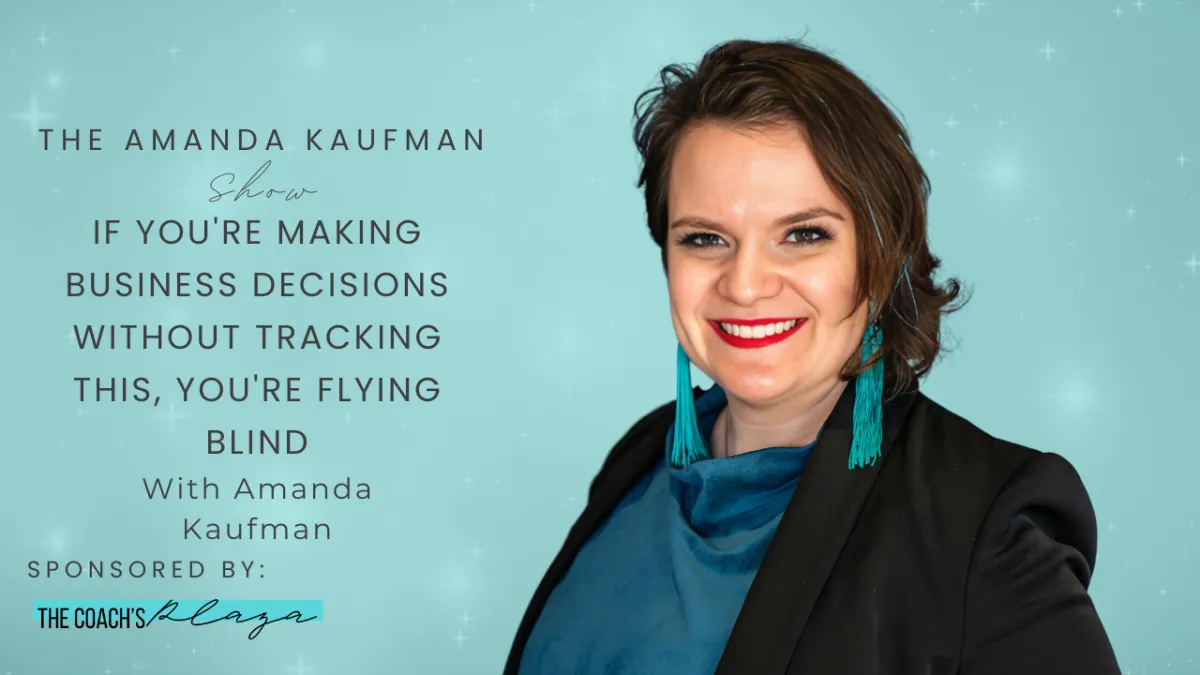
If You're Making Business Decisions Without Tracking This, You're Flying Blind
Let me ask you something.
Would you ever get into a car, put a blindfold on, and start driving?
Of course not.
But this is exactly what people are doing in their business every single day.
They’re making decisions based on how they feel instead of what’s actually happening.
And then they’re confused about why things feel inconsistent.
So let’s talk about it.
The Real Issue Isn’t Strategy
Most people think they need a better strategy.
They think they need a better offer, better content, better messaging.
But a lot of the time, that’s not the real problem.
The real problem is that you’re not tracking anything.
So every decision you make is based on a moment.
You had a quiet week, so now you’re questioning everything.
A post didn’t land, so now you think your audience isn’t interested.
A conversation didn’t convert, so now you’re wondering if your offer is wrong.
That’s not strategy. That’s reacting.
And when you build a business that way, it’s always going to feel unstable.
One Result Is Not the Whole Story
This is where things start to go sideways.
You try something once, and then you make it mean everything.
You change your schedule and attendance drops a bit, so now the time must be wrong.
You test a topic and it doesn’t perform the way you expected, so now the topic must be bad.
But you’re missing context.
You’re not looking at patterns. You’re looking at moments.
And when you only look at moments, your emotions fill in the gaps.
That’s where all the “this isn’t working” thinking comes from.
Not from data. From interpretation.
You’re Already Good at Tracking
Here’s the part that might surprise you.
You already know how to do this.
If you’ve ever coached someone, you’re paying attention to way more than what they say. You’re noticing tone, hesitation, what they’re avoiding, what they’re not saying out loud.
You’re tracking in real time.
If you’ve ever done a body scan or any kind of reflective practice, you’re tracking.
You already have the skill.
You’re just not using it in your business.
Instead of observing what’s actually happening, you’re jumping straight to conclusions.
The Only Numbers You Actually Need
You don’t need a complicated system.
You don’t need a massive dashboard.
If you’re trying to get consistent clients, there are really just a few things that matter.
How many conversations are you having?
Not content. Not planning. Not thinking about your business.
Actual conversations with people who could work with you.
Then, how many of those conversations turn into clients?
And finally, what is a client actually worth over time?
That’s it.
If you know those three things, you can make decisions that are grounded in reality.
If you don’t, you’re guessing.
Where Things Start to Break Down
A lot of coaches care deeply about doing a good job.
So what happens?
They over-explain.
They add context that nobody asked for. They try to make sure the other person fully understands everything. They soften their invitation because they don’t want to come across as pushy.
And it feels like the right thing to do.
But when you actually track what happens, you start to see something different.
The more you simplify and just invite someone to the next step, the better the conversation gets.
Not because you’re doing less. Because you’re being clearer.
Clarity removes friction.
You Don’t Need to Become Someone Else to Sell
A lot of people think they’re bad at sales.
They’re not.
They’ve just stopped doing something that used to feel natural.
You already know how to ask for what you want. You already know how to make a case for something you believe in.
But somewhere along the way, you started holding back.
Now there’s more second guessing. More hesitation. More overthinking.
And instead of practicing and tracking what actually works, you avoid it.
That’s what slows everything down.
The Question That Actually Matters
If things feel stuck, this is the question to come back to.
What are you procrastinating on right now?
And what are you worried might happen if you actually did it?
Because most of the time, it’s not that you don’t know what to do.
It’s that you’re avoiding doing it.
You’re avoiding the outreach. The conversations. The moments where something real could happen.
And until you look at that honestly, no strategy is going to fix it.
Chapter List:
00:00 Why making decisions without data is like driving blind
02:10 The trap of emotional decision-making in business
04:40 How to actually read your results instead of overreacting
07:00 Stop overcomplicating and start using real data
12:50 Why your business needs constant pivots
17:40 You already know how to track, you are just not using it
26:45 The only 3 metrics that actually matter
31:30 Sales is not your problem, avoidance is
Full Transcript:
Amanda Kaufman (00:00)
So let me ask you something. When was the last time you made a business decision based on data rather than a gut feeling?
Well, hello and welcome back to A Strong Start. My name's Amanda Kaufman and you're joining me for my weekly live completely complimentary training that is talking all about how to get more clients with less headache. And this week I'm super excited to chat with you because we've got, we've got to talk. All right, if you're building your business and you're not tracking the super important metric,
Then I don't even know why, right? So let me ask you, would you ever get into a car with a blindfold? Like would you put a blindfold over your eyes and obstruct your vision before you got behind the wheel of a car? Of course not. But people do this with businesses all the time. They drive blind, they drive without the clarity about exactly where they're going. We've talked in prior episodes about getting into massive action.
In this episode, we're gonna be talking all about something that I wish I knew so much sooner. Because here's the truth about the coaching industry. They tell you, get this certification and then you'll be a coach. But what a lot of people like me and a lot of other people feel is like, we wanna build a business, we wanna build a career, we wanna build.
a life around becoming this thing. It's not about knowing what questions to ask, although that's very important. It's about building a business that supports a lifestyle while still, while operating in our absolute zone of genius. So let me ask you something. When was the last time you made a business decision based on data rather than a gut feeling?
And I am, like I've been in business for 19 years. I got like this pop-up thingy that's totally driving me crazy, but now it's out of the way. When was the last time you made a decision that...
was based on data instead of just how you felt. And as a entrepreneur, as a empath, as a woman, as a mother, emotions are very important to me. Emotions overall should certainly play in from the perspective of the quality of your life. I would never recommend to somebody that...
You should pursue this thing, even though it's not aligned to who you believe you are, even though it's not aligned to your future, the way you see your future, even though, like I would never recommend that to millionaires. But a lot of people, they have this vision for what they want to create, what they want to build in a business. And the reality is, is that there is so much that needs to go into that business to make it really successful. So today, I'm going to be sharing with you
Probably one of the most boring lives that I've ever done. Just being completely candid because the thing is is that if it was all about the excitement, if it was all about the emotional rush and that's all that it took to be successful, I mean, what are we even doing here?
so here's the thing. Most coaches decide on what to offer based on how they feel about it or what they wish was true. Based on what they feel about it or what they wish was true. Rather than gathering data. And when I started to gather data for my business, things changed dramatically. Like, so.
When you feel good, you tend to kind of coast, you tend to kind of relax into the flow of feeling good and like that's fine. And when you're building something and you're building something good, it probably is gonna take effort, discomfort. It's probably gonna take things that are not already really natural to you. And I share that with you with love because so many people, hope that their coaching skills are gonna be what
is gonna get the clients in the door. That's not what gets clients in the door. Even like this live. It's not terribly well attended today. And I'm like, okay, that's interesting. So in my mind, I'm looking at the data. like, well, I changed my broadcast time to 10 a.m. instead of 9 a.m. Well, I'm not totally sure what emails have gone out about this and I can ask my team after. Maybe the topic was not.
the right topic. So I could analyze after I'm done here, I could analyze like the headline. What was the headline as compared to other times that I spoke that I had a higher turnout rate. So when we're operating as an emotional entrepreneur though, we take like one piece of data, so for example a lower turnout rate, and we make it mean like everything. We make it mean like, I must, they must be sick of hearing from me.
they must not be interested anymore. Nobody wants to build a coaching business. my God, my business is gonna fail. And like, if you've got a strong imagination, that makes a lot of sense that you would be thinking all these horrible things if what you tried didn't totally work. And I'm here to tell you that I have been doing this live stream and sharing content in my business for a solid six years.
And I don't always have a high turnout rate for everything. But you want to know something crazy and why I keep talking, why I keep going, whether people are here or not. And I see Megan's here. Hello. Whether people are here or not is because I know that a lot of people catch the replay. And I know that when I get the transcript out of this training, guess what? I've got a LinkedIn article. I've got a podcast. I've got short form reels. I've got
all these posts, and so this one instance of showing up is gonna turn into up to 150 pieces of content. Now, should I ignore that I have a lower turnout rate on this particular talk than I have in other ones? Absolutely not. I should look at the data. But what I see a lot of people do is they look at one data point and they interpret this crazy trend that's actually based on like,
how you were treated when you were growing up and the records that are still playing in your head about your belief system, about who you think you are and all this kind of this stinking thinking basically. And just this morning I got a message. I actually, okay, this story needs to be told. So I was reached out to over LinkedIn by someone who's looking for a coach who has a military background. And I just thought, you know what? I think I know that coach.
And he's really good about like posting on social media really regularly. So he's always top of my mind, I guess. So yeah, I reached out to him directly and I was like, hey, I may have a lead for you. I may have somebody who would be really interested in the fact that you have a military background. Who here would just like love to get leads like that? Shout out why in the chat if you're like, I love it to be nice and easy, easy, easy, easy, easy, breezy like that.
So I reach out to the fellow and he reaches back, super kind, but he wrote me like this really long message that was basically like, I don't have a funnel. And if you give my text number, they can text me and then I'll reach out, we'll have a conversation. And like, there's no pressure and all this kind of, like he put all these qualifiers on it. And I'm just so curious, like people who are here live, like.
Have you ever felt like a good thing comes into your world and the first thing you do is you start qualifying? Right, you start saying, well, it's not this, it's not that, I'm not like this, I'm not like that, I don't do this, I don't do that. And you just wanna make sure that this inbound amazing opportunity is clear that you're not as good as they might think that you are.
I know I've definitely fallen into that trap and I'm not picking on my friend. He's amazing. I still made the referral and everything, but I did tweak what he said when I sent it over to my friend and I said, you know, I asked around, I've got this, this fellow who I think could be a really good fit, text him at this number and set up and, and, and set up a call, tell him I sent you. I kept it super casual. I cut out all the pre-qualifiers. Why? Because I have enough data in my business.
to know that when I cut the fluff and I cut the BS and I simply invite somebody to the next step without pre-qualifying, without basically apologizing for not being somebody else, just like all of the, my baggage, basically, without all my baggage, and I simply make it really easy for people to step forward into the next step, guess what? I end up with better quality conversations overall.
Who, so here's the thing, how do I know this? I've tracked it. I've tracked the data. I've tracked my courage to do the outreach. I've tracked how effective my outreach is. So here's how you do that. Number of people you reach out to, number of responses, right? You can calculate what percentage of people are responding when you say hello. I literally have done this.
And what a lot of coaches do is they kind of do one thing, you know, so they'll do the webinar once or they'll send the message once or they'll go to the networking event once. And it feels so icky, your emotions just kind of hijack the whole thing. And you start telling yourself all, Megan was like, you know, I need to hear that about cutting the BS. I get it, right? Because you do want to do a really good job. You want people to know.
that you're coming from a really genuine place. You know that like you want all that and I get that, I totally feel the same way. But here's the crazy town thing and here's what the data actually shows. When you add a bunch of fluff and stuff or AI slop, seeing more of that lately, when you add a bunch of fluff and stuff and you're not simply helping people directly and making it very easy for them to take the next step, they assume that because you're having to qualify that the opposite is true.
Right? So if you say out loud the words like, I'm just a really honest person, what question immediately pops into your head? That maybe I'm not like, why am I bringing it up? Why am I bringing up honesty? Hmm. That's interesting. Like it's kind of out of flow of the rest of the thing. It's different. If you get directly asked, like, are you an honest person? And you say, yes, I'm an honest person. Got to take a sip.
But if you're volunteering information that was never asked for, it raises these questions in people's minds. It's like, well, are you really genuine or do you wish you were really genuine? Are you really honest or do you wish you were really honest? Are you really authentic or do you wish you were really authentic? And what I've learned over time, and again, it's data that's told me this. This is not because I just got this big download and it's mysterious and it's just magical.
I know that the more time I spend talking to actual people, the more relaxed I get, the more authentically I come across. And I know this because I've asked people, so why talk to me about this or what led you to want to talk to me about whatever challenge I'm coaching them through. And they say the words to me, you're so authentic. You're so, I love your energy. You have such a great vibe. They have different ways of saying it.
But you know what I never said to them? I never said, I'm really authentic. I never said, I have a really good vibe. I never said, I'm known for my energy. I never had to say it with words. What do you think I was using instead?
I just, I can't help it, I gotta be me, right? I was just doing my thing, my thing, right? And I relaxed into it. Yeah, yeah, and you have said it to me, that's so true. So here's the thing. If you keep making emotional decisions in your business, like what you say to people or where you go to meet people or how you present your offers or how you share with people, if you keep thinking about it,
purely through the feels and the emotional lens and especially please listen, please listen. If you're someone who's been at this for a while and you're feeling that feeling of frustration that you should be in a different place by now and you feel frustrated that you aren't making the kind of progress at the sort of pace that you wanted to by now, please, please, please, please, please hear me. It's probably because you're using your emotions to rule your days and your decisions.
And here's how I know this. I did this. When my business gets like, hmm, temperamental, shall we say, she's always responding to me. She's always responding to like how I'm feeling about myself, the story I'm telling about myself, the story I'm telling about how I am with other people. And it's all very emotional stories, right? And when she's good, when she's paying me nicely, when she's flowing easily, when it's like working pretty good.
I am keeping my emotions in check and I'm making decisions from a data place and a data driven perspective instead of purely emotional. So here's the thing, building a business does require pivots. If you've been frustrated by having a ceiling of revenue or like a really slow trickle of interest on your calendar,
I can guarantee you that you need to make a pivot. You must pivot. You cannot keep doing the thing that you've been doing and expect a new and different result because that is the definition of insanity after all. But doesn't it just make sense that business requires pivots? And I don't care how big the business is. I used to work for one of the biggest consulting firms in the world. And I didn't understand in the beginning and now I completely understand.
They were constantly reorganizing, restructuring, reframing, readjusting, redoing. They were always pivoting. But guess what? It was because they are one of the biggest companies in the world for what they do. And if they didn't make those pivots, they wouldn't be here. And I realized that as a small business owner, it's not different. We have to shift our message. We have to...
We have to improve our processes. We get to improve our capability as a coach. We get to learn more about people. And the more reps you get, the better you get at what you do. Would we agree on that? Shout out Y in the chat if you totally agree. It's like action, getting into action. So in prior episodes, I was talking a lot about the, I'm gonna actually just draw it because you're here, I'm here.
and because I'm broadcasting on Instagram as well, I'm going to use paper. Wish me luck. Okay, so we've been talking about the Let's Launch formula for the past little while. And if you're following along in notes, shout notes in the chat if you're one of my note takers that joins me every week and whips out your journal. Okay, so big old triangle, all right. And then remember, the Let's Launch formula, it applies whether you are smashing a ceiling,
or starting out fresh. I see you taking notes. I see you taking notes. That's awesome. Okay. So last week we were talking about how there is, if you don't take action, there won't be any traction, right? I would rather you get into the business car with the blindfold on and try to go somewhere. This is metaphorical. Okay. Don't come after me people.
But I want you to get into, I would rather have you do dumb stuff than know stuff. Okay? Dumb stuff rather than know stuff. But I know that you're not gonna wanna do dumb stuff forever. Can we all agree on that? Just show the why in the chat. If improvement is absolutely super and critical and important. And if we're gonna smash a ceiling, we probably have to improve one of mainly three things. So the second thing that we're talking about today.
is tracking what you're doing. So this is taking the blindfold off. We're taking the blindfold off and we're saying, all right, so how am I showing up at those networking events? How am I showing up on the internet? How am I showing up in my inbox, in the inbox with other people? How am I showing up in DMs? How am I showing up in text message? How am I showing up in phone calls? How am I showing up in classes? How am I showing up in the grocery store? How am I showing up?
Right? And, and when we track, you know, what's crazy, I was thinking about this this morning as I was prepping for today's live, you're already good at it. You're already good at tracking. It's just that you're probably not applying it to your business. So let me, let me tell you why you're probably already really good at tracking. Most coaches are familiar with a body scan. Have you ever done a body scan? If you don't know what it is, please tell me in the chat. But a body scan is like when you're, when you're meditating or you're
It's just observing like how do you feel from head to toe or from toe to head depending on your preferences. And so it's like a meditative practice that gets you into your body. It gets you into your feelings. And what are we doing? Tracking. We're tracking where you've got that tightness in your back or where you've got that tingle on your elbow. We're tracking. We're slowing down. We're paying attention.
I'm gonna give you another example of where coaches are so good at tracking already. You are really good at tracking BS. You're really good at it. So like when somebody's sitting across from you in a coaching call and they're kind of like masking what's going on, they're not really telling you the full thing, you sense that, you track that, and then you ask follow-up questions that reveal the deeper truth.
I assume, right? I'm assuming that's what's going on in your coaching sessions. Let me know if that's true, right? Shout out true in the chat. If you are like, you're somebody who pays very deep and close attention inside the coaching session, right? So that same capability can be applied to your business. So one of the things I wanted to share with you today is how I can discern with my clients, like what they need to work on.
Right? Because the odds are probably your coaching sessions are really good. Otherwise you wouldn't be trying to sell them. Otherwise you wouldn't be trying to enroll people into that experience. You already have some kind of evidence, you've tracked it, that people really benefit from your coaching. Shout out why in the chat if that's true for you. And if it's not true for you, make it true. Okay, so my very first coaching.
My very first coaching sessions, Debbie, I know for sure that you're getting good results with people because otherwise they wouldn't hire you to do it, right? They wouldn't show up to multiple sessions. Silly girl. Silly girl. my gosh. It's so crazy. OK. So average coaches tend to operate on their feelings without slowing down and doing like a business scan. OK. So.
The coaches that are really successful, the ones that smash ceilings, that are successful in making pivots, it's not that they've pre-calculated the best pivot they can make, it's that they are choosing to make the pivot and then if that doesn't work, they make another pivot, and if that doesn't work, they make another pivot, and if that doesn't work, they make another pivot. So a lot of people are like, Shawnee object syndrome, you shouldn't have it.
That's a tricky one, y'all, because the thing is, is you need to do enough of something, you gotta take enough action to get a result before starting something new. That's totally true. But if it doesn't work, or if it doesn't work the way you did it, then you need to track that and maybe pivot what the action is. So my friend this morning that I was referring business to specifically said, I don't have a funnel.
That's like, they specifically said that. And how many coaches tell me with so much pride, and entrepreneurs, I don't have a funnel. I'm like, you don't have education as to what a funnel really is. And so what a funnel really is, is it's a designed customer journey sequence that is meant to serve the person where they're at. And what my friend didn't realize is that yes, he does have a funnel. He posts to social media. That's the top of his funnel.
He goes to networking events, top of his funnel. He connects with people authentically, top of his funnel. Then in the middle of his funnel, he continues to post to social media. He also texts people who give him permission to do so, and he's got motivational texts that keep him top of mind. And then he invites them to one-on-one clarifying conversations. That is a funnel. It is. It's a customer journey that goes step by step by step, and it's repeatable, and he does it all the time.
So what he meant to say was, I'm really bothered by disingenuous connection and I like to show up to my conversations with authenticity. That does not mean he does not have a funnel. But what it also told me as somebody who helps people with building stability in their business is he's probably tried some technical things and had them fail. I know I have. Shout out I have in the chat if you ever have too.
And what it took me a very long time and literally hundreds of thousands of dollars spent to realize is that the funnel, the steps that you take people through, whether it's like posting to social media, coming onto live streams. Hello, you're in my funnel. I hope you don't mind. Hope the water is fine. But like it's the message throughout the funnel that is the thing. And the way I look at funnels is a great funnel is courteous.
to those who are moving through it that want your help. And it's also courteous to people that are a terrible fit for working with you. When the messaging is really good, the message is gonna push away people who are not gonna be able to afford your thing, they're not gonna be able to benefit from your thing, they're not gonna be coachable in your thing. And it's courteous to have a process where people can jet out and exit before making the commitment to getting on a phone call, right?
The thing is, is most coaches don't want to do the work to figure out what that message is. And they are scared of the iterative nature of nailing that, of nailing that. And part of it is like really not the coach's fault, not my fault, not your fault, not everybody's fault. The thing is, is that people say what they need to say to get people into a program, but that doesn't mean that they necessarily are going to be able to reproduce the results within.
the short amount of time that people wanna work with people. And so that's why for me in my own business, I changed my coaching program to be more of an evergreen model. The way it works is like when you join me in the Experts Network, it's not the Experts Academy, it's not the Experts Course, it's the Experts Network. And the reason why is because it has coaching in it, it also has community in it, and it has curriculum in it.
And the way it works is you enroll for six months so that you're actually committed to the goal. that serves as a bit of a filter that nobody joins the network without having a level of commitment. And then after that, you can just stay. And it's a very reasonable rate to stay if you wish to stay. If you don't wish to stay, that's OK. You can leave. There's always a door that you can use to exit. And no one said you had to come to all the coaching calls. No one said that you had to do your homework. Like, I am not your mama.
I'm somebody who is here to really help, but I share all that with you because I used to do programs that were like 16 weeks or eight weeks or 12 weeks. And what I found was some people would do it really quickly. Lots of people needed more time. And when they had this looming pressure to get the heck out of my coaching and get the heck out of my program, then it was so much extra pressure and it's already high pressure to build a business in the first place. So I just changed the model of what I did.
But guess what I used to make that decision? Not emotional impulse, data. Data. I used to sell the Experts Network as a year-long access. And what I noticed is that people would drop off around month nine, typically, and they wouldn't give it a full effort, because they always felt like they had more time. So right now, the current experiment is six months.
because I'm finding that when people are focused like that, they do make meaningful change, but they still have enough space to actually do it, and there's no pressure to exit at the end either. So data-driven, data-driven. I think there's really only three things that you have to track to be successful in your coaching business, right? And so I know, like I've definitely gone down the path of.
very complicated analytics, very complicated dashboards, very complicated tracking. And if you're under six figures, meaning $100,000 in revenue per year, you simply don't need all that. You don't need all that jazz, right? Show to a few in the chat or a why in the chat if you're thrilled to hear that tracking really comes down to just these three things. So number one, and this is the first thing that I ask people when they're working with me privately and they're complaining about their income.
The first thing I like to ask is how many consults did you have in the last seven days? Right, how many consults did you have in the last seven days? You might call your consult a discovery call, a strategy session. The point is, did you have a conversation about what it could look like for you two to work together and did somebody hear the offer come from your lips? Right? And so that usually tells us everything we need to know, right? Because the answer is so often zero, one, very few. The next...
One is how many conversations are becoming clients. So I actually did this audit in my own business very recently. I used AI, right? So what's really cool, you guys, is like, you don't even have to be like all that techie, like as in you don't even have to be terribly good with spreadsheets these days because we've got Claude and it's pretty great. You definitely want to make sure you check your work and that it's accurate. But boy, boy, it's gotten me excited.
And what I did is I used my AI to analyze all the conversations that I had, who became customers, who didn't become customers, how much time am I spending with non-buyers. And I did a full analysis. It was like my time on my calendar. And shout out nerd in the chat if you love that and if you want more of that. Because I'm thinking about doing more AI content for you guys. But I don't want to lose our primary objective, which is to get clients. OK, I'm seeing a couple nerds.
So seriously, like what I found in my own business is I was spending like a lot of time with people who are never gonna be a customer and honestly are terrible collaborators. I like them as human beings, so I've gotten really good at hanging out with people who are cool, but that's not necessarily gonna drive my business forward. And just making like the delineation or the clarity in my own practices in business, like social time versus business time, and being really careful that I'm not over saturating my social time, because your girl likes people. Okay.
The third one is how much are people paying you over the lifetime of your time together? So it's not what they pay you the first time they pay you, it's how much they pay you in totality for the relationship. And this has really changed in my business. And I think it's worth mentioning in 2026, an observation. When 2020 happened, a lot of people, there were two,
things that really happened in that season when it comes to money and people's willingness to pay. The first thing is there was a lot of credit programs and like money that got pushed into the economy through lots of different means. So people felt they had a lot of money. The second thing is that people were also questioning a lot of decisions in their life because they were being faced with these mortality questions.
And so their propensity or their likelihood to make an investment was like way higher. Because why not? You know, one life to live, YOLO, right? So if you compare YOLO, or if you pair YOLO with access to credit and funds, like the coaching industry saw this bubble. It just saw this bubble of people who were, and then there was also people who were affected in the job market who decided, you know what, I'm gonna go start my own business.
And so businesses like mine, we did pretty well in that season because a lot of people were looking at possibly starting their own side hustle, their own gig. And the thing is, like since then, the market is not, it's not saturated. Everybody says it's saturated. I'm like, nope, it's changed. It's changed, right? So exactly, we could do this business while you were locked in. so just like tracking all that data.
What I realized is that AI has not killed coaching and I can tell you this because my business has continued to, know, soldier on. And are people a little slower to make the decision? Yeah, probably. I think the amount of time it goes from being a stranger to being a client is a bit longer, but I'm not mad. And here's why I'm not mad is because one of the frustrations I've had with the coaching industry for the longest time is how complacent a lot of coaches were.
and about the actual coaching. And so I'm like, you know what? I think this is gonna be good for everybody that we just raise the bar, the expectation of our standards of like how we actually move through the world as coaches and as leaders, that you're only gonna want to do that work. You're only gonna want to set up that infrastructure if you're genuinely very serious about actually helping people, right? So good. Now,
tracking, I told you there's like three things we really can do usually in a coaching business. And you know what, if you want to get better at sales, definitely drop the word expert. Come join us in the Experts Network. Or if you're in the first five club, make sure you watch the curriculum about sales because once you, sales is non-negotiable. Like you have to learn that. But I think the first thing is, are you even having conversations? Because we can talk about how a sales conversation doesn't work.
But it's like if you're not having friendly conversations with people who are looking at you as the expert in what you do, the first thing we're gonna do is we're gonna do more outreach, more connection, more invitations for connection, more, right? Then we're gonna worry about getting better. So when you say like people hate sales or people are nervous about sales, totally, but you know what helps a lot is selling.
Right getting in the game and like I said earlier I would rather have you take action have a dumpster fire of a sales conversation That just is such a bunch of lessons like I would rather you have that action Track what happened track what you thought was gonna happen and then what actually happened and then that gives you your curriculum Because I got to tell you a lot of people think they suck at sales. They are scared of sales That is different than sucking at it, right?
The truth is is that you've been good at sales pretty much your entire life. And let me prove it to you. You were a kid. Has anybody ever encountered a kid and like their tenacity to get what they want? You know, I've got several kids and like if a kid wants ice cream, they will ask and they will ask and they will ask and they will make the case for what makes it so important for mom to, to relent and let them have ice cream just this one time. Even though last night it was just this one time.
And the night before that, it was just this one time. know, kids know how to push buttons. And adults learn, don't push the button. Don't ask the question. Don't have the conversation. Don't touch. Don't be there. Right? And it's like a lot of messaging that we internalize about how we're not to interact with other people. And the thing is, not that you should show up like a kid asking for ice cream in your business. I'm just saying you have innate ability to sell.
And so much of your sales woes is honestly just tracking, where did I obstruct it? Where did I add BS? Where did I add questions that no one was asking? Where did I make my offer sound kind of shitty, right? And it's not that you need to be cocky and say like, mine is the best.
you do want to say mine is great because mine is different because mine works particularly because you need to have genuine reasons for that. And again, if you're tracking what's happening, like recording your sales calls and listening to them back, and you're also just tracking that you have the sales call and what the result was, you're going to be like ahead of about 98 % of coaches. So next week, we're going to keep going with this formula and we're going to go even deeper.
I'm so excited about this one. have to confess. think being a triangle, I want everything to be just like balanced and perfect. But we're going to talk about your belief. We're going to talk about your belief in your abilities and to cultivating a vision of your future that serves you so you can start acting today in a manner that makes your future self say,
Thank you so much. At the earlier part of this live, it was a little quiet. I'm so glad everybody who's stopped by, hello. So nice to have you here. But it started out little quiet. We've been talking about tracking the data. You know what's crazy? I've had many lives where it started out slow like that. And my emotional entrepreneur brain goes, oh no, I messed up. I didn't have a good hook, didn't have a good title. I messed up all these things like I listed earlier.
And have a lot of data that says if you just keep talking and you go for half an hour or so, you're gonna hit a lot of the same numbers. And that's exactly what happened this time. So when my data was saying, you're losing, you're not winning right now, I tapped into belief and I said, you know what, I'm not gonna quit, I'm gonna keep going, I'm gonna keep blah, blah, blahing as I do.
And obviously I'm not saying blah blah blah stuff. It's very impactful and important stuff. Shout out Y in the chat if you've loved it. But the belief part is super important because on the way to getting the data, on the way to taking the action, on the way to developing your skills, you're gonna kinda suck for a sec and it's not gonna feel good. And the emotional entrepreneur is gonna be like, shut it all down, start over, can't have this, I look like a schlub, I can't do this.
blah blah blah blah blah. It's belief in the parts that are working that are gonna keep you going. I'm so glad I stuck around today, right? Because I want you to know that it's not about lying to yourself. So next week we're gonna talk about what do we need to do to activate and cultivate a stronger belief system in a better brighter future in connection with your business. And I'm gonna start at 10 a.m. Central. And if you've loved this,
You would really love my program, The Experts Network. So here's why I know you would love it. Is I coach multiple times a week. There's also a private feature available with The Experts Network. So if you want to work with me privately, it is a little more expensive, but it's awesome, right? You'll love it. And the thing is, is we don't just talk about belief. We tie it to your actions. We tie it to what are the results that you're getting for real in your business.
And the whole lens that I'm looking through is your business goals. So if your goal is to scale your business, amazing. If your goal is to have more profit in your business, we can do that too. If your goal is to shift and pivot your business and to serve a different market, I can help you with data-driven strategy for how you're going to approach that so you can have way more belief and way more confidence in what you're doing.
That's what we do in the Experts Network. So if you're interested in it, shout out the word expert or send me a DM on Instagram at TheAmandaCoffman with the word expert and I will send you a video. It's application only to the network. I don't let everyone in that I meet. I don't let everyone in that asks. And the reason why is because it's a network. It's not an academy, it's not a course.
This is giving you curriculum, it's giving you community, it's giving you connection with others who are also growing and building their business. So if you want more information about the network and how the application process works, just shout out expert or send me a DM with the word expert and I will be sure to send you the information that you need. All right my friends, thank you so much for being here. I know you will, we got a seat for you Debbie, we got a seat for you.
So keep showing up, hey, this week. Track your data, right? If you don't have enough sales, just check first. Are you even having enough conversations? Are you reaching out to people? Are you inviting people to a conversation? If you're not doing that, it could explain the slowdown. And if you're like, I don't know who else to reach out to, get your phone out and use those gorgeous social media network that you've collected and curated over the years.
and send a direct message to people that you like and ask them what's going on and wish them well. Okay? Like it doesn't have to be this pitch slap of an interaction. And I know that's what you're afraid of doing. So simply don't, don't do that. Instead help, right? Serve, be of service, be of wild connection. And yeah, are you actually getting up and going to work?
Yeah, what are you procrastinating about? Yeah, exactly, exactly. What are you worried is going to happen other than what you want that is causing you to delay, to divide and be defensive, right? And the more clear you can get on those things, the more you get to address them. All right, my friends, we will see you very soon. Thank you so much for joining me this week and we will see you next week.
I think if I can turn it off. All right. See you soon.