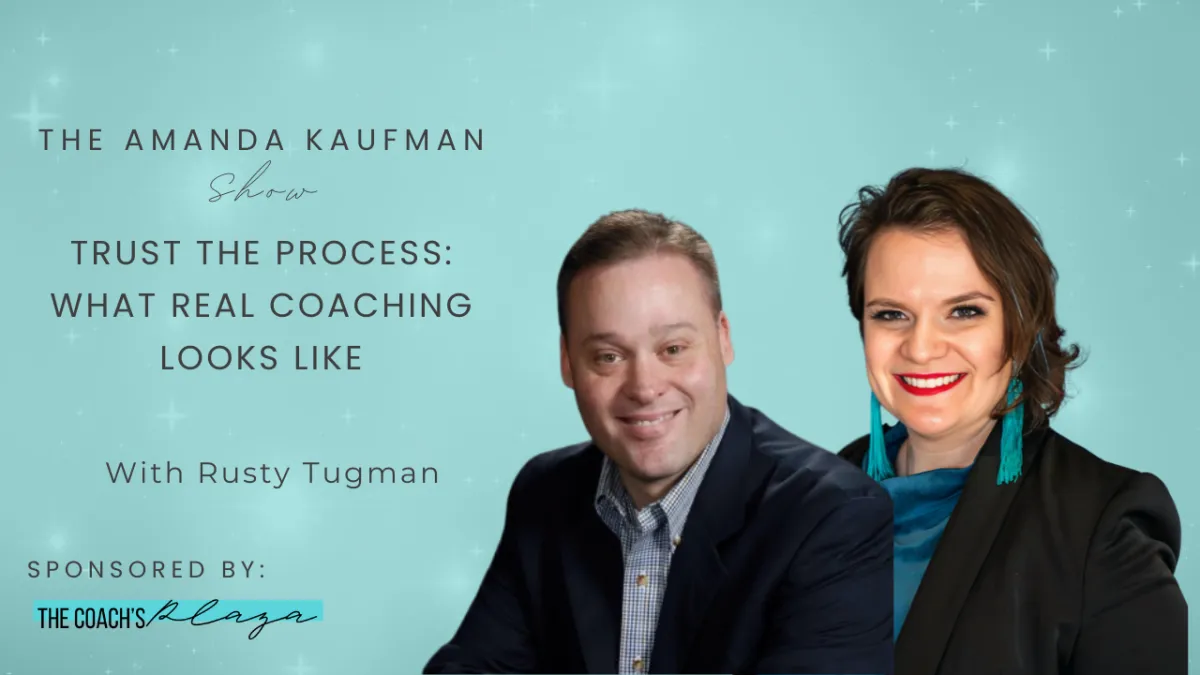
Trust the Process: What Real Coaching Looks Like
Trust the Process: What Real Coaching Looks Like
Coaching is one of the most misunderstood professions in the personal development and leadership space. It is often lumped together with consulting, mentoring, motivation, or advice-giving. In this episode of The Amanda Kaufman Show, I sat down with Rusty Tugman to slow that conversation down and get precise about what coaching actually is, why it works, and what happens when people truly experience the process.
Rusty is a leadership trainer and workplace coach for the Oklahoma Department of Human Services, where he helped build the first internal coaching program of its kind in the history of Oklahoma state government. He is also a professional certified coach through the International Coaching Federation. What stood out immediately in our conversation was not just Rusty’s credentials, but his respect for the coaching process itself.
Coaching is not about having the answers
One of the biggest misconceptions about coaching is that the coach must be the expert in the client’s field. Rusty’s experience challenges that idea directly. Coaching is not about providing answers. It is about creating the conditions for clarity.
At its core, coaching is a guided conversation built on the belief that people already have what they need to move forward. What they often lack is perspective, structure, and space. When those elements are present, confusion gives way to insight. Indecision becomes conviction. Next steps become visible.
This is why people describe true coaching as an aha moment. Not because something magical happens, but because the noise quiets enough for clarity to emerge.
Why trust in the process matters
Rusty emphasized that one of the most important lessons for coaches, especially early in their careers, is learning to trust the process. Many coaches put immense pressure on themselves to perform, impress, or prove their value. That pressure often gets in the way of presence.
When a coach trusts the process, the session stops being about the coach and becomes about the client. The coach can listen more deeply. Ask better questions. Hold space without rushing to fix or explain. This is where real value is created.
Trusting the process also removes the need to overdeliver. Coaching does not require charisma or cleverness. It requires discipline, patience, and respect for the structure of the conversation.
The difference between coaching and everything else
Another theme we explored was the blurred line between coaching, consulting, and mentoring. In practice, many professionals move between these roles. Rusty shared that in internal coaching environments, there are moments when a leader genuinely lacks information or experience. In those cases, offering perspective or guidance can be appropriate.
The distinction is not about rigid rules. It is about intention and mindset. Coaching begins with the assumption that the client is capable. Even when advice is offered, the coach brings the conversation back to ownership. What do you think about this? How does this fit your situation? What would you want to try?
This balance allows coaches to serve clients without undermining their agency.
Experience builds confidence
Rusty’s journey into coaching did not start with a grand plan. It started with one conversation. That conversation created value, and that value traveled. The program he built inside a state agency grew organically, without marketing or promotion, because people talked about what they experienced.
This is an important reminder for coaches who feel pressure to build visibility before they build skill. There is no substitute for doing the work. Every session teaches you something. Every client sharpens your discernment. Confidence grows from experience, reflection, and continued learning.
Rusty also highlighted the role of certification and training in strengthening confidence. While formal credentials are not required to begin coaching, they do provide structure, language, and a shared standard. For many coaches, that foundation makes it easier to trust themselves in the room.
Coaching as a leadership practice
One of the most important reframes in this episode was the idea that coaching is a leadership role. Coaches are not passive listeners. They are responsible for how the process unfolds. They guide the arc of the conversation. They manage time, focus, and depth.
This leadership does not override the client’s agenda. It supports it. When coaches embrace this responsibility, they become more effective. They stop hesitating. They stop second-guessing. They show up with calm authority.
Leadership through coaching is not about control. It is about stewardship of the process.
What people actually get from coaching
When coaching is done well, people leave sessions with clarity. They understand what matters most. They know what to do next. They feel supported rather than judged.
Rusty shared that many clients do not realize they have never experienced true coaching before. They may have worked with consultants or mentors, but the experience of being deeply heard and guided through their own thinking is different. That difference is where transformation happens.
Coaching does not fix people. It empowers them to move.
Trust creates momentum
The core message of this episode is simple but not easy. Trust the process. Trust that clarity will come through conversation. Trust that you do not need to be the expert to create value. Trust that when people experience real coaching, they feel it.
For coaches, this trust allows you to relax into the work. For clients, it creates safety. And when safety is present, progress follows.
Coaching is not about doing more. It is about doing the right thing, consistently, with intention. When you trust the process, the results speak for themselves.

Chapter List:
00:00 Introduction to Coaching and Leadership
00:59 The Role of Coaching in State Agencies
04:43 The Organic Growth of Coaching Programs
09:44 The Transition from Ministry to Coaching
11:48 Trusting the Coaching Process
17:51 Navigating the Coaching Landscape
20:51 Connecting with Rusty Tugman
Full Transcript:
Rusty Tugman (00:00)
when people experience true coaching, I mean, it's just, it's an aha moment. there's clarity.
it helps them to go step through that confusion. It solidifies their conviction. I mean, it gives them next steps and the accountability and the support that they need to reach their goals.
Amanda Kaufman (00:33)
Well, hey, hey, welcome back to the Amanda Kaufman show. And today I'm excited to introduce you to Rusty Tugman. He is the leadership trainer and workplace coach for the Oklahoma Department of Human Services and the owner of Tugman Coaching and Consulting LLC. He's a professional certified coach with the International Coaching Federation and a certified team coach and certified change leadership coach through the Center for Executive Coaching. This man loves to coach.
I'm really excited to have you here on the show, Rusty. We've got some cool things to talk about. Hello and welcome.
Rusty Tugman (01:09)
Well, thank you. I'm excited to be here. So thank you for having me. I'm looking forward to the conversation.
Amanda Kaufman (01:14)
Love it. You know, I think what really stood out to me when we talked about you joining the show was that you do have this role with the state of Oklahoma. I wonder if you just take a beat and tell us a little bit about what is that and how did that get started?
Rusty Tugman (01:32)
Yeah, well, thanks for asking about that. So as you mentioned, I'm the leadership trainer and workplace coach for the Oklahoma Department of Human Services, which is Oklahoma's largest state agency, a little over 6,000 employees. So pretty large workplace. And so I actually went there as a leadership trainer. And so in my role, I train, coach, and consult with the supervisors, managers, and executives throughout the agency.
on all things leadership. But in that role, I was able to create an internal coaching program, which is the first of its kind in the history of government in Oklahoma. And in that program, it's actually become a really robust program because we're able to offer executive coaching, leadership coaching, workplace coaching, conflict coaching.
team coaching, group coaching, and then just this month, in fact, just next week, we're gonna be launching a training for supervisors and managers called Coaching Skills for Leaders that's going to equip them with coaching skills and a coaching mindset that they can use in their everyday leadership. So that's a little bit of how it came about. There's more to that, but that's kind of the sketch of that program.
Amanda Kaufman (02:45)
This is like a dream come true for a lot of coaches. You I remember when I first got my first certification as an ICF coach, everybody was talking about, you know, regulation and the role that coaching is gonna play. And my impression at the time was like, that's a nice idea, but we don't have, you know, the coaching industry is such a wild west. And so for you to have like this foothold of the legitimacy of working in a state agency the way that you have been, I think is a real win
Rusty Tugman (03:05)
Mm-hmm.
Amanda Kaufman (03:15)
the coaching space because they're recognized like this is a very credible organization recognizing the role that coaching can really play in enhancing their performance, which is just incredible.
Rusty Tugman (03:27)
Absolutely. And the way that it came about is really interesting too, because like I said, I originally went there as a leadership trainer. And one time I was out in some part of Oklahoma, doing a training for a team. And when I walked in, you could just tell they had just been through it they were just having a tough, tough week. And so, you know, I kind of asked what was going on. And so they told me, and so we just abandoned the training. I just pulled up a chair and said, all right, let's just talk.
And after that, I was reporting back to my boss and I said, man, I wish there was more we could do to support our employees. And he said, well, have you ever thought about coaching? He said, I think with your background, you'd be good at it. And I never thought of that before. so anyways, we started diving into it and looking into it, seeing what all it was. And so I actually started our whole program started with me coaching one employee. That was it. And, but that employee got so much value out of it.
that she told her colleagues, so they requested coaching, and then it just grew from there. And so what's cool about our program is we never really advertised it, we never marketed it within the agency, it was truly just organic. And what's really great though is that the leaders of the agency, they were just seeing so much value that people were getting out of coaching because like you said, it was helping to improve performance.
It was helping to improve communication among teams, but also in this space, it was really having a positive impact on employee wellbeing. And so the leaders were seeing all of this. And so to their credit, they've been really supportive of growing this program and giving it the space that it needed to really build. so it's been an incredible journey.
Amanda Kaufman (05:16)
That's such a valuable lesson to anybody listening to this episode because, know, I'm thinking about, I've been coaching for almost nine years as an entrepreneur and very similar to you. You know, I just started with pulling up a chair, having a conversation, know, just kind of dropping all the pretense and just like, what is up, but like actually for real and what do you want, you know, and where are you headed and what do you see and just like putting it
back to the person who is seeking this change and feeling super stuck and just kind of letting go of some of the formality, but then also just like returning the power of the conversation back to that person, you know, which is essentially what coaching is about. I, I, and I think.
Rusty Tugman (05:57)
Right.
Amanda Kaufman (06:00)
I've reflected on this a lot. We're recording this at the very beginning of the year. And I'm like, you know, I've afforded having pretty crap marketing, like just not not not fancy, not dancy, no cars, no mansions, none of that. And simply having real conversations because there's no better marketing strategy than doing a dang good job that makes people want to actually talk about it. You know, if you're if you're feeling really stuck, I think like that's very counter to what a lot of coaches and entrepreneurs are
Thinking they need to do they think they need to have this incredible social media presence They think they need to become somebody who they are not they they think that they have to present a side of them that they feel in conflict within their own value system and you know, I love I love this whole sentiment of serve one person powerfully Right and who knows if that one person is going to be connected the way that it worked out for you But if you do that one strategy over and over again
You'll have an abundance of opportunity and you'll get better as a coach like I'm actually really curious about that rusty like since that first Engagement where you did do a good a really good job, and they talked about it. Are you a better coach? Yeah
Rusty Tugman (07:11)
I am and
I think there's a couple of reasons for that. mean, one is just more experience. You know, I've done a lot more coaching since then. like every coach, you always make mistakes, you know, and all of that. there's things that you repeat. And that's why it's important for coaches to reflect. mean, you know, one of the things we do is help others reflect, but it's important for us to reflect on how we're doing and how the sessions win. And so
Just through the experience, the reflection on experience, I've gotten better. But also, I've done a lot more certification. And the ICF certification process, it's so helpful. Just going through it, really learning about just the craft of coaching, the science behind it, all of that is so important. so I would say because of those two things, I am better.
Amanda Kaufman (08:01)
Yeah, I'm actually going for my third certification in a couple of months. ⁓ you know, thank you. Thank you so much.
Rusty Tugman (08:06)
Good for you.
Amanda Kaufman (08:09)
I couldn't agree more that like having having the training can boost your confidence so much because you have this structure to fall back on or some principles that you can fall back on and you're also learning from mentors. You're learning from people who have quite a lot of experience as well. So I, I don't believe that you need a certification to get started per se, but I have noticed that those that do formalize their education just a bit.
tend to have more confidence about what it is that they're doing when they're walking into the coaching itself. And you've been a coach for a while, yeah?
Rusty Tugman (08:44)
Just for about I guess about four years now So not not not too long. Yeah
Amanda Kaufman (08:49)
Wow, okay, cool. Yeah, that's
incredible. To, in just four years, build a relationship with an entity that you're now serving, what, 6,000 people? Did I hear that right? That's incredible. That's incredible. What would you have told yourself four years ago, knowing what you know now?
Rusty Tugman (09:00)
Mm-hmm. That's right.
Amanda Kaufman (09:08)
Like when you were very first starting, you know, did you have all this confidence that you were going to turn around and work for the state and you were going to you're going to make this big opportunity come to life or like take us back to when you were starting and what would you tell yourself now knowing what you know now? Or tell yourself then knowing what you know now.
Rusty Tugman (09:26)
Yeah, yeah, well,
yeah, yeah. Well, and it's funny because, you know, like I mentioned earlier, I mean, I kind of came into it by accident, which is funny because I hear that from a lot of coaches, you know, they kind of got into it accidentally. you know, so my background before I went to work for OKDHS, so I spent 30 years in full-time ministry. And so I was very used to having
conversations, in-depth conversations with a variety of people from all different backgrounds on a variety of topics. And so when I first came into it, I mean, I knew how to do that. I knew how to connect with people and I wasn't afraid of difficult topics or things like that because I'd been doing that. But coaching is so different than just simply having a conversation.
You know, coaching is a, it's a guided conversation. Like you said, there's structure to it and that structure it's needed, but there's, it's also very purposeful because you know, in coaching, you're really drawing out, you know, from people, know, and coaching begins with this belief that, that you have it within you to accomplish the things you want to accomplish. But sometimes we just need help kind of drawing that out. And that's what really
coaches can do. And so that's the part that I was a little bit like, can I do that? I'm not really sure how to go about all of that. And so there was a lot of trepidation going into it. But just even from that first coaching experience, mean, just the clarity that was gained, just those aha moments, think, OK.
this is awesome. I want to keep doing this. I want to help people in this way. And so I think, I think what I would have told myself back then, because one back then, I would not have believed that what has happened, it happened, you know, I mean, just the growth that we've had in our program, the way coaching has really been adopted in our agency. I mean, it's been phenomenal. I wouldn't have believed that, but I think the thing that I did
and that I would tell myself is trust the coaching process. Because the value that people were getting, wasn't because of me, you know, because I'm this great coach. It was the coaching process that when you actually, and that's why I think like the certification, the education, like all this stuff that you just mentioned, that's why I think that's important.
because there's a lot of people who call themselves a coach, but really what they're doing is consulting or mentoring and all of that's very different. And, but when you really are able to use the structure and the process of coaching, that's what people are really relating to because that's what's bringing out and creating the value that they're getting out of coaching. So that's probably what I would have said is just trust the coaching process and, and just, you know, and kind of see where it goes.
Amanda Kaufman (12:20)
So here's a curiosity that I have, like what your perspective would be around this is, you know, over the years I've sold peer coaching, where I've sold like the process of coaching and we're gonna use this process together and you can direct it towards your goals and I've sold that, sold plenty of that, right? I've also sold a lot of info products and more lately I have taken a role of more of a mentor to coaches ⁓ where I am also training, right?
Rusty Tugman (12:35)
Mm-hmm.
Mm-hmm.
Amanda Kaufman (12:48)
in there. And this is one of the things about coaching that I think is really, you know, a challenge and that is the claim to the term. Like what is a coach exactly? And so the stricter definition, you know, that ICF uses is a way of looking at it. How do you reconcile, you know, the pure form of coaching? So coaching is a...
Rusty Tugman (12:48)
You
Mm-hmm.
Amanda Kaufman (13:13)
process by which the client is discovering the best answer to their questions, to their issues, challenges, right? And the coach is a facilitator of that process. And there's lots of different processes you can follow, but in essence, that's what it is versus mentorship or training is more instructional or consulting where it's diagnosing and potentially instructional. How do you reconcile this is what coaching is?
while at the same time selling it. Because that's where a lot of coaches get super stuck is how do I defer to the client while at the same time advocate for selling a process. How do you go about that?
Rusty Tugman (13:45)
Mm-hmm.
Yeah, it's a great question. One of the things that comes to my mind just listening to you talk about that is I remember one person that I had in one of the certifications that I did in that training. It was led by a person who was a very experienced coach and consultant and had done so in, you know, really large companies. mean, kind of the biggest companies you can think of.
He helped them and all, so very experienced. what was interesting is when he would talk about this and kind of just that tension that you're speaking to, what was interesting was his approach was that, am here to serve.
Sometimes that means that I am going to be just that strict process oriented coach because that's exactly what they need to accomplish their stated goals. But he said, but sometimes I have to put on that consulting hat because they don't know exactly what they need or they really, they're stumped, they kind of just need some guidance through some things.
And so he says, sometimes I'm doing that a little bit. And I thought that was really interesting because, when you go through ICF training, you know, it's all about just, you know, that strict, you know, process. And what I've learned with internal coaching and is with internal coaching, you know, you definitely use the coaching process and we're pretty strict on that. However,
There are times when there's a leader that they're having an issue with an employee or they're facing some kind of challenge and they truly don't know what to do. And you can ask and you can pull out of, you know, all that, but they truly do not know the next step, whatever. And so that's when sometimes you kind of switch and kind of put on that consultant hat and say, okay, well, let me share an idea with you. And you kind of share.
what if you approached it this way? And then I always try to kind of bring it back to coaching and say, what do you think about that? And then we kind of, do you think that's something you could do? What would you need to do in order to follow that? So it's kind of that blend. So I don't know if I'm, I hope I'm getting to your question, but I do think that there are times where you recognize that to serve this client well, I may have to be flexible a little bit because sometimes what they need is that more of that consulting.
Amanda Kaufman (16:13)
You're here.
Rusty Tugman (16:17)
or sometimes they do need more of that mentoring. But I always want to show up and be present with that coaching mindset.
Amanda Kaufman (16:24)
Absolutely, know, I, wonderful answer, beautiful answer. it's definitely something that stumps a lot of coaches because that, that deference, like I was saying to the client being the genius.
I think that's one thing that as you're developing as a coach and you have the experience over and over again, you start to really discern, like, this a challenge? Like, is the obstacle that my client is facing, is this a matter of conviction or confusion? Because if it's a matter of conviction or confusion, then that means that the data is there. The information they need is there to be able to navigate through and you can ask the questions, then they'll navigate through.
Rusty Tugman (17:00)
Right.
Amanda Kaufman (17:03)
The discernment is that sometimes people simply don't have the experience or the exposure to be able to access the data. So it's not really a question of conviction or confusion so much as fog. Like it's just straight up not like, it's not a matter of making a decision about information that is there so much as making perhaps a decision to obtain information and to gain education. And sometimes that coach can be that jumping off point for it.
Rusty Tugman (17:24)
Mm-hmm. Yeah.
Amanda Kaufman (17:29)
But I think it can be that that's sort of the gray zone area that people do really struggle with. And something that really helped me was, and I heard this reminder, no kidding, five times before I finally received it. So if you're listening and you're like, yeah, okay, whatever, this might be the first or the fifth time that you're hearing it. But I really had to hear that coaching is in fact a leadership role. are leading people through a process. So while the client still owns their agenda, they still own their outcomes.
and all of that, the part you own is how you show up in that process. And part of that is to be able to start to make those discernments, which of course you're going to gain. You're going to gain a lot through actually coaching real human people. Right. And just trusting that process. Like you said, I love that. I love that. So good. Well, Rusty, what is one thing you wish that coaches really knew that would help them be way more successful?
Rusty Tugman (18:10)
That's right. Yes.
I I mean, I said it before, but I think I'd go back to trust the process. And the reason for that is because I think sometimes as coaches, we put a lot of pressure on ourselves, you know, that we have to be the expert in all of this. We have to have all the answers and things like that. But if you really trust the coaching process, it can take that pressure off of you.
because I don't have to be an expert in your field to be able to help you. And if I understand that, then again, that just takes a lot of pressure off. It takes a lot of anxiety away because I can truly just be here in the moment helping you, guiding you. And so what I want to be is I want to be an expert, so to speak, in the coaching process. And so I'll share this example with you. So I was coaching...
I was coaching an executive and this executive had done some coaching with kind of a large external coaching company. And anyways, after our first session, she just said, man, that what I just experienced here, that's worth way more than what I got from doing all this coaching with these other people and things like that.
Well, again, it wasn't about me. What it was, was she was experiencing that coaching process for the very first time. Because there's a lot of coaching companies that what they really are doing is consulting, or they're really good at marketing, but they're not really doing the coaching. But when people experience true coaching, I mean, it's just, it's an aha moment. I mean, they're just, you know, there's clarity. Like you said, they're...
it kind of, it helps them to go step through that confusion. It solidifies their conviction. I mean, it gives them next steps and the accountability and the support that they need to reach their goals.
So I guess that's what I would say is trust the coaching process, that if you truly use coaching, it will create value for the people you're serving. And so just trust that.
Amanda Kaufman (20:25)
I love that. I love that. And you know,
When you're learning that process, something I would add just based on some recent conversations I've had in the community is make sure you're seeking the mentorship in the coaching process as well. You know, it is a different and unique relationship. It's different than being a friend. It's different than being a trainer. But I think the thing about coaching is I think of it as coaching itself is a tool. Coaching itself is a process. And so you, the person who's doing it, who's embodying the role
Rusty Tugman (20:38)
Yes.
Amanda Kaufman (20:55)
of coach in that process. You might also have other roles, right? You might have roles of like being the CEO of your business. You might have a role around potentially training. Sounds like you've got a really cool leadership training where the leaders themselves are going to learn how to use coaching tools in their relationships as well. know, coaching itself could expand to be like the major scope of what you do, or it could be actually minor scope of what you do. And in either way, it's going to be that process. Love, love, love, love, Rusty, what's
Rusty Tugman (21:22)
Yeah, will sit.
Amanda Kaufman (21:23)
the best way for people to connect with you and get to know you a little better.
Rusty Tugman (21:29)
I would probably say LinkedIn. Just connect with me on LinkedIn. I'm pretty active there and love to connect with new people. So that's where you could find me, just Rusty Tugman on LinkedIn.
Amanda Kaufman (21:40)
Love it. And we'll make sure to have the link to Rusty's LinkedIn and all of his other connections in the show notes below. Rusty, thank you so much for being here.
Rusty Tugman (21:50)
Thank you, Amanda, I so enjoy this and thank you for all you're doing to support coaches.
Amanda Kaufman (21:54)
I you appreciate you very much and dear listener if you love this make sure you grab the link to the episode wherever you happen to be listening or watching and send it to three of your co-chief friends they need to know that success looks a lot of different ways for people and Rusty I think you you do a beautiful job of showing like yet another amazing way that you can have greater and greater impact starting with that one person that you powerfully serve and By the way, if you're listening still and you haven't hit subscribe, make sure you do we're gonna keep posting about it on our social
media
but you know those algorithms you might just miss something if you're not subscribed so go ahead and hit the subscribe button where you happen to be listening or watching and finally if you've been loving the show you like what we do the best way to say thank you is leave a review because when people are thinking about listening and joining us on these episodes they do check those reviews out so an honest review goes a super long way we'll be back with another episode super soon but in the meantime make sure you keep doing what matters