What Moves You: A Different Way to Think About Mental Health
What Moves You: A Different Way to Think About Mental Health
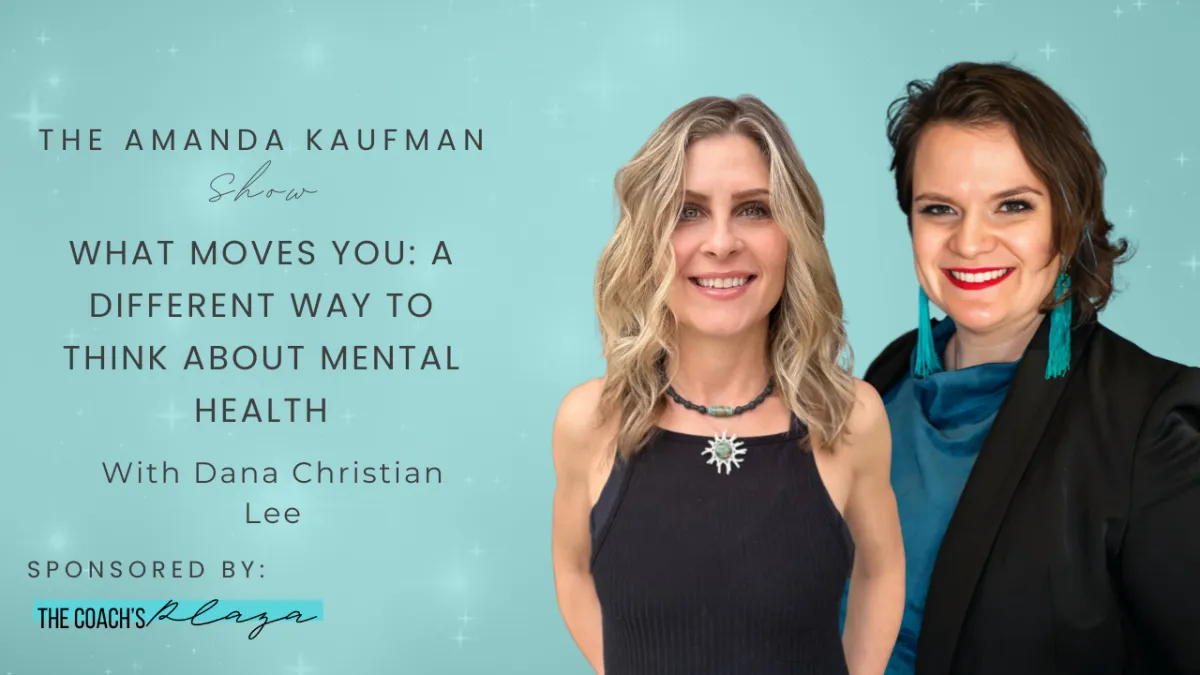
Mental health conversations often start with what is wrong. What is broken. What needs fixing. In this episode of The Amanda Kaufman Show, I sat down with Dana Christian Lee to explore a very different starting point. Instead of centering the problem, we centered the person. Instead of asking what hurts, we asked a quieter, more revealing question. What moves you?
Dana is a longtime educator, a mother, and a producer with more than 25 years of experience creating spaces for learning and connection. She is also part of Tell My Story, a nonprofit that uses film to empower young people and families to engage in meaningful conversations about mental health. What struck me immediately about our conversation was how grounded her approach is. There is no rush to diagnose. No pressure to perform healing. Just an invitation to notice, feel, and reconnect.
Why film opens conversations that advice cannot
Dana shared why film has become her medium of choice. Film allows people to engage with difficult topics without immediately inserting themselves into the story. You can watch someone else struggle. You can witness courage. You can feel resonance or resistance. And only then, if you choose, turn inward.
This matters because so many mental health conversations feel confrontational without meaning to. Advice often assumes readiness. Questions can feel intrusive. Film creates a third space. Something outside of you that still reflects you. It softens defenses and makes room for honesty.
Dana described how people of all ages can identify with struggle. But what truly brings people together is hope. When audiences witness young people being brave enough to tell their stories, something shifts. The room becomes collective. People are no longer isolated in their thoughts. They are connected through shared humanity.
From performance to presence
One of the themes that kept resurfacing was disconnection. Dana named something many of us feel but rarely articulate. In a world that rewards performance, people lose touch with who they are. Social approval becomes louder than internal signals. Likes, productivity, and appearances start to override curiosity, intuition, and rest.
This disconnection is not a personal failure. It is a cultural pattern. When mental health is discussed only as a problem to solve, we miss the deeper issue. Many people are not broken. They are simply disconnected from what matters to them.
Reconnection does not require dramatic transformation. It often begins with awareness. Paying attention to what drains you. Noticing what brings energy. Allowing yourself to feel instead of constantly optimizing.
The power of asking better questions
The film Dana produced, Shift: Do What Moves You, is built around a deceptively simple question. What moves you? Not what should you do. Not what looks impressive. Not what will be approved. What actually moves you.
This question opens space for both adults and young people. For parents, it can surface reflection about their own childhoods, unfulfilled dreams, and unconscious projections. For kids and teens, it offers permission. Permission to explore interests. Permission to choose curiosity over compliance. Permission to see themselves as active participants in their lives, not passive recipients of expectations.
Dana shared how often parents first reconnect with their younger selves when watching the film. They remember moments when time disappeared because they were fully immersed in something they loved. That memory alone can be emotional. It highlights both what was lost and what is still possible.
Mental health as movement, not management
A powerful reframe in this conversation was the idea that mental health is not just about managing symptoms. It is also about movement. Emotional, physical, and relational movement. When energy flows, it does not stagnate. When people feel choice, agency increases. When curiosity replaces judgment, growth becomes possible.
This does not mean avoiding hard realities. Pain exists. Struggle is real. But coping mechanisms that numb or distract often deepen disconnection. Dana spoke about small, embodied actions that can create shifts. Stepping outside. Taking a walk. Allowing stillness. Even something as simple as feeling warm water in the shower can interrupt shutdown and reintroduce presence.
These are not solutions. They are openings.
From problem-focused to possibility-oriented
There is a growing mental health crisis, and acknowledging it matters. But Dana’s work points to something equally important. The shift from problem to possibility. When people are invited into conversation instead of correction, engagement deepens. When stories are shared without judgment, healing becomes communal instead of isolated.
Tell My Story is rooted in the belief that storytelling is an ancient and powerful practice. It connects. It teaches. It reminds us that we are not alone. And it gives people permission to become the authors of their own lives rather than characters trapped by circumstance.
An invitation, not an answer
This episode is not about telling you what to do. It is about slowing down long enough to ask a question that matters. What moves you right now? Not in theory. Not someday. In your actual life.
Mental health does not always require more information. Sometimes it requires space. Space to listen. Space to feel. Space to choose differently.
If you are a parent, a leader, a coach, or simply a human trying to navigate a noisy world, this conversation offers a grounded reminder. You are allowed to reconnect. You are allowed to shift. And you are allowed to let movement begin from within.
When you ask what moves you, you are not avoiding responsibility. You are reclaiming agency. And that may be one of the most important mental health practices we have.

Chapter List:
00:00 Introduction to Dana Christian Lee
02:08 The Power of Film in Mental Health
04:00 Creating Impactful Stories
08:33 Navigating Personal and Collective Journeys
13:46 Reflecting on Childhood and Parental Projections
17:22 Empowering Conversations and Choices
Full Transcript:
Dana Christian Lee (00:00)
people of all ages can identify with struggle.
And everybody wants to see triumph. Everybody wants to see hope. So when we can all sit in awe of young people being courageous, specifically about our film, it unifies us as a collective,
Amanda Kaufman (00:34)
Well, hey, hey, welcome back to the Amanda Kaufman show. And I'm so excited about this episode because how I met Dana was very synchronistic. So Dana Christian Lee is a devoted mom to William and Grace and a longtime educator with more than 25 years of experience. She's originally from Michigan and she and her family moved to Northern California in 2019, where Petaluma instantly felt like home.
With degrees in education, certifications in yoga and mindfulness, Dana blends heart, presence, and wellbeing into every space that she leads. Her passion is creating community through connection, conversation, and accessible mental and physical wellness. And in 2023, she joined Tell My Story, which is a nonprofit empowering parents to prioritize their children's mental health.
through film, music, and open dialogue. Dana, welcome to the show.
Dana Christian Lee (01:38)
Hello Amanda, I love that the universe brought us together.
Amanda Kaufman (01:42)
a million percent. So dear listener, know, Dana and I met because I was flying to the movie premiere for Moms Rising, which is a movie project that I've been involved in for the past few years. And what you notice, I was walking through one of the biggest airports in the nation. I bump into someone I know and that someone I know knew Dana. And so when I told this person about date about what I was about to do with the premiere of the movie, she says you have to meet Dana.
And so we did, like how synchronistic is that? Like I didn't look her up, she didn't look me up, we weren't in each other's marketing circles. It was just literally a friend of a friend, saw an opportunity for cool connection. So Dana.
Dana Christian Lee (02:25)
and was
meant to be.
Amanda Kaufman (02:27)
It was meant to be. Absolutely. So Dana, catch us up a little bit on what are you focused on right now as you're heading into the new year? Like what's 2026 going to be focused on for you and maybe tell my story?
Dana Christian Lee (02:43)
Wow, that's a big one. 2025 was such a big year that I'm wrapping it up right now and also launching into this new year with a big creative heart. And right now we're getting distribution of Tell My Story's latest film called Shift, Do What Moves You. And my personal goal is to have that film screened.
a thousand times in 2026 all across the globe. So distribution of our new film is a really big thing. Countless conversations with young people specifically to hear about how this film lands, do a lot of presencing with them to see what they need.
and then to move into this next wave of what Tell My Story is about. So we're making another film on AI as we speak, so that's in the works. And also, I have a couple other creative projects as a producer in my mind and on the way, so stay tuned for those.
Amanda Kaufman (03:40)
That's so exciting. And, you know, one of the things that really sparked with us when we were speaking, you know, getting to know each other off off off off the air was around this idea of using different mediums like non-traditional mediums to share really important messaging. You know, I work with a lot of coaches, lot of entrepreneurs. There's a lot of people. I read a stat the other day that 83 percent of people want to write and publish a book.
And I thought in the United States, which I thought that was so interesting. But what brought us together was message through film. So I'm so curious if you don't mind just sharing a little bit about what was it about the medium of film to share an important story like why pursue that versus the other maybe more traditional ways of working with people with mental health and speaking and like all that kind of thing. Why film?
Dana Christian Lee (04:35)
Film is a great connector of mind, of heart, and of people through something outside of yourself. So you don't have to insert yourself right away in a conversation. You can feel yourself in a story of another person and identify, yeah, I feel like that. yeah, that resonates. that doesn't resonate. So I think the connection to what a film does, particularly with our young people telling their stories,
people of all ages can identify with struggle.
And everybody wants to see triumph. Everybody wants to see hope. So when we can all sit in awe of young people being courageous, specifically about our film, it unifies us as a collective,
cheering these young people on, and then also asking ourselves, what do I love? What moves me? And then when the film ends, we're back in a space where we all feel connected without having to say a word.
Amanda Kaufman (05:34)
It's so beautiful. You know, what came through for me as you spoke about that is there's so much good information out there, but because it's not paired with inspiration, it's not paired with like that shared emotional reason to talk about the good information that's out there. can see how it doesn't really land. And especially in our current
circumstances in in 2026 when I look at social content, for example, and I'm definitely one of these creators, but a lot of social content is very casually produced. It's it's not maybe you could just take us through like what what is the process as a producer when you're when you're bringing a film forward? There's a lot more to it than, for example, sitting down and doing a podcast not to diminish what we're doing. I'm just saying like for a podcast to have
even close to that amount of impact, you know, would require an immense amount of preparation and planning and all of that. So with film, what do you keep in mind as a producer to make it a successful inspirational experience?
Dana Christian Lee (06:42)
For myself, I focus on my life as an experiment, right? Like I watch myself in situations, which then leads me to hold a space of presence with other people, to be able to engage with their emotional landscape, if you will, energetics and observation, and then deep conversation. So I talk to a lot of people, I talk to a lot of groups, a lot of young people, and I feel their need first.
Amanda Kaufman (06:53)
Mm.
Dana Christian Lee (07:08)
and I use my intuition to say,
Where am I being guided? What story needs to be told? So it's less because we live in such a top-down culture, Amanda. It's like the mind can get tricky. It doesn't always speak truth to us. Most of the time it doesn't necessarily speak truth. So for me as a producer, I end up as a mom and as a woman, especially like I listen to my heart. And so I feel deeply like in having all these conversations with our first film, what I wish my parents knew important conversations.
but they were difficult and I could tell that people wanted to feel hopeful. So in every conversation that's what I wove together was a feeling and then from that feeling I asked myself what do I want people to experience and then what's gonna land and the name shift
was super powerful for me when it came through because everybody I speak with, young, old, doesn't matter. They all want something to shift in their lives for the better. People want to be happier, they want to be healthier, they want to be more connected. So telling story with heart is what comes through first for me and then having...
that word that's gonna land and that invitation that asks people to dig deeper inside their hearts and then begin to take small or larger actions in their life, do what moves you. Because as a society, we all know we have a mental health crisis and we're moving, shifting that paradigm from problem to possibility.
So that is the inspiration, that was the flow, and this was my first go-round as being a producer. So it was a lot of learning, a lot of lying on the ground, like with creative crisis, you know, that kind of thing. Logistics, kids getting sick for filming, you you name it, it happens.
Amanda Kaufman (09:07)
Yeah.
Dana Christian Lee (09:08)
But I would
say that creating and producing this film came specifically from direct experience with young people, with parents, with a lot of listening with heart, feeling culture, and then asking, what do I, I could feel the direction I wanted this to go. And then I was able to move it.
Amanda Kaufman (09:26)
I can hear from just even how you're describing this, the intentionality and the...
allowance for that inspirational space to be able to do it because I love what you said about things being so top-down in I did some research the other day actually around relative market sizes. I was just super curious What was the market for mental health? versus what was the market for for coaching and Coaching is like this teeny tiny
little market as compared to the market for mental health. Like it's a massive growing demand for mental health. And I thought that that was like a really interesting finding. It didn't surprise me to be very honest. But it really does point to how important it is to have content and conversations resulting from the content.
that are steering us in that direction of growth. Because one of the big things that I see as a difference between coaching and pure mental health support is that coaching is very forward focused. It's about the attainment of goal. It's about overcoming challenge. It's about very forward focused. And I think being able to activate and bring those two things together, you're always going to have the mental health needs, of course.
But as a society, if we could also start to shift, like you said, just start to shift and like choose to pursue goals, choose to pursue a better version and to support each other more openly, that seems like a worthy goal. Yeah.
Dana Christian Lee (11:05)
Yeah,
in a world that's outwardly focused on what other people think, how you present yourself, what your social media presence is like, people disconnect from essentially who they are.
Amanda Kaufman (11:16)
Mm.
Dana Christian Lee (11:17)
listening
to their own heart, listening to their own needs, being curious instead of, you know, what's happening, which is running around trying to please people to get more likes, more followers, you know, achieve and external goals aren't bad, like wanting to have a career or, you know, don't get me wrong. But when we do that from a place that's ungrounded and not plugged into one's truth,
Amanda Kaufman (11:36)
Totally hollow.
Yep.
Dana Christian Lee (11:39)
And so
one of the interesting things this film reveals too is the challenging question of what moves you. But also when parents see the film, there's a resonance that asks them to reflect on their own children, right? And what they're pursuing and how they're holding space for their kids and are what their kids doing actually what they want to do as opposed to what the parents want them to do. So like when my daughter was young, the first thing I did was put her in ballet. I liked ballet. I thought she might like ballet too, right?
it after a while and so I was like okay fine but I didn't push her in that direction not that I'm like a stellar parent but I try to to tune into my kids to listen and to hold space for that and so asking ourselves as adults right like what are my dreams what were my unfulfilled dreams am I projecting my needs onto my own children so there's a lot of things you know to hold and it's not with judgment it's just with spaciousness and openness and curiosity and presence because when we can let
Amanda Kaufman (12:09)
you
Dana Christian Lee (12:36)
our guard down and just begin to feel into this, so much opens up. And that's where the enthusiasm, that's where the excitement comes in to say, I feel something rising. Like that's inspiration. It's spirit rising within to say, maybe like if you're really having a hard time as a kid and doing the new thing called bed rotting or just rotting in your day, like maybe just get in the shower.
Amanda Kaufman (12:52)
Mm-hmm.
Dana Christian Lee (13:01)
Shift how you feel physically by feeling warm water and then getting to school on time. Those can be some things that can move your life in a positive direction, right? Because everybody wants a life that has happiness, that has no pain. And our coping mechanisms we use can sometimes thwart that, right?
Like we can binge whatever, right? Like instead of getting quiet or even just going outside, taking a walk. And so this film invites all of us to be reflective and sometimes seeing who we are right now is challenging, but it's also inspiring to say if I'm not really liking where I am or what I see.
This is an opportunity. This is not life against me. This is life for me because it wants to come through me.
Amanda Kaufman (13:52)
I'm so curious, like in the conversations that you've had so far with parents, I imagine they do see like potentially that projection or that desire that they once had. Are you also seeing them discover that there's a permission that the parent themselves also has to shift? Like to realize like you can still activate the goal. There's plenty of time. Like so much of my coaching is really rooted in that, but I'm curious if that's coming up from the movie.
Dana Christian Lee (14:20)
Yeah, absolutely. So I've had a lot of parent groups and the first thing that I sense happens and people communicate is they see themselves as their young self first. Because when I'm specifically leading, I ask people to remember a time when they were young where they were doing something where they lost track of time.
that they really loved. Where were you? What did it feel like? So, Amanda, for you, what do you remember about being young and like just living life fully with confidence and no like filter?
Amanda Kaufman (14:54)
was always building stuff. Like I was always designed it and funnily enough, I was always designing like communities and clubs and I still remember my very, very first club was with one other girl. And it was this hip cat club. But I was like, I would get busy. You know, we had business cards, we had an agenda, we had like all the things and it's so funny because like even to this day,
Dana Christian Lee (15:05)
Yes! It was what they called?
Amanda Kaufman (15:17)
Anytime I have an opportunity to volunteer or to help with something or to like play a role, it's a version of that. It's just this version of like the little logistics and coordination of helping everybody do a thing together. But yeah, like that's what I thought of as soon as you said it.
Dana Christian Lee (15:32)
Yeah, and it's fun because some people get joy like you do for sure, like, I remember being that and then I get built on that. It became the foundation of who they were. But there are some that chose a path maybe that hasn't brought them joy like that. And then...
Amanda Kaufman (15:48)
yeah. Well, I totally stepped
away from that path, by the way, for the record, like, because I wanted to earn the money and I wanted to have the prestige. So I, so I chose a path that I thought would give me more of that. And what's really funny is like, I got a whole degree in chemical engineering and I'm applying to all these jobs afterwards and I didn't get it. I didn't get one, an engineering job at all. I ended up kind of reverting back. And it's so funny because I've had three major
Dana Christian Lee (15:52)
Sure.
Amanda Kaufman (16:15)
three to four major career shifts over my life. And you're really raising this up like right now. I'm like, oh my God, I'm going back to that little girl. the more, every time I do it, it's because I'm getting more freedom. But that expression of the freedom for me is more of that little girl. That's fascinating.
Dana Christian Lee (16:26)
Mm-hmm.
Well, and so that's what's unwinding for people. They're kind of going back and having this sense of who they were, what it felt like, if they were in nature, fishing, climbing trees, whatever. And then particularly I've seen some men like express that they got stuck in a corporate box.
Amanda Kaufman (16:41)
Hmm.
Dana Christian Lee (16:55)
or they put themselves there and like they didn't get outside as much. So it was liberating for them. And when I have conversations with groups of people, I can see tears in their eyes. I can see a sense of sadness. But then once the conversation keeps going and talking about the inspiration of, like you said, it is never too late to choose yourself and to do something that moves you and taking a moment, if it's been a very long time, to ask yourself.
Who am I right now? And what do I love? And even if I don't love it, what do I like?
And then people start to unpack that. And then they get more curious then about their children. So then we get into the conversation about young people and how when energy moves, it doesn't get stuck. They're more awake, they're more aware, their brains are on, their hearts are open. And school or family time or whatever responsibility they have becomes more joyful because they know they have a foundation within themselves of choice. These kids really want choice in their lives.
Amanda Kaufman (17:42)
Yeah.
Dana Christian Lee (17:57)
And that's been reflected to me again and again by high school students that I speak with. And they identify with the kids who choose resilience in the film. So it's very fascinating to see. you know, this is just beginning. So having conversation like this with you is very exciting because I want it to be a universal fit. You don't have to have children. You don't have to be a parent. This is a human conversation. And storytelling is an ancient practice.
of connecting, of teaching, of being part of something larger in such a beautiful way. And I'm so humbled to be able to get people, like you said, 84, what'd you say? 84 % of people want to write a book. what I asked them, that just means people want to share. They want to tell their own story. Hence, you know, we have tell my story and that's what I want people to be able to do.
Amanda Kaufman (18:40)
Yeah, 83, I think 84.
They do.
Dana Christian Lee (18:51)
with their lives. Become the hero of your own life. Shine your light. The world needs people in their truth. The world needs people in their passions. And then the world needs people to be present to help others see that they have that inside themselves too. And that's what this film does. It's like a lighthouse.
Amanda Kaufman (19:13)
I love it. Well, Dana, what is the best way for people to follow you and find out more about what you do?
Dana Christian Lee (19:23)
Well, my personal Instagram is just at Dana Christian Lee through Tell My Story. Everything is tellmystory.org, Facebook, same, Instagram at Tell My Story Community, and you can reach me at Dana, D-A-N-A, at tellmystory.org. And anyone that's inspired by this message, send me an email.
Send me a DM. Let's talk. And if you want to have our film, we can work together to create an event where you screen the film and there's no charge to you. That's the beauty of this. And then have a dialogue after around what moves you, whether it's your school, for your kids, a business that you run, community organization that you're part of. This is the raw material that can fit almost any place.
Amanda Kaufman (20:12)
love it. Well, thank you so much for being here today. I really appreciate your time.
Dana Christian Lee (20:19)
It's so nice to be here. I feel like I know you and we've only met once and this is so beautiful. This is the power of technology for good.
Amanda Kaufman (20:29)
a million percent and I feel exactly the same way. And dear listener, if you found this fascinating and you want to share it with three of your friends, don't forget to grab the link and send it on to them through however you guys like to chat, whether it's over DM or text. And if you haven't already, make sure you smash the subscribe button so you don't miss another interview. And we are going to be back very, very soon. And in the meantime, if you've listened to a few episodes of the show and you just think we're...
We're awesome and you want to support us. One of the most incredible things you can do takes about two minutes and that is of course to leave an honest review. So those reviews, they really help people to decide whether they want to spend time with us. And of course we are immensely grateful for your support. Thank you so much for being here and we will see you in another episode.
Dana Christian Lee (21:13)
Thank you.