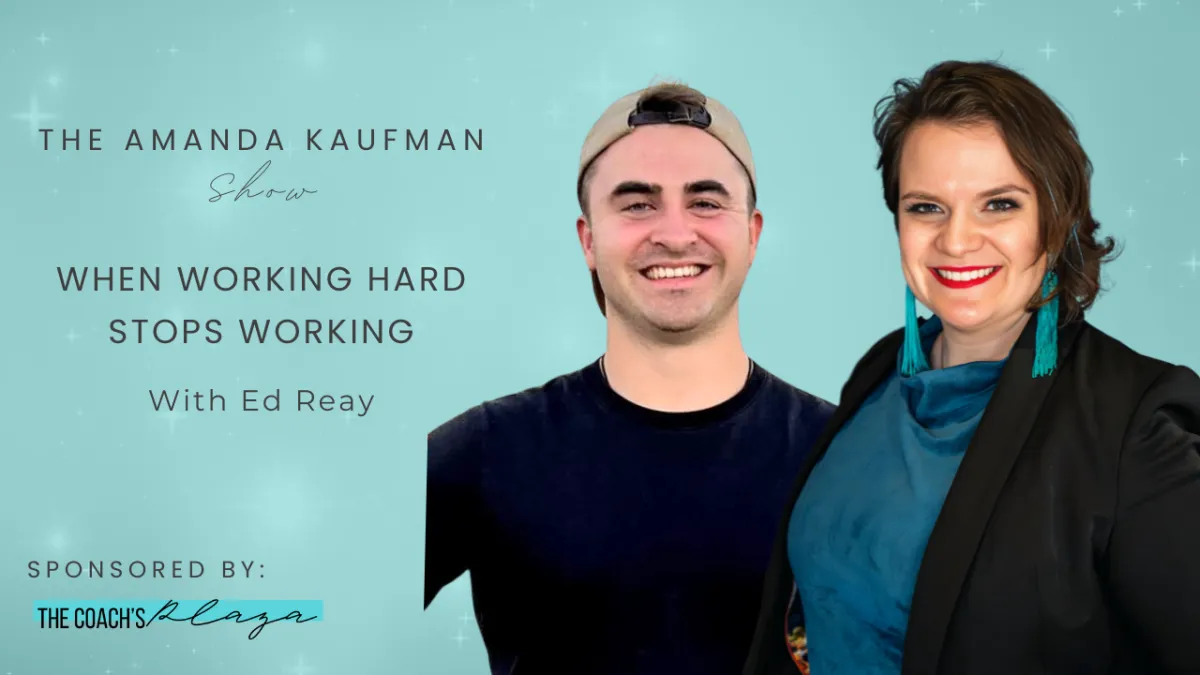
When Working Hard Stops Working
When Working Hard Stops Working
There is a particular kind of frustration that shows up after you have done everything right.
You have invested in coaching. You have built the habits. You have read the books, followed the frameworks, and applied the strategies. You are not avoiding the work. You are doing it. And yet something feels off. Growth feels heavy. Progress feels expensive. Momentum feels fragile.
This episode was born from that moment.
In my conversation with Ed Reay, we kept circling back to the same truth from different angles. When working harder stops working, the problem is rarely effort. It is almost always the environment.
The Mistake Smart People Make When They Get Stuck
Smart, capable people tend to default to self correction.
When something is not working, they assume they are the problem. They need more discipline. More strategy. Better execution. More personal development. So they double down.
They add more tactics. They optimize. They force consistency. They push through resistance and call it growth.
What they rarely stop to question is the system they are operating inside.
If the environment is misaligned, effort does not compound. It leaks. The harder you push, the more friction you create. Eventually, even things you once loved start to feel like obligations.
That is not a character flaw. It is a systems issue.
Why Environment Matters More Than Effort
Environment is not just physical space, although that is part of it. It is the structure of your days. The order in which you give your energy. The conversations you are avoiding. The parts of yourself you are suppressing to stay professional, productive, or palatable.
It is also the emotional and energetic context you are carrying into your work.
When your environment is clean and aligned, progress feels lighter. Not effortless, but easier. You still work hard, but the work gives something back. Ideas flow. Decisions clarify. Capacity expands.
When the environment is off, even simple tasks feel heavy. You can still produce results, but it requires force. Over time, that force becomes unsustainable.
This is why so many people burn out while doing work they are technically good at.
The Difference Between Busy Work and Real Progress
One of the most important distinctions we explored in this episode is the difference between activity and embodiment.
You can do all the right actions without actually being in them.
You can journal without reflection. You can plan without intention. You can execute without presence. From the outside, it looks like progress. On the inside, it feels hollow.
This is what performative personal development looks like. Lots of movement. Very little change.
Real progress shows up when intention is aligned with action. When you are not just doing the thing, but actually there while doing it. That level of presence changes outcomes without changing the tactic.
Same action. Different result.
When Strategy Becomes the Wrong Lever
Strategy matters. Structure matters. Tactics matter. This episode is not an argument against skill or execution.
It is a reminder of sequence.
Strategy works when the conditions support it. When the environment is hostile, strategy becomes something you fight against instead of something that works for you.
This is why people cycle through programs, hires, and offers without resolving the underlying issue. They keep changing the visible pieces while leaving the system intact.
At some point, the most productive move is not another plan. It is a redesign.
Adjusting the System Instead of Forcing the Outcome
One of the words that stood out to me in this conversation was adjust.
Not fix. Not burn down. Not overhaul overnight.
Adjust.
Growth is not about making one perfect change. It is about making honest ones. Sometimes that means changing how your day is structured. Sometimes it means ending something that no longer fits, even if it once worked. Sometimes it means admitting that the version of success you were chasing no longer matches who you are.
Those adjustments can feel small, but they create disproportionate relief.
When the system changes, effort starts working again.
Why This Matters Right Now
Many of the people listening to this show are not beginners. They are not stuck because they lack knowledge. They are stuck because the way they are living and working no longer matches who they have become.
If growth feels harder than it used to, that is information.
It is not a sign to push harder. It is an invitation to look at the conditions you are asking yourself to thrive in.
You do not need to fix yourself.
You need to look honestly at the environment you are operating inside and decide what needs to change so effort can work with you again, not against you.
That is when working hard stops feeling like punishment and starts feeling like progress again.

Chapter List:
00:00 Introduction to Ed Ray and Ecosystems
02:43 Cultivating Environments for Success
05:31 Understanding Ecosystems in Business and Life
08:20 The Importance of Intention in Personal Development
11:12 Navigating Obligations and Choices
13:59 The Role of Energy in Personal and Professional Growth
16:41 Conscious Decision-Making and Agency
19:29 Expanding Your Terrarium: Strategies for Growth
21:58 Conclusion and Keeping Up with Ed Ray
Full Transcript:
Ed Reay (00:00)
here's the hot take, a lot of the time what we think is effective work is just busy work.
You can do the thing. But are you really doing the thing?
Amanda Kaufman (00:30)
Well, hey, hey, welcome back to the Amanda Kaufman show. And I have to tell you today I had extra spring in my step because I knew I was going to get to interview Ed Ray. So Ed Ray is a marketing consultant who's consulted on over 115 offers doing seven to nine figures annually. He is the founder of Rulebender AI and is trained on nearly a dozen esoteric and healing systems.
When he's not meditating and exploring consciousness, he's learning Japanese, he's breakdancing or planning his next trip abroad. Ed, welcome to the show.
Ed Reay (01:11)
Thank you. Super excited.
Amanda Kaufman (01:13)
well, and to close the loop on why I was so excited, I had such a spring in my stuff today is your listener, you may not know this, but Ed coached me for at least a year and a half might have even been two years. Yeah. And it was straight up some of the best coaching that I've experienced. that's saying something because I've been in this industry for over 10 years. So.
Ed Reay (01:25)
Thank
Amanda Kaufman (01:35)
Yeah, my goodness. So Ed, us up. Like what has you super excited these days? What are you doing? What are you working on? What are you exploring?
Ed Reay (01:43)
Okay, well, first thing is, what has been the most exciting these days is,
The best way to put it is ecosystems. Cultivating an environment for success. And that's both for my clients, but also for myself. I just came from a four day hike to hike and camp inside Haleakala, which is, if you don't know, it's a dormant volcano in Hawaii. And it was crazy. It was crazy.
Amanda Kaufman (02:17)
What?
Ed Reay (02:22)
I walked 50 miles over within three and half days camped in a cabin and well while also carrying a 40 pound backpack the entire time and the entire volcano is a vortex very spiritual zone.
So I had a lot of insights and understandings and like emotional breakthroughs on things I've been like, you know, trying to work on for ages. And it's very funny how when the conditions for success are right.
You don't, mean, yeah, you have to try hard, but man, is it easier. Man, is it easier when you just have the conditions for success set up. Like if I was to try and break through all those things on my own time without, you know, my mentor and my mentor's mentor and without the environment itself, it would be very difficult. So what gets me really excited is cultivating the right environment for success.
Amanda Kaufman (03:13)
That's so cool. I we met years ago because I was drawn to a company called Clients and Community. And I was so excited about this idea of community. I was like, yes. And in working with them, I really did flip from a coach who's looking for clients to somebody who's wanting to create more of a community container. So talk to me a little more about
What do you mean by ecosystem? Because to me, community speaks very much to like people, you how people are interacting, whether they feel like they belong or don't belong inside that community, and maybe the culture that you have in there. But you're specifically using the word ecosystem. So I have to imagine you're thinking about more than that.
Ed Reay (03:57)
Yes. So ecosystem environment. I frankly, I'm still playing with the verbiage, but the concept is this. I, I, I saw this like on Instagram years ago and it stuck with me today, which is if you have a fish in a fish bowl, okay. The fish is sick. You have two options. You can vaccinate the fish to get them healthy, or you can just clean the fucking fish bowl.
which in our businesses and in our lives, we're trying to vaccinate the fish when it's like, just, just clean the fish bowl, right? And that fish bowl could be anything. a lot of the times it's an energy thing, not always necessarily a physical thing. So, it could be your, your office environment, you know, maybe you have it's cluttered.
Maybe you don't like the colors, maybe they don't inspire you. And then these are very, very physical, tangible things. But maybe the structure of your business, know, like maybe you spend every single morning, you know, head first in serving clients. And then by the end of the day, you feel exhausted and you don't have the energy or the capacity to build your business. So then we have to change your structure and your environment that way.
Another one could be maybe you're not doing the things that you enjoy in your personal life. know a lot of people who work eight, 10, 12, 14 hour days in their business, six, seven days a week, raise your hand if that's been you, right? Fuck it's me, right? For so long. But then you're not doing the things that you really, really enjoy in your life.
And then it's like, well, why are you working so hard? No wonder why you don't want to grow your business. No wonder why you sabotage client work. No wonder why, you you hire and fire the same person 12 million times. No wonder why you're in and out of relationships, because you're just not happy with your life. You're not doing things that you enjoy that light you up. Right. So that's also environment. It's like the ecosystem is everything inside of, of a, know,
Amanda Kaufman (05:52)
Yeah.
Ed Reay (06:00)
What's it called? Like a terrarium. You know those like little like, like in, in, uh, incapsulements. I don't know what you call that. Okay. Have you? Yeah. Yeah. I was, I was going to say, yeah. Have you seen, have you seen like the Simpsons movie when they have like the big dome dropped on them? Like, that's like, like, that's what I think of, right? Um,
Amanda Kaufman (06:09)
Yeah, yeah, it's like a whole ecosystem inside there and, you know, it's a cycle of life and death in there.
Yeah.
Ed Reay (06:25)
So you need to have everything balanced inside of that ecosystem for success, right? Like if you're just jamming caffeine every single day on an empty stomach, you know, you're going to destroy your gut health, your gut microbiome, you're to have less energy, you're going to be more irritable. You don't say like everything, everything plays into each other. So that's what I mean by ecosystem, right? Like if, if you have an important conversation that you need to have with your spouse about something.
and even putting that shit off that because that the energy, the energy of that, that, energy of, of stuckness of contraction will carry over to other parts of your life and your business. You know, when you go get your cup of coffee in the morning from the Starbucks drive-through, you're not going to be as happy, right? Cause you're, you're holding onto that energy. So the more that you can let go of the energy and release it, then
the rest of your stuff expands inside of the terrarium. And eventually the terrarium actually increases in space and capacity, but not because you're trying to push the terrarium. It automatically and pretty much magically expands itself because that's what's required because now your ecosystem.
is more spacious, it takes up more space. your terrarium, whatever you want to consider your terrarium, that could be your business, could be just straight up money, that could be life fulfillment, energy, zest for life, it could be your social, it's all together, it's all in your terrarium of you, of who you are. And I love the terrarium analogy because I love greens, my favorite color, so it's very, very appropriate.
Amanda Kaufman (07:57)
Mm-hmm. Mm-hmm.
It's a perfect metaphor.
I mean, like when we met years ago, it was in the capacity of more of like your copywriting expertise, which is, by the way, genius. It's just so good. But somehow our relationship really evolved very quickly to like, maybe we should do some coaching together. And I'm so glad that we did, because just thinking back to where I was at that time, it was like...
Ed Reay (08:13)
Yeah. Thank you.
Amanda Kaufman (08:29)
You know that feeling when you are just like running really, really hard, but you're not getting anywhere. you know, taking it back to that metaphor with the terrarium is if you're just like digging, digging, digging and going harder, harder, harder, or trying to like force push the walls, you might make a little bit of progress like in this one particular area just through brute force. But like, I think one of the biggest things that I learned in our relationship, particularly is like,
Ed Reay (08:50)
Yeah.
Amanda Kaufman (08:55)
to allow for your intuition more about what would be more balanced. And I still remember this one session we had where I realized that a program that I had poured hundreds of thousands of dollars into
growing. You remember this? And basically another metaphor, drag it out to the backyard and shot it, you know, and came up with something completely different. It was, it was not just a very liberating experience, a little bit really was, but it was, it was so expansive because it, challenged me. I think what freaked me out about the new program was it's like, well,
Ed Reay (09:12)
Bye!
Amanda Kaufman (09:34)
I wanted to do something that was fun. I wanted to do something that was gamified. I wanted to do something. And I was like, am I fun? I don't think I'm fun. Am I fun? I don't know if I'm fun. So I had to like explore parts of me that I had up to that point kept under, you know, under lock and key because my identity up to that point was so, you know, entrenched in corporate ideas and chemical engineering and doing things right. And, you know, all these kinds of things.
Ed Reay (09:43)
crazy.
Amanda Kaufman (10:02)
And yeah, honestly, one of the most rewarding experiences in my life, not just in my business. And yes, listener, I made like a lot of money from it because I enjoyed that process and it was was absolutely infectious. Even my kids contributed to that program.
the helps with character development and like choosing the, the, the cartoon characters that I had in there. And, you know, to this day, my son, bugs me. He's like, so mom, when am I getting my, when am I getting my check? You know? So yeah, no, I can, I can really see the expansiveness of it when you allow it. What do you think gets in the way? Why, why do people not realize, well, you can even talk about me at like,
Ed Reay (10:22)
All right.
That sounds about right.
Amanda Kaufman (10:43)
Absolutely, that's okay. But in general, like when you see somebody who's really struggling and you're like ecosystem problem, how can you how can you name it, call it and why are they there?
Ed Reay (10:53)
So first of all, it's almost always an ecosystem problem. It just depends on where in the ecosystem it is. Right. Because there's a whole concept of how you do one thing is how you do everything. if someone is so for example, if you're stifling yourself and the parts of you in your business that's more fun, more excited, more like out of the ordinary.
Amanda Kaufman (11:00)
Right.
Ed Reay (11:17)
You're going to be stuffing that with your family, with your friends, with yourself, with God and your spiritual, your spiritual self too. So.
Like, yeah, it will show up in business, but really it shows up everywhere else. So that's the beauty of it is when you can fix, I don't say fix, fix is not the right word. When you can adjust one thing and adjust everything else. That's why the ecosystem is so powerful. Um, yeah.
Amanda Kaufman (11:42)
I really like your word adjust because
sometimes we make these adjustments, right? And it throws it out of balance in a new way. Right? And so have to adjust again. Yeah.
Ed Reay (11:49)
Yes, exactly. And then it's all fine. It's all fine tuning. Like, you know,
maybe maybe you adjust for all right, fuck it. I'm gonna fire my whole team and just sold this. And you go, Oh, that was a massive overcorrection. So you just find he just fine tuning is okay, maybe instead of having 10 people, or five people, we have one or two heavy hitters that are more bought in, but we pay them way more above market rate.
instead of having 10 people is 80 20 right? So it's almost always an ecosystem problem. And the thing is to is like, your personal energy also is part of your ecosystem, like your beliefs, your worldviews, your past traumas you haven't dealt with yet. Those are the seeds, those are the soil of your terrarium, everything grows from those. It's all interconnected. So that's that's how it works.
And then when you cultivate the soil, when you cultivate it and you go, those are weeds, let's pull them out. All of a sudden your terrarium grows and you're not having to do anything.
There's this beautiful thing that happens where the more that you dig into yourself, the more that you get deeper into yourself, the more life literally opens up and just the craziest things happen to you that you would never have imagined otherwise. Like you couldn't even fathom them because it's from something beyond you. That's the thing is like we are the keepers of our own terrariums, but the terrariums are not ours.
Amanda Kaufman (13:13)
Yeah, okay, I think I think I'm tracking where you're going with that. But do say more about that. Like it's it's not yours. It's so true. my gosh. Yeah, say more.
Ed Reay (13:22)
No, do you
I mean, do you really truly have control over when you die? No, not really. Do you have control over who shows up in your life and when? No, but you can get your terrain in the best order that you possibly can get it into. So, you know, when the opportunity comes, you are prepared, right? And then that
Amanda Kaufman (13:38)
Mm-hmm.
Yeah, I love
that quote by Seneca about luck is when preparation meets opportunity. Yeah.
Ed Reay (13:49)
Opportunity. Yeah, it's a good one.
Good one. Yeah. So that's the thing too is like, uh, energy as well is part of the terrarium. Like if you have a lot of trapped emotions that you haven't worked through, then you're going to stifle yourself because of this emotion. And that will show up with these other parts of your life and your business. And then your external reality also reflects that too.
So a lot of the time if your outside is not feeling good, isn't what you want, there's something inside, right? As above, so below, as within, so without, right? Same thing, but it's all within the confines of your terrarium.
That's like, that is the secret is like, if there's something that you're not happy with in your life, it's because something in your terrarium is off. There's something in there. You just have to figure out what it is. That's like 80 % of battle.
Amanda Kaufman (14:38)
Mm-hmm.
What would you say?
So a lot of people that I am in community with and that may be listening here today, they love personal development. They love personal growth. They love spiritual growth. They love it. Talk to me a little bit about like ecosystem and progress. So what I mean by that is sometimes we can be in that exploring and
This is my perspective and I'm curious if you even agree with it, but sometimes we think we're exploring something or we think that we're looking, you know, doing the hard work and all this kind of thing. And it's what I would call performative personal development, you know, and it's, it's, it's where you're like journaling endlessly for hours a day and, and you're doing the green tea and the kale and you're doing like the crystals and like all the stuff, but
you're not, you're not progressing. Like if I was to look at that ecosystem, it's like, okay, well, has your health improved in any way? you, are your relationships any richer? You know, is your bank account any different? Like, is there any change, you know, making manifest or are we, you know, can you speak to the person who might be perhaps growth addicted?
You know, and like, like that's the actual challenge is they're not doing the damn thing. They're not living their life.
Ed Reay (16:08)
So, oh my gosh, that was me forever. And here's the hot take, it's true, is a lot of the time what we think is effective work is just busy work. Okay, there's a lot of angles for this one. I'll go with this.
It's not about doing the thing. It's about doing the thing. What I mean by that is, can do the activity you can do. And this was me for the longest time. And I'm still getting at this, But you can do the thing. You can do the thing. But are you really doing the thing?
Amanda Kaufman (16:33)
Okay, unpack that, yeah.
Ed Reay (16:48)
Like is your intention in it? Is your full heart and being and presence in it? And this sounds like woo woo woo shit. Also welcome to hanging out with me. think of it like this. Have you, I'm sure this is yes Amanda, but for the listener, breaking the fourth wall here, have you ever been in a relationship with someone and they said, love you?
And you could tell they really meant that they really, really fully meant that you could feel it. And then maybe you guys just had an argument or you're in a bad point in the relationship and they say, love you. And you can feel it's hollow. They said it the exact same way. So if the words are the same, the tonality is the same. What's different, the energy and the intention behind it.
That kind of proves you can feel the difference of energy. So yeah, I'm journaling. I'm doing the activities. You're doing the activities, but are you actually embodying in it? Are you actually doing the journaling? Right? Like we're going to not look at like how effective is your journaling and are you doing the right tactics? Because that's secondary to this.
which is again, this is what I talk about. This is the route. Like I go for the route cause these tactics are helpful. But you know, if someone's still not going with intention, but they're doing the right thing, it doesn't matter because they're still not doing it with intention and with intentionality. Right.
Amanda Kaufman (18:21)
It's
amazing what you can accomplish with really strong intention, you know, like.
Ed Reay (18:26)
That's why
people who are way fucking dumber than you, Mr. Mrs. Listener, who are way less experienced and, you know, have way less going on for them are way more successful than you and way happier because they're going at it with full intention. That's a big part of actually like the smart person's dilemma is that we are so in our head that when we go and do the thing, we're not doing the thing.
Are we, we're doing it, but we're not actually doing it because we have all this other shit going on in our heads.
Amanda Kaufman (18:58)
I imagine it
as like this high friction execution, in like, definitely recovering perfectionist as well of just like, and when I think about perfectionism is like, well, what is that? It's creating an ideal in your mind of what something ought to look like in practice. And then when you go to do the thing, it's not assembling according to that perfect ideal because that was in your imagination, right?
Ed Reay (19:13)
Yeah.
Mm.
Amanda Kaufman (19:24)
putting those pieces together. if you're experiencing the judgment the whole time, it's like, it doesn't look good. It's not what I had in mind. no, it's not really working. You know, it's like, yeah, you're doing the thing, but you're probably operating at 10 % of your true capacity because if you just let go of all of that and really contributed, like really did the thing. And I remember that actually in your copy teaching. You were just like, listen to music.
Ed Reay (19:31)
Yeah.
Amanda Kaufman (19:51)
you know, get a little drunk, you know, like do something to relax a bit and my copy improved like Huge amounts huge amounts just by not thinking so hard about getting it, right? Because also objectively what is right?
Ed Reay (19:58)
I remember that.
So again.
doesn't exist. Again, it's comes back to the ecosystem. Yeah, it comes back to the ecosystem. It's like, like my marketing is not going great. It's like, okay, well, we can look at your tactics, which is what are you saying? Or we can go deeper, and we can look at who you're being while you're writing. And then we can look at your beliefs about writing, look at your beliefs about your your work, and then the writing fixes itself.
Amanda Kaufman (20:09)
It doesn't exist. You're just thinking about it, right?
Yeah.
Mm-hmm.
That's Yeah, that's super powerful. So like, you work with lot of business owners and things like that. Have you talked to a lot of people about this ecosystem thing? Is it relatively new?
Ed Reay (20:41)
This is something I've only just started talking about. Like, I mean, like I've been doing this for years as you under like, and this has been like an underlying undercurrent of what I've done with clients only in this conversation. Actually, am I really like kind of pulling the pull the curtain, you know,
Amanda Kaufman (20:59)
Right. Leaning right into it. I love it. I'm honored, honestly. I think that that's delightful. That's exactly what my intention was for this show is like, let's just have the conversations. Right. Yeah, that actually makes me feel super good. So it's almost like a full circle moment, actually, as I think about this. Right. Because, you've done things like rule bender AI, you know, to help business owners with their compliance, you know, with their advertising and things like that.
super cool, but it's also like a super analytical side of you to express that, right? So how's it feel to actually say it out loud? I'm just curious. How's your terrarium doing?
Ed Reay (21:31)
Yeah.
It's yours.
My terrarium is growing right now because like that I like, I think by talking, especially around like the right people and like you really get it, especially because like you get my style and you know, we worked together for so long. So it felt really, really good to actually put to words what has been my under like my subconscious operating system. And then putting into a metaphor is like, yeah, sorry, it's not bad.
Amanda Kaufman (22:04)
It's not bad. It's not right. It's actually very good. It's very good. And you're expanding, right? So, you know, historically you've helped a lot of business owners and a lot of like copywriters specifically. And now you're looking, you're looking to work with like more just like business owners in general. And I'm curious, like what, what is appealing to you about maybe expanding that market and that influence?
Ed Reay (22:27)
because so for context for those who are listening, a good split of my audience is marketers and a good split is business owners. Before I would lean heavily on marketers and copywriters. The thing is a lot of what they're looking, I mean, obviously they're looking for like personal growth. Some of them are right. Because they're so focused on just doing the work.
they want someone who will do the work with them in terms of like, I have 10 million emails for you to review. And while I can crush that 1 million percent, and I do review emails from a client, it's like that's a very important part of the work that we do. Like I mentioned before, for me it's about the soil of the terrarium, right? Like if we're looking at emails and know, copywriting, that's super important, super important. And also,
It's the, you know, the coconuts on the palm trees. It's not the soil that makes the tree grow. And so working with coppers and marketers, again, I will work with them if they're the right fit for what I have going on 100%. It's a business owner. They have control over their own terrarium.
Amanda Kaufman (23:18)
Hmm.
Mm-mm.
Ed Reay (23:34)
Right. For the. Yeah, exactly. Right. So with, with marketers, they have their hands in many other people's terrariums and every terrarium is different, which is fine, but they don't have that full control over their own terrarium. Right. Versus a founder or, or at least like a, you know, C-suite, they're going to be like, yeah, like I want to grow my own terrarium. I want like, that is my goal. I want to increase my capacity.
Amanda Kaufman (23:35)
Arguably that's why they became one.
Mm.
Ed Reay (24:02)
I want to increase my fulfillment. want to increase what my business and life are both capable of. One of the mistakes that I made with my old lifestyle copywriter was only focusing on the money and on the free time. Money and time. I forgot about the third one. Energy.
Amanda Kaufman (24:08)
Mm-hmm.
you
Ed Reay (24:25)
energy because it's not just about making a lot of money and having a lot of free time because holy shit have I had that for a lot of my life but I was miserable because they didn't have the energy.
Amanda Kaufman (24:34)
Hmm. Yeah, the misalignment was in the energetics of it. like, I relate to that, too. I mean, I've had seasons of plenty and I've had seasons of very little. And I've also had.
Ed Reay (24:35)
And I don't
correct.
Amanda Kaufman (24:47)
Like if you were to chart it all out around satisfaction and fulfillment and connection It's actually really fascinating to look at and you know, we happen to be recording this just before the new year Do you do a lot for like planning your new year or setting new intentions or anything like that any rituals that you like to follow? No, none of that. I love the end of the year. I like beginnings actually more specifically
Ed Reay (24:53)
Yeah.
Amanda Kaufman (25:13)
Yeah, so I get like really excited on the first of the month and the first of the year and like Mondays are my favorite. So yeah, I just I love it. But but, you know, coming back to like this whole fulfillment thing is like I I've had like the absolute worst net worth ever and been so like in love with what I was doing and in love with who I was doing it with. And, you know, I've also had seasons where I had like plenty
Ed Reay (25:20)
That's good. That's good.
Amanda Kaufman (25:41)
where I was also very in love with what I was doing and what I was who I was doing with. But I've also had like the other way to where it was like broke his joke and friggin miserable. And I've also, you know, had seasons of plenty where it was just like absolutely exhausting and draining. So like, I do think like money is super important. But it's not like.
Well, it's like the saying in the Bible about the love of money, right? Like you can't build a life for the love of money. You know, that's not the way.
Ed Reay (26:07)
Yeah.
Yeah. 100%. And I want to make it super clear that when I say energy, don't like, I don't just mean the woo woo energy. I don't just mean that. Yeah. Yeah.
Amanda Kaufman (26:21)
Well, I was actually going to ask you to define energy because, you know,
we are so like, loosey goosey about that term as coaches. Like, what do you specifically mean by it?
Ed Reay (26:31)
So what I mean by energy and this context specifically This is about because it's all because it's all energy. We are energy, know subatomic particles if you really want to get down to that but what I by injury in this case is you
Amanda Kaufman (26:41)
Right.
Ed Reay (26:45)
I just had it. It's the vitality and the vibrance at which you approach your life. How about that? How about that for fucking like that? Like if you wake up in the morning, you're like, shit, I have to do this. I have to do that. I have to do that. And it just, you feel like you're just grinding and you're doing the thing for the sake of doing it. Like, yeah, you're going to have some parts of your life in your day that are that million percent. It's
Amanda Kaufman (26:53)
That's pretty good. Yeah, I like it. Yeah.
Ed Reay (27:08)
It may take some time to get to the point where you don't have that at all, right? If that ever exists, different per person, right? And seasons. But if you're like, you know what? have this to do today. I have this to do today. I have this. I know it's not what I want to do, but holy shit, am I going to crush it? You're doing the action. It's the same thing.
Amanda Kaufman (27:25)
Mm-hmm.
Yeah, I love that. was actually just doing a high performance session just before we started recording. We were talking all about contribution. We were talking about like that playing full out. it's so funny because like in that session, I love to ask, you know, what, where are you like not totally playing full out? Like where are you hedging your bets a bit and, you know, not really in the highest level of contribution that you're really capable of?
Ed Reay (27:34)
Yeah.
Mm.
Amanda Kaufman (27:55)
And of
course it's like, it's a group program. So it was like silence, right? And so it led to a great conversation. Whenever that happens, pro tip coaches, whenever you get like total silence of a question that you've asked, a fun way to get it to go again is just talk about some like confidentiality, confidentially of course, but talk about some of the private conversations you've had around this topic. So that's what I did is I was saying like, hey, a lot of people tell me that they're not doing it because of past experience or they're not doing it because
because they have fear of rejection or they're not doing it because of blah, blah, blah, blah, blah, And it's funny, right? And it's like, and I said, how many obligations do you have that are just obligations for the sake of the obligation being there? And it was just because somebody asked. It wasn't because you have desire in that path. It's not because you're the best suited to that. It's not because you had enthusiasm. So the guidance I gave, and I'm curious what you would say to it, is I said, if you look at an obligation,
and it's got you really like depressed or anxious or frustrated and you're getting those feelings going. That doesn't mean that you shouldn't do it. But then think about what happens after you do it or after you do it for a long time. If after you do that struggle for a long time, you still don't feel anything. It still is like dread or it's it's this like that wasn't worth it. That is like, well, that's a false obligation. That's probably something you should get rid of.
and consider like either changing the goal or changing the approach. But like there's something that probably has to change. I'm just curious, like, how would you coach that if somebody's like not not playing to their fullest potential? Let's just say and they see that as an indicator.
Ed Reay (29:38)
Well, first of all, in the group coaching program, you're a lot nicer than I am. I would just start calling fucking names like Johnny. Why aren't you, you know? Yeah. I wouldn't be like, this is what I've been hearing. I'd be like, Hey motherfucker. Be like, especially, especially if I have had like side conversations and like, I know certain things I'm like, Hey Johnny, this is a good time for you to share what we talked about yesterday. ⁓
Amanda Kaufman (29:45)
Why do that to?
Yeah, yeah, yeah, yeah, exactly. like, hey, remember that?
Ed Reay (30:02)
I like putting people into the spotlight because then they can't like anyway, that's my style. It's actually done of course. The big question is like assessing well, where were they in their life mentally, etc. When they decided to take on the obligation. I like to go down to the
Amanda Kaufman (30:18)
Ooh, that's so good. So just like reflecting on the timeline.
Ed Reay (30:21)
Yeah, I go down to the root of it, the seat of it. It's like, why did you take this on? Like, why are you doing this in the first place? It's like, you know, if you have to up your kids from school every single day, let's say that's the thing, and that's your obligation for whatever reason you feel away about that line. Okay, well, you decided to have kids. You decided to put them in school in this particular place that requires you to go drive. Right? So we're going to look at all the reasons why you chose these things, which is okay. You just, these are your choices.
Amanda Kaufman (30:45)
Ciao!
Ed Reay (30:51)
But we have to be honest about what your choices were. And then when we look at what your choices were, we go, OK, well, why did choose these things? Why do you want kids? Because this, this, and this. OK, great. That's good. Why are they in school? So we don't just look at the action. We look at all the underlying. Again, this comes down to your terrarium. We're cultivating the soil. There's magma and like,
Amanda Kaufman (30:55)
That's so good. Yeah, just that part even being honest.
Ed Reay (31:18)
millions of years of delicious nutrients underneath the surface that we're trying to get to right now with this type of conversation to help nourish the rest of your terrarium. And all of a sudden, we either now come to conclusions about what we want to do. Maybe you have a sitter go and pick your kids up a few days a week. Maybe that's it. Maybe we change where they go to school.
Amanda Kaufman (31:25)
Mm-hmm. Mm-hmm.
Ed Reay (31:42)
Maybe they do homeschooling because actually, you know, I had kids because I want to, you know, you know, do it differently from my parents. Yet here I am complaining about wanting to pick them up. Actually, I want to spend more time with them. Let's change it so they are fucking homeschooled.
Amanda Kaufman (31:59)
That's it, yeah.
Ed Reay (32:00)
That's, but we make all these decisions that we don't consider the root. We don't consider the, the, the, the, the beginning point of it, right? Like that's, that's what it is. It's like, it's not about obligation or not obligations about why did you start this in the first place? It's about who, who were you and where were you mentally, spiritually, physically, emotionally, when you made these choices and what were your other choices? Why did you choose that? And then what caused you?
to think that this was the appropriate choice, for better or for worse, and then we make a decision off of that.
Amanda Kaufman (32:35)
Mm-hmm.
Sure. Yeah. And you know, it just came up for me too is like, what if anything has changed about that? Right? Like what has changed about maybe the circumstances? you know, sticking with the kids example, we had my youngest was in public school. Right. And that was a decision we made for a while. And then we were like, you know what?
new information, new things have come to light. And we're just like, okay, based on all this new information, you get to make a new decision, right? You're not as stuck. think that's like the biggest thing. what you're describing to me is consciousness. It's like, are you conscious? Are you awake to your agency and to like what's informing your decisions and to the infinite possibilities that you are plugged into in a given moment?
How awake to that are you? And if you're not awake to it, then it's gonna sound a lot like a lot of complaining and suffering, I think.
Ed Reay (33:32)
Yeah. Another thing that just came to me actually is maybe it has nothing at all to do with the kids school. Maybe, you know, person who's, who's listening to this, maybe they just scheduled their final meeting of the day really close to when they're supposed to leave to pick their kids up for school and their fucking meetings go over. So, Hey, dumb ass, make your calls half an hour sooner. And then like all of a sudden, wow. The resentment and stress is gone.
Amanda Kaufman (33:58)
Right, exactly, because you're still with the root.
Ed Reay (34:01)
Yeah.
Amanda Kaufman (34:03)
So good. Well, Ed, what's the best way for people to keep up with you?
Ed Reay (34:08)
That's where they keep up with me is Instagram. That's probably the best way. And you can also join my newsletter at edray.com. So I would recommend you give me a follow on Instagram and also go to edray.com, join my newsletter. At least a few times a week, I drop sauce, similar to what we've talked about here today. So if you want to expand your terrarium easily, effortlessly, without direct effort, just by cultivating and changing your ecosystem,
you're gonna wanna be on there because I share a lot of things that will help you in your personal life, that will blow up your business in the best way possible, and all the things in your business that will change your personal life too.
Amanda Kaufman (34:44)
So good. Thank you so much for being here, Ed.
Ed Reay (34:47)
Thank you for having me, it a lot of fun.
Amanda Kaufman (34:49)
Dear listener, if you haven't already hit that subscribe button, make sure you do and grab the link to this episode. Share it with at least three of your friends who
perhaps need to expand their terrarium. That's a fun metaphor and a hard word. I'm going to say it. Fun metaphor and a hard word. ⁓ But yes, so do share it with three of your friends because we're all on a growth trajectory and it doesn't have to be all suffering all the time. You know, we can make these tiny tweaks that swing big doors. And finally, you know, if you've been loving the show, one of the things that really helps is an honest review, because when people are stopping by to think about whether they want to listen
Ed Reay (35:04)
Good one.
Amanda Kaufman (35:26)
in, they check out those reviews. So if you've been listening for a while and you love what we have to say, do take two minutes and leave an honest review. And until the next time, just keep doing what matters.